

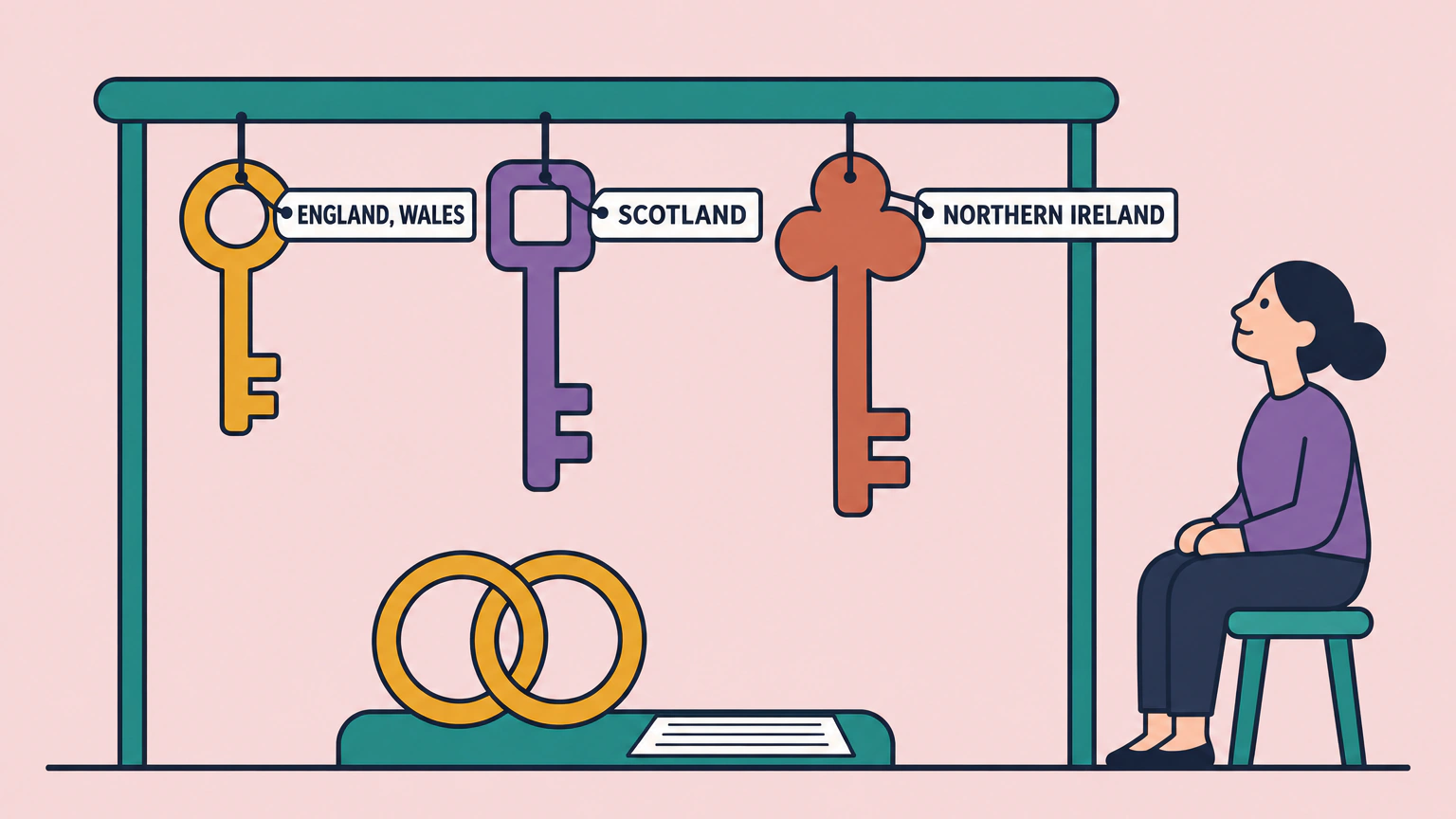
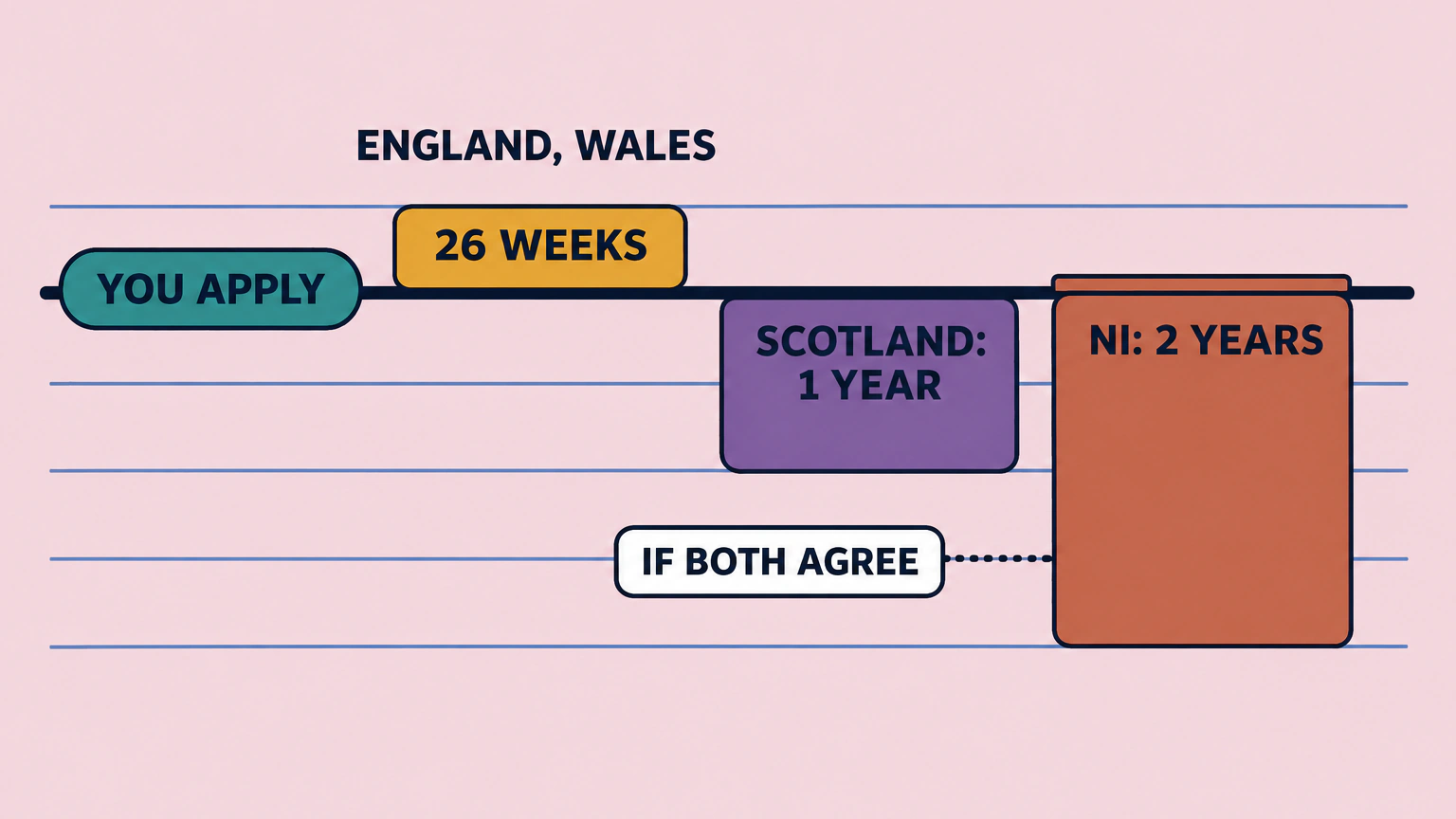
The UK has three divorce laws, and where you live decides which one is yours. In England and Wales you apply first, give no reason and wait at least 26 weeks. In Scotland and Northern Ireland the wait usually comes before you can apply, as a year or two of living apart, unless you can prove adultery or behaviour.
England and Wales come first, then Scotland, then Northern Ireland, and the fees and help with costs cover all three. If you live in Belfast or Aberdeen, the English steps aren't yours.
On this page
- Why the answer depends on where you live
- How divorce works in England and Wales
- What if your husband or wife won't reply?
- How divorce works in Scotland
- How divorce works in Northern Ireland
- What the court charges in each nation
- What a divorce leaves unfinished
- Do you need a solicitor?
- Questions people ask about divorce in the UK
Why the answer depends on where you live
Here's how the three systems compare.
| England and Wales | Scotland | Northern Ireland | |
|---|---|---|---|
| The law | Matrimonial Causes Act 1973, no-fault since 6 April 2022 | Divorce (Scotland) Act 1976 | Matrimonial Causes (Northern Ireland) Order 1978 |
| How long you must be married | One year | No minimum | Two years, whatever the reason |
| What you need to show | A statement that the marriage has broken down, with no reason given | One year apart if your spouse consents, two years if not, or adultery or behaviour | Two years apart if your spouse consents, five years if not, or adultery, behaviour or two years' desertion |
| Can your spouse block it? | Only on narrow legal grounds | They can defend it, and the one-year route needs their consent | They can defend it, and the two-year route needs their consent |
| Set wait after you apply | 20 weeks to conditional order, then 6 weeks to final order | None | 6 weeks from decree nisi to decree absolute |
| Hearing if it's agreed? | Usually none | Usually none, the court reads the paperwork | Yes, you give evidence to a judge |
| Where it goes | HMCTS, online or by post | Sheriff court or Court of Session | County Court or High Court, through the Matrimonial Office |
Civil partners use the same courts and timetables, under the word dissolution.
The row that matters most is the wait. In England and Wales the clock starts when the court issues your application. In Scotland and Northern Ireland it usually has to run out before you're allowed to apply, because the time apart is counted right up to the day you start. A couple married five years who split up last month could apply in Cardiff this week. In Glasgow they'd usually need a year apart and the other spouse's consent first, and in Belfast, two years. Wales shares England's law, and you can apply in Welsh.
If you've been married less than a year in England and Wales, or less than two years in Northern Ireland, you can't divorce yet. A legal separation, or sometimes an annulment, may be open to you meanwhile, so ask a solicitor.
Which courts can take your case
What counts is where you and your spouse live and belong now, not where you married. Habitual residence means the place you normally live. Domicile is closer to the country you treat as your permanent home.
In England and Wales the court looks at the day you apply. It can take your case if, for example, you both live there, your spouse lives there, or you've lived there for at least a year, or six months if it's also your domicile. On a joint application, either of you living there is enough.
In Scotland, one of you must be domiciled there or have lived there for the whole year before you start. For the sheriff court, one of you must also have lived in that court's district, the sheriffdom, for 40 days. Northern Ireland's list is much like England's, and the petition asks which statement fits.
A marriage from abroad counts if the UK recognises it, and a certificate that isn't in English needs a certified translation. If you live in different nations, ask a solicitor where to apply.
How divorce works in England and Wales
Since 6 April 2022, nobody in England or Wales has to give a reason. You state that the marriage has broken down for good, and the Matrimonial Causes Act makes the court treat that statement as "conclusive evidence". No blame, no separation period. Three stages matter: the application, the conditional order and the final order. The online form is hard to get wrong. People come unstuck by not knowing what each stage does to their position.
Should you apply alone or together?
Apply alone, as a sole applicant, if your spouse won't agree or you don't think they'll respond to the court. Apply together only if you both agree and you're not at risk of domestic abuse. On a joint application you each confirm, separately, that you want to carry on at every stage, and you both use the same method, online or by post. If your spouse stops responding, you can carry on as a sole applicant.
Sole is the norm: nearly three in four applications in England and Wales in April to June 2026 came from one spouse. Joint cases moved faster, though, averaging 49 weeks from application to final order against 60 for sole ones, on the Ministry of Justice's figures. One money catch: for help with the fee on a joint application, you both have to qualify.
The six steps, in order
Online or on paper, the route is the same.
- Apply online or by post and pay the fee. The court checks and issues your application.
- On a sole application the court sends it to your spouse, who has 14 days to respond. On a joint application you both get it.
- Wait 20 weeks from the day the court issued it.
- Apply for the conditional order. The court reviews it, which may take several weeks.
- Wait at least 43 days after the conditional order.
- Apply for the final order. Do it within 12 months, or you'll have to explain the delay to the court.
Have these ready before you apply:
- Your original marriage certificate or a certified copy, with a certified translation if it isn't in English
- Proof of any name change since you married, such as a deed poll
- Your spouse's full name and current address, plus their email if you want the papers sent online
- The fee, or your Help with Fees reference number if you've applied online for help
- A debit or credit card if you're applying online
- Your answer to the financial order question, which should be yes
One plain warning: you stay married until the final order, and the conditional order changes nothing about your status.
How long it really takes
The law's minimum is 26 weeks: 20 from the day the court issues your application until you can apply for the conditional order, then six more before the final order, which GOV.UK counts as 43 days. GOV.UK's divorce guide says to expect at least seven months, and real cases take longer. In April to June 2026 the median case in England and Wales reached its conditional order in 28 weeks and its final order in 40. The average to final order was 68 weeks, but the Ministry of Justice says old cases inflate it and the median "may act as a better indicator".
One reason for going slower is a choice. Many people hold back the final order until the money is agreed, because GOV.UK says to apply for a binding money arrangement before you apply for the final order. So start talking about money as soon as the application is issued. A court can shorten either wait in a particular case, but don't plan on it.
What if your husband or wife won't reply?
Silence doesn't stop a divorce in England and Wales. GOV.UK says it plainly: "If you do not reply the divorce can still go ahead without you." On a sole application your spouse gets 14 days to respond, and refusing isn't enough. They can't dispute the divorce "simply because they do not want a divorce". A real dispute needs a genuine legal reason, such as a claim that the marriage was never valid, has already ended, or is outside the court's power. It also takes an answer form and a £240 fee.
If the 14 days pass in silence and it's safe to contact your spouse, ask them to reply. They can still respond late. If they don't, the court will tell you what you can do. Citizens Advice sets out three routes:
- if you know where your spouse lives, a court bailiff can hand them the papers, for £47
- if you have evidence the papers arrived, the court can treat them as received, called deemed service
- if you truly can't trace your spouse, the court can let you go ahead without serving them, called dispensing with service
The last two each cost £62 to apply for.
There's a backstop at the other end. On a sole application only you can apply for the final order at first. Your spouse can apply too, but only three months after the earliest date you could have.
In Scotland the one-year route needs your spouse's consent, so without it you're on two years apart. In Northern Ireland the two-year route needs consent, so without it you're on five. If the acknowledgement of service never comes back there, the Matrimonial Office can help you find another way, such as a Master's order.
How divorce works in Scotland
Scotland has two routes, and which one you use depends on your children and your money, not on how you feel about each other. The Divorce (Scotland) Act 1976 gives four ways to show the marriage has broken down for good: adultery, behaviour, a year apart if your spouse consents, or two years if not. The person applying is the pursuer, and the other spouse is the defender. There's no minimum length of marriage and no conditional stage. The court grants the divorce and issues an extract decree as your proof.
The DIY route
The simplified procedure is built for people without a solicitor, and the Scottish Courts and Tribunals Service lets you use it only if all of these are true:
- you rely on a year apart with your spouse's consent, two years apart without it, or an interim gender recognition certificate
- there are no children of the marriage under 16
- there are no money matters to sort out
- no other court case under way could end the marriage
And the court can allow it only if neither of you has a mental illness, personality disorder or learning disability. The sheriff court forms are SPA for a year apart, SPB for two and SPC for an interim gender certificate. Each carries an affidavit, a sworn statement, which you sign before a justice of the peace, a notary public or a commissioner for oaths. A justice of the peace does it free. The fee is £156.
The trap: you can't ask for maintenance, a lump sum or a transfer of property on this route, so make any money agreement legally binding first.
The ordinary route
Everything else goes this way, including any case with a child under 16 or money to sort out. It starts with an initial writ, the document that opens a sheriff court case. There's no set form, and the courts service strongly advises getting legal advice. Adultery and behaviour cases come here too. They need no time apart, but you'll need details or evidence, and if your spouse contests it, proof can be hard and expensive.
Citizens Advice Scotland says an agreed divorce with no children or money issues can take up to six months, and longer where children are involved and the court isn't satisfied with the arrangements for them. One money warning: the court's power to order a lump sum or property transfer is tied to the day the divorce is granted, so read how the Scottish time limit for money claims works before decree.
What counts as living apart
The time apart has to be continuous and run right up to the day you start. Getting back together for up to six months in total doesn't break the clock, but those months don't count towards it either. Citizens Advice Scotland gives an example: a couple split in January, get back together in April and split again in September, and the three months from January to April still count. You can even live apart under one roof, if you're truly leading separate lives rather than living as a married couple. Separately, an interim gender recognition certificate issued to either of you is a ground of its own.
How divorce works in Northern Ireland
Northern Ireland's system is the most formal of the three, and it's still built around a court hearing. The words are older too: you present a petition as the petitioner, your spouse is the respondent, and the court grants a decree nisi first and a decree absolute at the end.
The two-year rule and the five reasons
You can't present a petition in the first two years of marriage, and the Department of Justice says that holds "regardless of the ground". The petition can still rely on things that happened in that time. After that you need one of five facts: adultery, behaviour, two years' desertion, two years apart with your spouse's consent, or five years apart.
Most people use separation. In 2023 close to three in four Northern Irish divorces were on separation grounds, about two in five were on two years apart with consent, and only 18% were on fault, according to the Department of Finance. A spouse facing a five-year petition can oppose it if the divorce would cause grave financial or other hardship and it would be wrong to end the marriage. For civil partners, adultery isn't a ground.
From petition to decree absolute
You type the petition and lodge it at the Matrimonial Office in Belfast, with your marriage certificate, an acknowledgement of service form and the birth certificate of any child under 18. If you're doing it yourself, an optional interview with the Matrimonial Office, at £81, lets staff check your draft petition first. The court then sends you the papers to serve on your spouse, by first-class post, recorded delivery or a process server. Your spouse fills in the acknowledgement of service and returns it to the office. When everything's in order, you lodge a certificate of readiness and pay the hearing fee, and the court gives you a date.
Then comes the part that surprises people who've read English guides. A judge hears the case. Even when your spouse agrees, you take a religious oath or make an affirmation and confirm what your petition says, because the law requires the judge to hear from you unless there's a special reason not to. If the judge is satisfied, you get a decree nisi. At least six weeks and one day later you can apply to make it absolute, and only then is the marriage over. If you don't apply, your spouse can, three months after that, but only with the court's permission.
If your spouse defends the petition, the case goes to the High Court and you should get legal advice. Matrimonial Office staff can explain the process, but they can't give it. Of the three systems, this is the one where an agreed divorce still normally means a day in court.
Is the law going to change?
Reform has been discussed, and that's as far as it has gone. The Department of Finance consulted from June to September 2025 and drew 405 responses. Its report, published in January 2026, found that most respondents opposed changing the law. Some who wanted to keep the fault grounds were open to smaller fixes, such as shorter separation periods. In April 2026 the finance minister, John O'Dowd, said he hadn't received DUP approval to take proposals to the Executive and that "time is running out" in this mandate, the News Letter reported. There's no divorce Bill on the Assembly's list, and the 1978 Order hasn't changed on any point here. Don't plan around a change.
What the court charges in each nation
Here's what each nation's courts charge for an undefended divorce, start to finish.
| Route | What you pay | Total now | From 1 April 2027 |
|---|---|---|---|
| England and Wales, sole or joint | One application fee | £628 | No date set |
| Scotland, simplified, sheriff court | One application fee | £156 | £160 |
| Scotland, ordinary, sheriff court | Initial writ £191, affidavits £82 | £273 | £281 |
| Northern Ireland, County Court | Petition £326, hearing £407, decree absolute £123 | £856 | £873 |
| Northern Ireland, High Court | Petition £326, hearing £488, decree absolute £123 | £937 | £956 |
The Scottish and Northern Irish rises are already set in law. A sheriff officer serving papers in a simplified case costs £15 plus the officer's own fee.
The gap is wide. Scotland's DIY route is the cheapest in the UK. Northern Ireland charges at three points (petition, hearing and decree absolute), so nobody pays it all upfront. In England and Wales one fee covers it, with no refund once your application has been issued. A guide still quoting £612 is out of date. Court of Session fees differ.
What you'd pay for help with the paperwork
| Route | Published price | What it covers |
|---|---|---|
| GOV.UK, on your own | The court fee only | You complete each stage yourself |
| Managed online service | £299 plus the court fee (Easy Online Divorce) | The divorce paperwork, handled for you |
| Online service, all-in | £900 to £1,400 including the court fee (Divorce-Online) | The high end includes a financial consent order |
| Solicitor, divorce only | £500 to £1,500 plus VAT (Setfords' rough guide), £750 fixed fee (Stowe Family Law) | An uncontested divorce |
| Solicitor, all told | £1,500 to £3,000 (Setfords) | An uncontested divorce with basic solicitor support |
Firms in England and Wales publish these prices themselves, so treat each as one firm's figure, not a market average. They pay for the divorce, not a fight. Most of a divorce's real cost is sorting out the money, which is where a solicitor's hours go. So it helps to know what solicitors charge by the hour. Setfords says contested cases that reach court typically start at £15,000 to £30,000 plus VAT. That's the best reason we know to agree what you can.
If you can't afford the fee
In England and Wales the scheme is Help with Fees. For a divorce fee, your savings, counting a new partner's but not your spouse's, usually have to be no more than £4,250. You can then qualify through certain benefits, including Universal Credit if you earn under £6,000 a year, or on income: up to £1,420 a month if you're single or £2,130 with a partner, with more allowed for each child. Earn a little more and you may still get part of the fee off. If you paid a fee in the last three months while eligible, you can claim it back.
Scotland has its own fee exemption for people on certain benefits, with the form on the Scottish courts website. In Northern Ireland you apply for exemption or remission on form ER1.
Legal aid differs more. In England and Wales it covers advice on divorce, money or children only if you've been in an abusive relationship and pass the means test. Family mediation is an exception, for example over child arrangements, though the means test still applies. The Legal Aid Agency decides. In Scotland, legal aid runs through the Scottish Legal Aid Board, and you may have to repay some costs from money or property you receive, which is called clawback. In Northern Ireland the legal advice and assistance scheme covers divorce, and the Legal Services Agency Northern Ireland decides legal aid for court cases.
For free advice, try Citizens Advice in England and Wales, Citizens Advice Scotland or Advice NI.
What a divorce leaves unfinished
A divorce ends the marriage, and that's all it does.
Money first. The divorce settles nothing about the house, pensions or savings. In England and Wales GOV.UK says to apply for a binding arrangement before you apply for the final order. On the application, tick yes to the financial order question even if you've agreed everything. Citizens Advice says ticking it won't start an application but keeps the door open, while ticking no and then remarrying usually shuts it. Our guide on whether you need a financial order takes it from there, nation by nation.
Children next. The divorce doesn't decide where they live, and in England and Wales GOV.UK says you can usually avoid a court hearing if you agree. If you can't, the court route is a child arrangements order.
Then your will. In all three systems a former spouse is generally treated as if they'd died, so gifts to them and their appointment as executor fall away, and the rest of the will stands. That can undo something you meant to keep, so check your will the day the divorce is final. Until then, your spouse is still your spouse.
Do you need a solicitor?
For most people, not for the divorce itself. GOV.UK's online service and Scotland's DIY route are built for people on their own, and Northern Ireland accepts personal petitioners. We'd get advice in four situations: there's money or property to divide, you can't agree about the children, your spouse is defending it or you're on Scotland's ordinary route, or there's been abuse. That's when divorce solicitors earn their fee, and family law solicitors are the call when children or a business need untangling. In Scotland, look for solicitors across Scotland, and in Northern Ireland, solicitors in Northern Ireland.
We're not your solicitor, and if there's money, children or abuse involved, a decision this size deserves proper advice before you file.
Start by working out which nation's rules are yours. Then take the first step today, even if it's only finding your marriage certificate.
Questions people ask about divorce in the UK
How long does a divorce take in the UK?
In England and Wales the legal minimum is 26 weeks, GOV.UK says to expect at least seven months, and the median case took 40 weeks to reach its final order in April to June 2026. In Scotland and Northern Ireland a year or more of living apart usually comes before you apply. Citizens Advice Scotland says an agreed Scottish divorce with no children or money issues can take up to six months.
Can I get divorced if my husband or wife won't agree?
Yes, in all three systems, but the route changes. In England and Wales your spouse can only dispute it for legal reasons, and the court can carry on if they stay silent. In Scotland you'd need two years apart, and in Northern Ireland five, unless you can rely on adultery or behaviour, or in Northern Ireland, two years' desertion.
How much does a divorce cost in the UK?
The court fee alone is £156 for a simplified sheriff court divorce in Scotland, £628 in England and Wales, and £856 for an undefended county court divorce in Northern Ireland. In England and Wales, an online service adds a few hundred pounds, and Setfords puts a solicitor's fee for the divorce itself at about £500 to £1,500 plus VAT. Disputes over money cost far more.
Can I get a divorce for free?
Sometimes the court fee can be cut or cancelled. In England and Wales, Help with Fees depends on your benefits, income and savings, and the savings limit for a divorce is usually £4,250. On a joint application you must both qualify. Scotland and Northern Ireland run their own exemption schemes, so check with the court before you pay.
Do I need a solicitor to get divorced?
Not for the divorce itself in most cases. GOV.UK's service and Scotland's DIY route are built for people on their own, and Northern Ireland accepts personal petitioners. Get advice if there's money or property to divide, you can't agree about children, your spouse is defending it, or there's been abuse.
Am I still married after the conditional order?
Yes. In England and Wales you stay married until the final order, and in Northern Ireland until the decree absolute. You can't remarry before then. If you want a binding arrangement over money, GOV.UK says to apply for it before you apply for the final order.
What's the quickest way to get divorced?
In England and Wales nothing gets you round the 20-week and six-week waits in an ordinary case, though joint cases have been quicker on average. In Scotland, adultery or behaviour needs no time apart, but you'll need evidence and the ordinary route. In Northern Ireland, no petition can go in before your second anniversary.