


The table covers England and Wales only. Scotland and Northern Ireland work differently.
On this page
- Who actually sets the rate you will pay
- The guideline hourly rates the courts publish for 2026
- Working out which band covers your solicitor's office
- A starting point, not a ceiling
- VAT, disbursements and the number that leaves your account
- When the bill looks too high
- Scotland and Northern Ireland do it differently
- Six questions to ask before you sign
- Common questions about solicitors' hourly rates
Who actually sets the rate you will pay
The letter is on the kitchen table. It names an hourly rate, and nothing on the page tells you whether that's fair.
Nobody hands solicitors a price list for private work. Each firm sets its own rates, and firms in the same town aren't always alike, as even the courts' own guide accepts. What the rules control is whether you're told the rate, and when.
The rate you agreed is usually recorded in your paperwork, but the Solicitors Act can still let you ask a court to assess the bill. In most cases you're the one paying it. If your employer has offered you a settlement agreement, though, read who pays for settlement agreement advice before you assume the bill is yours.
Your paperwork is where the rate is usually recorded
When a firm takes you on, it usually sends a client care letter, sometimes with its terms of business attached. The Solicitors Regulation Authority (SRA), which regulates solicitors in England and Wales, says firms often use it to set out the likely cost and how to complain. It's normally where your agreed rate is written down.
Check the hourly rate for everyone who'll work on your file, not just the partner you met. Check whether those rates include VAT. And check what would trigger a rise.
The SRA admits that "some client care letters are designed to comply with our obligations, rather than to provide information to clients in a user-friendly way." If yours reads like that, ask the firm to set out the rates in a short email.
What the rules make your firm tell you about price
The SRA's Code of Conduct says clients must get "the best possible information about how their matter will be priced", both at the start and as the matter goes on.
The SRA Transparency Rules go further for six services to individuals. A firm that advertises any of them must publish price information on its own website:
- buying, selling, mortgaging or remortgaging a home
- dealing with an uncontested estate in the UK after a death
- immigration applications, not asylum
- immigration appeals at the First-tier Tribunal, not asylum appeals
- summary-only motoring offences dealt with at one magistrates' court hearing
- employees' unfair or wrongful dismissal claims at the Employment Tribunal
That information must show "the basis for your charges, including any hourly rates or fixed fees". It must also give the experience and qualifications of whoever does the work and their supervisors, the likely disbursements, and whether VAT applies. For those six, you can often check a firm's rates before you ring. For anything else, ask.
The guideline hourly rates the courts publish for 2026
The Master of the Rolls, who heads civil justice in England and Wales, sets these figures, and HM Courts & Tribunals Service publishes them on GOV.UK. The current rates took effect on 1 January 2026, a 2.28% rise on 2025. The uplift used service producer price inflation, an official measure of prices for business services. Following a Civil Justice Council recommendation, the rates have been uprated for inflation every January since 2024.
What they're for is narrow. After a fast track trial or a hearing lasting up to a day, a judge can decide on the spot how much of the winner's legal costs the other side pays. That's called summary assessment, and these figures are the judge's starting point. If you're using civil litigation solicitors in a court dispute, these are the numbers that come up when costs are argued.
Guideline hourly rates from 1 January 2026, England and Wales
| Grade | Who that is | London 1 | London 2 | London 3 | National 1 | National 2 |
|---|---|---|---|---|---|---|
| A | Solicitors and legal executives with over 8 years' experience | £579 | £422 | £319 | £295 | £288 |
| B | Solicitors and legal executives with over 4 years' experience | £393 | £327 | £262 | £247 | £247 |
| C | Other solicitors or legal executives and fee earners of equivalent experience | £305 | £276 | £209 | £201 | £200 |
| D | Trainee solicitors, paralegals and other fee earners | £210 | £157 | £146 | £142 | £142 |
What Grade A, B, C and D actually mean
A fee earner is anyone at the firm whose time is charged to you. The courts' guide sorts them into four grades.
Grade A is a solicitor more than eight years qualified, with at least eight years in litigation, or a Fellow of CILEX (the Chartered Institute of Legal Executives) eight years after qualifying. Grade B is over four years qualified, with at least four years in litigation. Grade C is any other solicitor or CILEX Fellow, or a fee earner of similar experience. Grade D is trainees, paralegals and other fee earners.
One detail trips people up. "Legal executive" means a CILEX Fellow, and the guide says nobody else is entitled to the title. A clerk without that level of experience counts as Grade D.
The guide expects junior people to do junior jobs, such as sitting behind a barrister at all but the most important pre-trial hearings. If you're instructing family law solicitors, ask who'll do the day-to-day work, and at which grade.
Working out which band covers your solicitor's office
There are five bands, three for London and two for the rest of England and Wales. The band follows the office your fee earner is attached to, not where you live. That's how the courts' guide places a fee earner, so a firm in another city brings its own band with it. GOV.UK lists 221 towns and areas by national band, plus the National 1 counties.
The five bands, and what each one covers
| Band | What it covers | Where that is |
|---|---|---|
| London 1 | Very heavy commercial and corporate work by centrally based London firms | Not tied to any particular London postcode |
| London 2 | City and Central London | EC1 to 4, W1, WC1, WC2 and SW1 |
| London 3 | Outer London | All other London boroughs, plus Dartford and Gravesend |
| National 1 | Twelve named counties, plus twelve named cities and districts | Includes Bristol, Liverpool, Manchester (Central), Oxford, Reading and Watford |
| National 2 | Everywhere else in England and Wales | Includes Bath, Leeds (Outer), Sheffield, Swansea and York |
Look up the guideline hourly rate
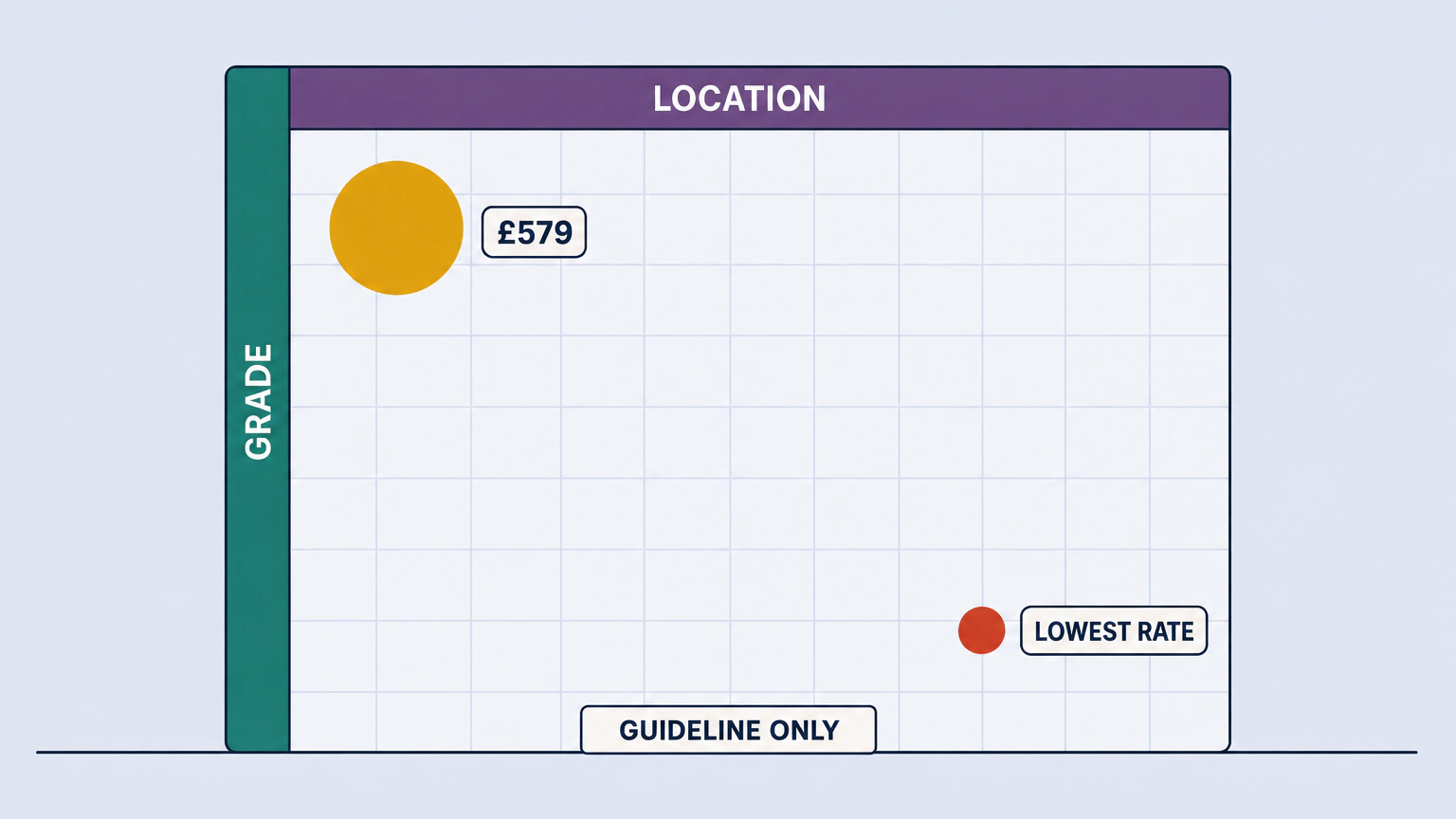
Changing these answers needs JavaScript. Without it you still get the worked example and both ends of the published range: the guideline rises with the fee earner's grade and with the London bands. The highest figure is £579 an hour, for a Grade A fee earner in a central London firm doing heavy commercial work. The lowest is £142 an hour, for a trainee or paralegal in either national band.
Pick where the office is, not where you live. If your town is not on the list, check the counties first, because those cover every town inside them.
If you are not sure, ask which grade fits. When the SRA Transparency Rules cover the service, the firm must publish the experience and qualifications of the people doing the work and their supervisors.
Only if you have one. Enter the rate before VAT, so the two numbers compare properly.
Enter the rate as a whole number of pounds, from £0 to £5,000.
£201 an hour
For a Grade C fee earner working out of an office in National band 1, the courts' guideline is £201 an hour. That is the figure a judge would start from when deciding what one side should pay the other.
This guideline table covers England and Wales only, so it cannot give you a rate for Scotland or Northern Ireland. In Scotland your solicitor has to tell you the hourly rate before work starts. If an account looks too high, you can ask for taxation by an Auditor of Court. In Northern Ireland, start with the Law Society of Northern Ireland.
This is a guideline, not a cap. Your own firm can charge more. Check your engagement paperwork for the rate you agreed.
Source: HMCTS, "Solicitors' guideline hourly rates", GOV.UK, in effect from 1 January 2026 for England and Wales. VAT at 20% is the standard UK rate (GOV.UK, "VAT rates").
Pick the office and the grade and you'll have your figure. Now the honest limit. The guide says the figures are grouped by locality "by way of general guidance only", and that "the rate to allow should not be determined by reference to locality or postcode alone." A judge compares a firm with others like it.
Location can also cut against you when the other side is paying your costs. Hire a London firm for a case with no real London link, which didn't need expertise found only there, and the guide says a judge should allow only the rate for where the work should have been done.
A starting point, not a ceiling
A guideline figure and your own bill are two different things.
The courts' guide is blunt: "The guideline rates are not scale figures: they are broad approximations only." They're a starting point for a judge deciding what one side pays the other. They don't cap what your own firm can charge once you've agreed a rate.
The rules actually lean the other way. When a court looks at your own solicitor's bill, costs are presumed "reasonable in amount if their amount was expressly or impliedly approved by the client". Agree to £250 an hour and the court starts from the view that £250 was fine.
So treat the guideline as a question, not an accusation. "Your rate is above the guideline for this band and grade. What am I getting for the difference?" is fair. "You're overcharging me" usually isn't.
The gap bites hardest when you win and the other side is ordered to pay your costs, because the judge starts from these figures, not from your firm's rate. And if your costs are unusually large and your solicitor never warned you the other side might not cover them, the court presumes they were unreasonably incurred. We'd ask early how much of the rate a judge is likely to allow.
Why private client rates often sit above the guideline
The guide accepts that "in substantial and complex litigation an hourly rate in excess of the guideline figures may be appropriate" for Grades A to C. It points to the value of the case, its complexity, urgency or importance, and any international element. It also says this isn't limited to commercial work. Court rules also weigh the skill and specialised knowledge involved.
Say a firm in central Manchester quotes £250 an hour for a solicitor three years qualified. That's Grade C in National 1, so the guideline is £201. The difference is £49, roughly a quarter above.
A gap that size isn't a warning sign by itself. On a simple matter, ask about it. On an urgent or high-value one, the guide itself says a higher rate can be justified. What deserves a harder look is a rate far above the band with nothing in the case to explain it.
VAT, disbursements and the number that leaves your account
This is where a fair rate becomes a bigger number. The guideline figures leave VAT out, and a quote may too. The standard rate is 20%, so a VAT-registered firm adds a fifth to its fees. That's why a quote "plus VAT" and one "including VAT" can't be compared as they stand. £300 including VAT is the same as £250 plus VAT.
Disbursements are separate again. They're money the firm pays out for you, such as a barrister's fee or a court fee, not charges for the solicitor's own time. Some carry VAT and some don't. For the six services under the Transparency Rules, the firm's published prices must say which. For anything else, ask for a list.
Worked example: A quote of £250 plus VAT is £300 an hour. Ten hours of that is £3,000, not £2,500. Get both numbers in writing before you sign anything, because the second one is what leaves your account.
When the bill looks too high
Start with the simplest move. Ask the firm, in writing, for a breakdown of the time recorded, by person and by task. You should have been told at the start that you can complain to the firm about its charges, and the SRA says complaints must be handled free of charge.
If that doesn't settle it, England and Wales give you a formal route. You can ask the court to assess the bill under the Solicitors Act 1974. The clock starts when the bill is delivered. Once the court orders an assessment, your solicitor has 28 days to serve a breakdown of costs.
Your window to have a solicitor's bill assessed by the court
| When you apply | What the court does | The catch |
|---|---|---|
| Within one month of the bill arriving | Orders an assessment, and you pay nothing into court to get it | This one is yours as of right, which is why the month matters more than anything else here |
| After one month, within twelve months of the bill | May order an assessment, on whatever terms it thinks fit | It is the court's discretion now, not your right |
| More than twelve months after the bill arrived, after judgment on the bill, or after payment less than twelve months ago | Orders one only in special circumstances | You have to show those circumstances, and the court may set terms about assessment costs |
| More than twelve months after you paid the bill | Cannot order one at all | The power is gone |
| Footnote | Solicitors Act 1974, section 70. If the assessment cuts the bill by a fifth or more, your solicitor pays the cost of the assessment. |
Red flag: Three lines worth querying on any bill: time recorded by someone more senior than the job needed, an hourly rate higher than the one in your client care letter, and a disbursement listed with no word on whether VAT applies to it.
Taking it to the Legal Ombudsman
The Legal Ombudsman handles complaints about legal services in England and Wales. According to the SRA, unclear costs are one of the most common complaints the Ombudsman receives.
Complain to the firm first. It gets eight weeks, and after that, or once you're unhappy with its final answer, you can go to the Ombudsman. Two clocks apply. The first is six months from the firm's written final response, but only if that response clearly told you the Ombudsman was available, gave its full contact details and warned you about the six months. The second is one year from the problem, or one year from when you should reasonably have known about it. Our guide on how to complain about a solicitor covers the full route.
We're not your solicitor, and a bill worth challenging is worth a conversation with someone who is.
Scotland and Northern Ireland do it differently
The guideline rates apply to England and Wales only. Scotland and Northern Ireland handle solicitors' fees their own way.
In Scotland, the Law Society of Scotland's rules say "the fees you charge must be fair and reasonable in all the circumstances." A solicitor charging by the hour must tell you the rate and any change to it. Raise a problem bill with the firm first, and the Scottish Legal Complaints Commission says a summary of how the fee was worked out should be free.
Still unhappy? You can ask the firm to send the account for taxation, an independent check by an Auditor of Court. The Auditor's decision binds you, and you can ask for a hearing. The Commission says the Auditor's cost is usually 3% or 4% of the final fee. The firm pays it if the fees were too high, and you probably will if they weren't.
In Northern Ireland, start with the Law Society of Northern Ireland. For work that didn't involve court proceedings, you can ask your solicitor to apply for a free remuneration certificate, within one month of the bill and before you pay it. Where proceedings were issued, you can apply to the Taxing Master's Office in Belfast to have the bill taxed.
Six questions to ask before you sign
These questions do the most good before you instruct a firm, not after the first bill arrives. Ask every firm on your shortlist the same six and write the answers down. If you found firms through our directory, you can read how we rate firms, but it's these answers that let you compare price.
- Ask for the hourly rate of every person who will work on the file, and which grade each of them is.
- Ask which guideline band the office sits in, then check the published figure for that band yourself.
- Ask whether the quoted rate includes VAT, and get the number written down both ways.
- Ask for a written estimate of the total hours, and what happens if the work runs over it.
- Ask which disbursements are expected, and which of those carry VAT.
- Ask when the rate can rise, and how much notice you get before it does.
Then put the rate you're quoted beside the guideline for that office's band and grade, and ask the firm about the gap.
Common questions about solicitors' hourly rates
Do solicitors charge VAT on top of their hourly rate?
If the firm is registered for VAT, yes. It adds the standard rate of 20% to its fees, so £250 an hour becomes £300. A quote written "plus VAT" looks lower than what you'll actually pay, so ask for the figure both ways. Some disbursements carry VAT and others don't, and those are worth asking about separately.
Why do solicitors charge in six minute units?
Six minutes is a tenth of an hour, which makes it an easy unit for recording time, and the courts count routine work the same way. When costs are assessed in detail, routine letters, emails and phone calls are generally allowed at six minutes each. At £200 an hour, one unit is £20. Your client care letter should explain how the firm records and charges time, so check it there.
What is a fee earner, and why does it change what I pay?
A fee earner is anyone at the firm whose time is charged to you: partners, solicitors, legal executives, trainees and paralegals. The guideline sets a different figure for each grade. In National band 1, it runs from £295 an hour for Grade A down to £142 for Grade D. The guideline is lower for more junior grades.
Do all solicitors charge the same hourly rate?
No. Each firm sets its own rates, and they vary with seniority, location and the kind of work. Even the courts' guideline, which isn't a price list, runs from £142 to £579 an hour. The courts' guide also accepts that firms in the same area aren't always comparable, so a few calls to compare quotes are worth making.
Is my solicitor allowed to charge more than the guideline rate?
Yes, if you've agreed to it. The guideline is a starting point for judges deciding what one side pays the other, not a cap on your own firm's charges. When a court assesses your own solicitor's bill, a rate you approved is presumed reasonable. You can still question work that wasn't needed, within the assessment deadlines.
How do I challenge a solicitor's bill?
Ask the firm in writing for a breakdown of the time charged, then use its complaints procedure. In England and Wales you can also apply to the court for an assessment, and within one month of the bill that's your right. If the firm hasn't resolved your complaint in eight weeks, you can go to the Legal Ombudsman.