

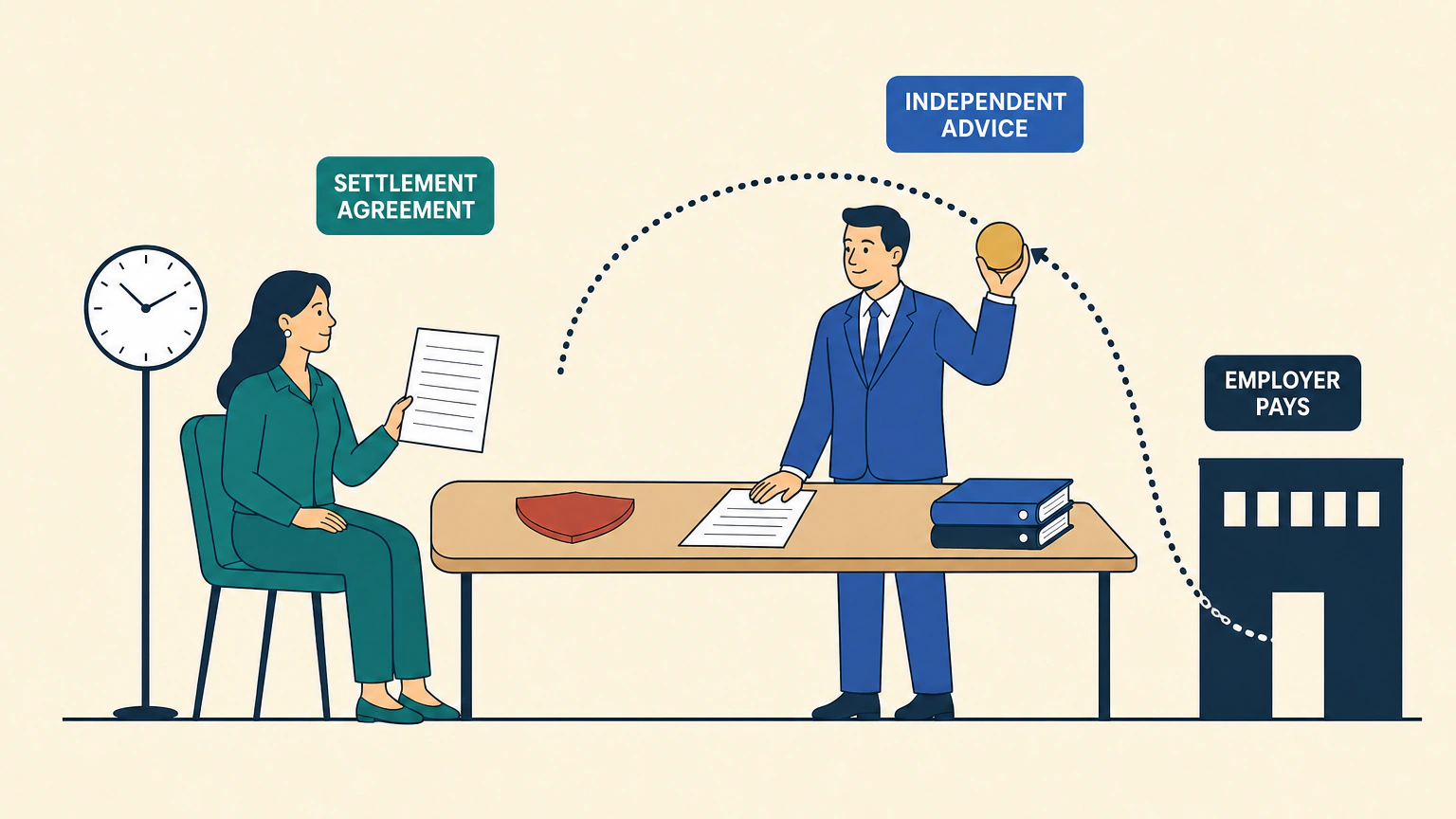
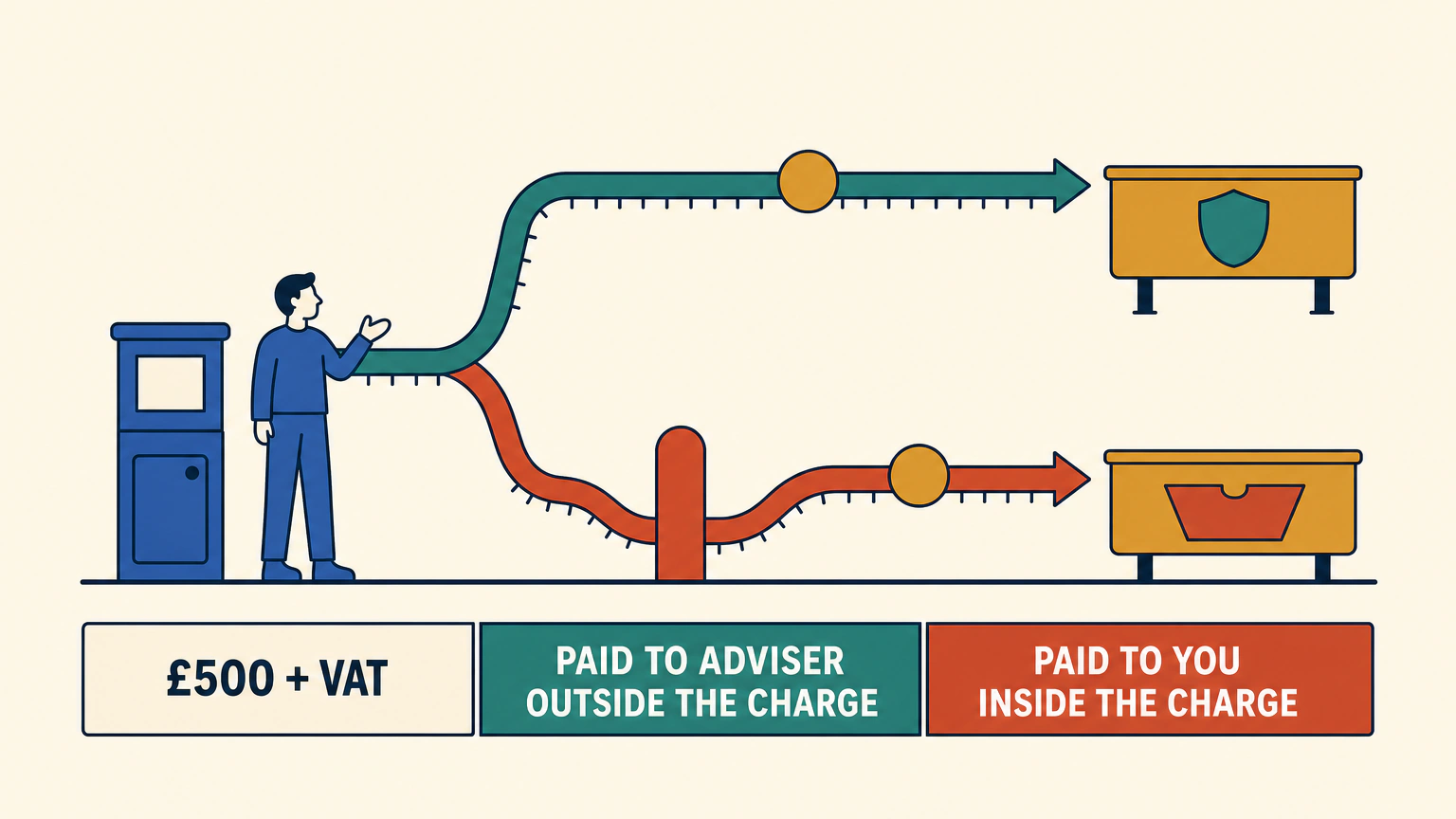
Then check where the money goes. Under section 413A of the Income Tax (Earnings and Pensions) Act 2003 (ITEPA 2003), payment of legal costs incurred exclusively in connection with the termination falls outside the termination-payments charge where the agreement provides for it and it is paid directly to your lawyer. Route the same £500 through you instead and that second limb is not met on its face.
On this page
- The short answer: who pays, and why employers contribute
- What the law says the advice must be
- The same rule across three UK jurisdictions
- What employers actually put on the table
- How the payment route affects the tax position
- How long you get to decide
- Confidentiality: what has changed, and what has not changed yet
- Before you sign: the six-point check
- Frequently asked questions
The short answer: who pays, and why employers contribute
No law makes your employer pay
Acas is blunt about it: the employer "should consider offering to pay the cost of any independent advice. They do not have to do this." Acas also lists not paying for it among the things that are not improper behaviour. The offer is a convention, not an entitlement.
Why they offer anyway
The agreement can waive a claim covered by section 203 only if the statutory conditions are met, and one is that you took advice from an adviser independent of your employer. Section 203(3B)(a) says a person is not a relevant independent adviser if he "is, is employed by or is acting in the matter for the employer or an associated employer".
That subsection also answers the worry underneath all of this, the one about whether a solicitor your employer is funding can really be on your side. Independence isn't a courtesy here. It is one of the conditions that makes your waiver work.
What the law says the advice must be
Six conditions, and all six must hold
Section 203(3) of the Employment Rights Act 1996 sets out what must be true before a settlement agreement can waive a claim covered by that section. Paragraph 4 of the Acas Code of Practice repeats the same six.
- It is in writing. An oral proposal is a starting point, never the finished document.
- It relates to the particular proceedings. The Acas Code notes that "full and final settlement of all claims" is not sufficient on its own: the agreement has to state specifically the claims it is intended to cover.
- You received advice from a relevant independent adviser on the terms and effect of the agreement and, in particular, its effect on your ability to pursue your rights before an employment tribunal.
- Your adviser held cover when advising, a contract of insurance or a professional indemnity covering a claim by you for loss arising from that advice.
- The agreement identifies the adviser by name.
- It states that the statutory conditions are satisfied. In Northern Ireland, that the conditions regulating compromise agreements under the 1996 Order are satisfied.
Red flag: take any of these to your adviser, not to your employer's HR team. - The proposed adviser is, is employed by, or is acting in this matter for your employer or an associated employer. Section 203(3B)(a) says they are not a relevant independent adviser. - You are asked to pay an advice centre for the advice. Section 203(3B)(c) removes advice-centre workers where the worker pays. A centre worker certified in writing as competent and authorised can qualify if the advice is free. - The agreement does not name your adviser, or says nothing about the statutory conditions. Conditions (e) and (f) fail on its face. - You are pressed to sign the same day. The Acas Code's general rule is a minimum of ten calendar days.
Who counts as a "relevant independent adviser"
Section 203(3A) lists a qualified lawyer; an officer, official, employee or member of an independent trade union, certified in writing as competent and authorised to advise on the union's behalf; or an advice-centre worker certified in the same terms. It also allows the Secretary of State to specify another description by order. Section 203(3B) removes anyone acting for the employer.
The advice-centre trap
Section 203(3B)(c) creates a narrow exclusion. An advice-centre worker stops being a relevant independent adviser if you pay for the advice. Free advice from a centre worker certified in writing as competent and authorised can satisfy the statute; the same person charging you does not qualify under that route.
The same rule across three UK jurisdictions
England and Wales, Scotland, Northern Ireland side by side
Two things change as you cross a border: who may advise you, and what the agreement's recital has to say.
| Where you work | Governing provision | What the statute calls the document | Who is a "qualified lawyer" | Tribunal named in the statute |
|---|---|---|---|---|
| England and Wales | Employment Rights Act 1996, s.203(3)-(4) | Settlement agreement | A person who, for the purposes of the Legal Services Act 2007, is an authorised person in relation to an activity constituting the exercise of a right of audience or the conduct of litigation | Employment tribunal |
| Scotland | Employment Rights Act 1996, s.203(3)-(4) | Settlement agreement | An advocate (in practice or employed to give legal advice), or a solicitor holding a practising certificate: see firms in Scotland | Employment tribunal |
| Northern Ireland | Employment Rights (Northern Ireland) Order 1996, art. 245(3)-(4) | Compromise agreement | A barrister (in practice or employed to give legal advice), or a solicitor holding a practising certificate | Industrial tribunal |
In all three, the adviser may instead be a certified and authorised trade union officer, official, employee or member, or a certified and authorised advice-centre worker. In Great Britain a discrimination claim settles under section 147 of the Equality Act 2010, which extends to England, Wales and Scotland only and is where a fixed contribution may run short, so choose from discrimination solicitors rather than whoever is quickest.
In Northern Ireland it is still a compromise agreement
Great Britain renamed compromise agreements in 2013 and Northern Ireland did not follow. Article 245(3)(f) of the 1996 Order requires the agreement to state that the conditions regulating compromise agreements under the Order are satisfied, and article 245(2)(e) points at "the Agency", the Labour Relations Agency, rather than Acas. Ask your adviser whether your recital cites the right statute. If you still need to find one, start with firms in Northern Ireland.
What employers actually put on the table
The published figures, and why they are not a market rate
The sources reviewed for this article did not identify a public national schedule of settlement agreement solicitor fees, and this site's employment category pages publish no numeric fee schedule. What follows is what seven firms say about their own charging. It is a spread rather than an average, and it reflects differences in scope and complexity, including whether anyone is negotiating.
| Firm publishing the figure | Figure it publishes | What it says the figure is for |
|---|---|---|
| Thompsons Solicitors | £350 to £500 + VAT | A typical employer's contribution, varying with seniority and complexity |
| Lawhive | £250 to £500 | A typical set contribution towards legal costs |
| Moss Haselhurst | £350 to £1,000 | The usual range, depending on complexity and sometimes on the sum being paid |
| Bates Wells Sudbury (BWB) | £350 to £750 + VAT | Straightforward advice with no negotiation, usually covered by the employer |
| Bates Wells Sudbury (BWB) | £750 to £1,500 + VAT | Where some negotiation is required; a top-up may be needed |
| Bates Wells Sudbury (BWB) | £1,500 to £3,000 + VAT and upwards | Discrimination, whistleblowing or multiple claims |
| KLG Law | £500 + VAT | A reasonable minimum for basic advice; it calls £250 + VAT outdated |
| SE Solicitors | Around £500 + VAT | Most contributions, higher for senior executives or two-stage settlements |
| Hibberts Solicitors | £500 + VAT | Its own minimum fee, covering preparation and a first meeting of about 60 to 75 minutes |
What a fixed contribution covers, and where it stops
Advice on the terms and effect is the compulsory part, so that is what a typical fixed fee prices: reading the document, explaining which claims you are waiving, signing the adviser's certificate. Work beyond that statutory advice, such as reading your grievance file, valuing your claim or writing a counter-offer, may be priced separately. Bates Wells Sudbury prices negotiation as a separate band.
If your solicitor's fee is higher than the contribution
Three moves are open this week, and none of them involves signing anything. Ask your employer to increase the contribution: Hibberts publishes that employers often agree once they are told the adviser's minimum fee is £500 + VAT. Limit the advice to what the contribution covers. Or pay the difference yourself, with the figure agreed in writing before the work starts. If the service then falls short, how to complain about a solicitor sets out the route.
How the payment route affects the tax position
Paid to your solicitor, or paid to you
Section 413A of ITEPA 2003 takes an employer's payment of your legal costs out of the termination-payments charge only if two conditions are met. Condition A: the costs were incurred by you exclusively in connection with the termination. Condition B: either a court or tribunal ordered the payment, or the agreement provides for it and it is paid directly to your lawyer. Your own agreement is your adviser's to analyse.
| How the agreement words it | Who invoices whom | Position under ITEPA 2003 s.413A | What to ask for before signing |
|---|---|---|---|
| Employer pays the contribution direct to the employee's solicitor | Employer pays the employee's lawyer directly; invoice arrangements depend on the retainer | Condition B(b) is met on its face: the agreement provides for the payment and it is made directly to the employee's lawyer | Ask your adviser to confirm that condition A is also met |
| Employer pays the contribution to the employee, who then pays the solicitor | Solicitor invoices the employee | Condition B(b) is not met on its face, because the payment is not made directly to the lawyer | Ask for the clause to be redrafted so the payment goes to the firm |
| Payment made under a court or tribunal order | Set by the order | Condition B(a) route | Not applicable to a negotiated settlement agreement |
Section 413A(4) defines "lawyer" by pointing at section 203(4) of the 1996 Act and article 245(4) of the Northern Ireland Order, so the person allowed to advise you and the person the money has to reach are described in the same words.
VAT, and when the £30,000 threshold may matter
For a solicitor charging VAT, the standard 20% rate sits on top of the fee. The Legal Practice works the arithmetic on its own page: a solicitor charging £500 invoices £500 plus £100 VAT, a total of £600, so a £500 contribution paid to you rather than to the firm can leave £100 outstanding. Section 413A takes a qualifying legal-cost payment outside Chapter 3's termination-payments charge. If the contribution fails that exception, it can fall within Chapter 3 under section 401; if it does, section 403's £30,000 threshold may matter. Take the figures to your adviser, or check the accountant is qualified first.
How long you get to decide
The Acas Code's ten calendar days
Paragraph 12 of the Acas Code reads: "As a general rule, a minimum period of 10 calendar days should be allowed to consider the proposed formal written terms of a settlement agreement and to receive independent advice, unless the parties agree otherwise." Calendar, not working days. Acas adds that reasonable adjustments may mean a disabled worker needs longer.
Pro tip: the ten days runs from the formal written terms, not from the conversation in the meeting room. If your employer wants it signed sooner, both sides can agree that, but agreeing is a choice you are making rather than a rule you are following.
What "protected conversation" means for the discussion
Two things keep settlement discussions out of an ordinary unfair dismissal claim: the without prejudice principle, which needs an existing dispute, and section 111A of the 1996 Act, which does not. Acas lists "not allowing a reasonable time to consider a settlement agreement offer" as improper behaviour that can strip that protection away. So taking the full ten days doesn't put that protection at risk. Not being allowed them is what can.
Confidentiality: what has changed, and what has not changed yet
What a confidentiality clause can never stop you doing
Acas states that employers cannot use a confidentiality clause to stop a worker whistleblowing, reporting a crime to the police, or sharing information about a crime to get advice and support as a victim of crime in England or Wales. Acas adds that English universities and other higher education providers cannot use one to stop workers disclosing sexual misconduct, abuse or harassment, or other bullying or harassment. The whistleblowing limb has a statute behind it: section 43J of the 1996 Act, in force since 2 July 1999, makes void any clause that tries to block a protected disclosure. From 6 April 2026 a disclosure that sexual harassment has occurred, is occurring or is likely to occur is itself a qualifying disclosure, under section 23 of the Employment Rights Act 2025. Acas says that protection applies even where the harassment or disclosure happened earlier.
The wider NDA ban is on the statute book but not yet switched on
Section 24 of the Employment Rights Act 2025 inserts section 202A into the 1996 Act, voiding any provision that purports to preclude a worker from making an allegation of, or a disclosure of information relating to, harassment or discrimination. It is not fully in force. Legislation.gov.uk records section 202A as inserted on 6 January 2026 for specified purposes only, by SI 2026/3, with section 24(1) further commenced for specified purposes on 6 April 2026 by SI 2026/323. Section 202A(3) leaves the conditions for an "excepted agreement" to be defined by regulations, and those regulations may determine how settlement agreements are treated; the section extends to England, Wales and Scotland only. A clause signed today is therefore not void merely because the 2025 Act exists. Ask your adviser where it stands on the day you sign.
Before you sign: the six-point check
Run this against the document itself rather than against what you were told in the meeting.
- Is it in writing, and does it name the specific claims it settles rather than only "full and final settlement"?
- Does it name your adviser, and state that the statutory conditions are satisfied?
- Is your adviser independent of your employer, and are you not paying an advice centre?
- Does the contribution clause pay directly to your solicitor?
- Have you had ten calendar days from the formal written terms, or knowingly agreed to less?
- Does the confidentiality clause carve out whistleblowing and reporting a crime, and where does section 202A stand today?
Anything you can't answer goes on the list for your first appointment. To book one this week, search employment solicitors near you. In Scotland and Northern Ireland, start with your own national directory instead.
This is general information about how settlement agreements are funded in the UK, not legal or tax advice on any particular agreement. A regulated adviser will be reading your document in any event, because the statute requires it.
Frequently asked questions
Does my employer have to pay my solicitor's fees for a settlement agreement?
No. Acas says an employer "should consider offering to pay the cost of any independent advice" and that they "do not have to do this". Employers commonly do, because an agreement can waive a claim covered by section 203 only if you took advice from a relevant independent adviser, a condition set by section 203(3) of the Employment Rights Act 1996.
How much do solicitors charge for a settlement agreement?
Published figures across the seven UK firms in the table run from £250 to £3,000 plus VAT and upwards, and the sources reviewed do not establish a national rate. Lawhive publishes £250 to £500, Thompsons £350 to £500 + VAT, Hibberts and SE Solicitors around £500 + VAT, and Bates Wells Sudbury £1,500 to £3,000 + VAT for discrimination, whistleblowing or multiple claims.
What happens if the employer's contribution doesn't cover my solicitor's fee?
You have three options. Ask your employer to increase the contribution: Hibberts says employers often agree once they are told the adviser's minimum fee. Limit the scope of the advice to what the contribution covers. Or agree the shortfall with your solicitor in writing before the work starts.
How long do I have to sign a settlement agreement?
Paragraph 12 of the Acas Code of Practice on settlement agreements says that, as a general rule, a minimum period of 10 calendar days should be allowed to consider the proposed formal written terms and to receive independent advice, unless the parties agree otherwise. The clock runs from the written terms, not the conversation.
Acas adds that a disabled worker may reasonably need longer, for example where a sign language interpreter is required.
What happens if I don't sign?
Nothing automatically. The Acas Code states that settlement agreements are voluntary and that parties do not have to agree them or enter discussions about them. Not signing does not itself end your employment; any underlying process your employer had started, such as a redundancy consultation, may continue.
Whether the employer pays if you decline to sign depends on the offer and fee arrangements; Hibberts says that under its policy the employer makes no contribution in that situation.
Can a trade union representative advise on a settlement agreement instead of a solicitor?
Yes. Section 203(3A)(b) accepts an officer, official, employee or member of an independent trade union certified in writing by the union as competent to give the advice and authorised to do so on its behalf. Section 203(3B)(b) removes them where the union is itself the employer or an associated employer.
Is the contribution to my legal fees taxed?
It depends on how the agreement routes the money. Section 413A of ITEPA 2003 takes the payment outside the termination-payments charge only where the costs were incurred exclusively in connection with the termination and either a court or tribunal ordered the payment, or the agreement provides for it and it is paid directly to your lawyer.
Section 413A takes a qualifying legal-cost payment outside Chapter 3's termination-payments charge. If the contribution fails that exception, it can fall within Chapter 3 under section 401; if it does, section 403's £30,000 threshold may matter. Your own position is for your adviser or accountant.
Is it a settlement agreement or a compromise agreement in Northern Ireland?
A compromise agreement. Article 245 of the Employment Rights (Northern Ireland) Order 1996 still uses that term, requires the agreement to state that the conditions regulating compromise agreements under the Order are satisfied, and refers to industrial tribunals rather than employment tribunals. The Order also points at conciliation by "the Agency", the Labour Relations Agency, where the Great Britain statute points at Acas.