

1257L is the standard tax code for the 2026 to 2027 tax year, and it tells your employer to treat the first £12,570 you earn as tax free. If yours reads anything else, three parts explain it: the number is your tax-free pay with the last digit taken off, the letters describe your situation rather than your tax rate, and an S or a C at the front means Scottish or Welsh rates apply instead of the UK ones.
On this page
- What 1257L is actually telling your employer to do
- Every letter that can turn up in a tax code
- Where a code that is not 1257L comes from
- If you pay tax in Scotland or Wales, read the first letter first
- W1, M1, X and NONCUM: what an emergency code really is
- Check your own code in about five minutes
- What to do when the code turns out to be wrong
- Questions people ask about tax codes
What 1257L is actually telling your employer to do
Get this straight first, because it saves a lot of wasted phone calls. Your tax code isn't your employer's decision. It's an instruction from HM Revenue and Customs, sent to whoever runs your payroll, telling them how much tax to take off each payday. Your employer applies it and nothing else. They can't round it up because you asked nicely, and they can't ignore it because it looks wrong.
You also get a separate code for every job and every pension you hold. That's where most of the confusion starts. One person can be on 1257L at their main job, BR at a Saturday job and something else again on a small pension, all at the same time, all correct.
The number is your tax free pay with the last digit taken off
HMRC starts with your Personal Allowance, which is £12,570 for 2026 to 2027. Then it takes off any income you haven't already paid tax on, and any deductions in your code such as a company benefit. Whatever is left is your tax-free pay for the year. HMRC chops off the final digit and puts a letter in its place.
So £12,570 of tax-free pay becomes 1257, and the L on the end makes it 1257L.
GOV.UK works the sum the other way with its own example. You get medical insurance from your employer worth £1,570. That's a company benefit, so it comes off your allowance, leaving £11,000 you can earn tax free. Your code reads 1100L. Nothing has gone wrong. The code is simply carrying the benefit for you across the year, a bit at a time, instead of landing you with a bill in April.
The letter describes your situation, not the rate you pay
This is the commonest misreading of the whole subject.
L doesn't mean 20%. L means you get the standard allowance. Your rate comes from the bands your income falls into, not from the letter on the end of your code. Someone earning £22,000 and someone earning £80,000 can both be sitting on 1257L and pay very different rates, because the code hands out the allowance and the bands do the rest.
Rate codes are the exception, and knowing which ones matters. BR and the D codes tell your employer to tax every pound from that source at one rate with no allowance at all. That is why they usually turn up on a second job or a second pension.
Every letter that can turn up in a tax code
These are HMRC's own definitions, in shorter words. Find the letters that appear in your own code.
| Code | What it means for your pay |
|---|---|
| L | You get the standard tax free Personal Allowance |
| M | Marriage Allowance: your partner has transferred 10% of their allowance to you |
| N | Marriage Allowance: you have transferred 10% of your allowance to your partner |
| T | Your allowance involves other calculations HMRC has had to make |
| 0T | Your allowance is used up, or a new employer has no details for you yet |
| BR | Every pound from this job or pension is taxed at the basic rate |
| D0 | Every pound from this job or pension is taxed at the higher rate |
| D1 | Every pound from this job or pension is taxed at the additional rate |
| K | Untaxed income worth more than your allowance, so the code adds income instead |
| NT | No tax is taken from this income at all |
A K code adds income instead of taking it away
A K code is the one that runs backwards, and it's the one that frightens people.
It appears when the things HMRC needs to tax outweigh your allowance. Four common reasons: you're paying off tax you owe from an earlier year through your wages, you've started drawing the State Pension or a taxable state benefit, you have company benefits worth more than your allowance, or your savings interest has gone past your Personal Savings Allowance.
Once your allowance is used up, the leftover has to go somewhere. So HMRC turns it into extra pay. Your code tells your employer to add that amount to your taxable pay across the year and tax you on the total. Your pay hasn't gone up. Only the figure the tax is worked out on has. That's why a K code feels punitive on a payslip even when the amount of tax is right.
Red flag: what a K code cannot do
A K code has a ceiling. The PAYE Regulations set an overriding limit of 50% of the payment, so your employer cannot take more than half your pre tax pay in any one pay period. The rest rolls forward to a later payday if possible. If it is still unpaid after the year ends, HMRC can adjust a later tax code.
Where a code that is not 1257L comes from
The number in a code moves in two directions, and once you've got that, most of the mystery goes.
Something is being taken off your allowance, which pushes the number down. Or something is being added to it, which pushes the number up. A company benefit, untaxed savings interest or rental income takes it down. If you've got a salary on one side and self-employment or a let property on the other, check whether Making Tax Digital applies to you as well, because that same untaxed income is what moves your code.
One cause catches people out every winter. If you file a Self Assessment return and owe less than £3,000, HMRC can put that bill into next year's tax code. You must already pay tax through PAYE, file online by 30 December and have enough PAYE income to cover it. HMRC does this automatically unless you ask it not to. The code drops and the payslip shrinks. Your coding notice should show that the bill from your own tax return sits behind the change.
| The code | What sits behind it | How the number is built |
|---|---|---|
| 1257L | The standard allowance and nothing else | £12,570 |
| 1263L | A £60 flat rate expense added to the allowance | £12,570 + £60 = £12,630 |
| 1271L | A £140 flat rate expense, the figure for joiners and carpenters | £12,570 + £140 = £12,710 |
| 1383M | Marriage Allowance received from a partner | £12,570 + £1,260 = £13,830 |
| 1131N | Marriage Allowance given to a partner | £12,570 − £1,260 = £11,310 |
Those sums show how the arithmetic works, not the only cause of each code. The same number can be reached more than one way, and only your coding notice names the actual reason yours reads what it reads.
If you pay tax in Scotland or Wales, read the first letter first
Which rates you pay is decided by where you live, not by where you work and not by where your employer's head office sits. Live in Berwick and work in Edinburgh, and you pay English rates. Live in Cardiff and work for a London company, and you pay Welsh rates. HMRC signals the difference with a single character at the front of the code: S for Scotland, C for Wales, nothing at all for England and Northern Ireland.
One trap first. SD0 and D0 look like siblings. They're nothing of the sort. D0 means the higher rate at 40%, and SD0 means the Scottish intermediate rate at 21%. Same shape, very different tax.
| Code | What it taxes, and where | 2026 to 2027 rate |
|---|---|---|
| S | Scottish rates on your pay or pension | six bands, 19% to 48% |
| S0T | Scottish rates with no allowance left | from 19% |
| SBR | Scottish basic rate on everything from this source | 20% |
| SD0 | Scottish intermediate rate | 21% |
| SD1 | Scottish higher rate | 42% |
| SD2 | Scottish advanced rate | 45% |
| SD3 | Scottish top rate | 48% |
| C | Welsh rates on your pay or pension | three bands, 20% to 45% |
| C0T | Welsh rates with no allowance left | from 20% |
| CBR | Welsh basic rate on everything from this source | 20% |
| CD0 | Welsh higher rate | 40% |
| CD1 | Welsh additional rate | 45% |
One code sits outside the pattern. HMRC's published list carries no Scottish or Welsh version of NT, because where no tax is coming off at all there's no set of rates to point at.
Which set of rates you get, and what happens when you move
It turns on your main home, which GOV.UK defines as where you actually live and spend most of your time. Owning, renting or living there rent free makes no difference. If you split your life between two homes, the tie is broken by where your possessions are, where your family lives, and where you're registered for your bank account, your GP and your car insurance.
Your employer's only job here is to enter the prefix HMRC sends them. Your job is to keep your address current with HMRC, and that's the bit that goes wrong. People move across the border, tell everyone except the tax office, and pay the wrong country's rates for months.
The good news is that HMRC corrects the position once it knows. It decides your taxpayer status for the whole tax year. If the move changes that status, the rate change is backdated to 6 April and the tax taken from your pay is adjusted automatically. The adjustment can then show up in one payday, which a Scottish higher rate taxpayer who spent eight months on English rates will feel.
Work out what your own code means
Pick where you live and what your code looks like. We will show you the codes that fit, and what to check on each one.
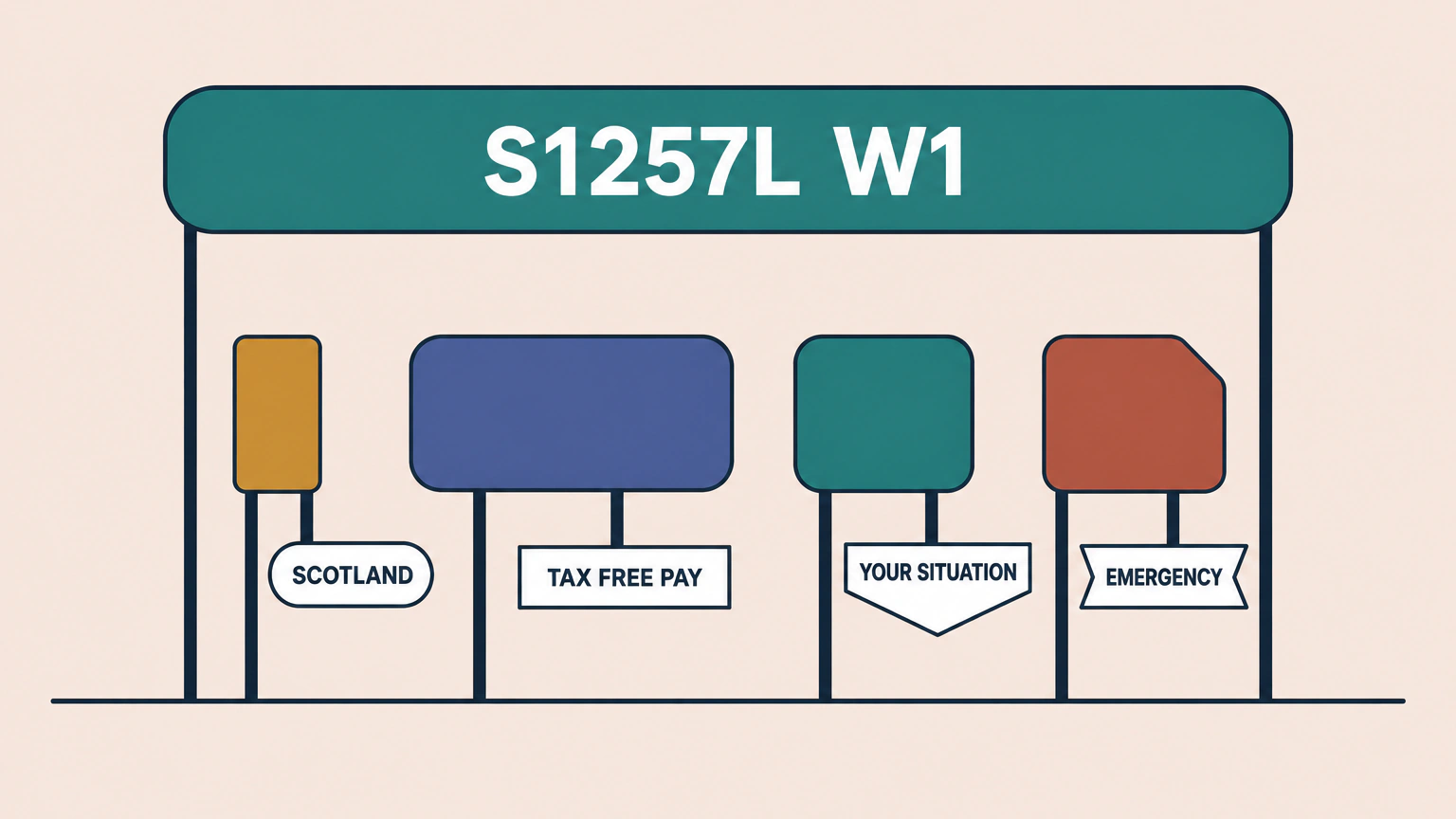
S1257L W1
- SScotland
- 1257Tax free pay
- LYour situation
- W1Emergency
Codes that fit: four
1257L
What it means
You get the standard tax free Personal Allowance.
What you pay
20% above £12,570, 40% above £50,270, 45% above £125,140.
What to check
The number should match the tax free amount on your coding notice.
1383M
What it means
Marriage Allowance. Your partner has transferred 10% of their allowance to you.
What you pay
20% above £12,570, 40% above £50,270, 45% above £125,140.
What to check
It should add £1,260 to your allowance, which usually makes the code 1383M.
1131N
What it means
Marriage Allowance. You have transferred 10% of your allowance to your partner.
What you pay
20% above £12,570, 40% above £50,270, 45% above £125,140.
What to check
It should take £1,260 off your allowance, which usually makes the code 1131N.
1257T
What it means
Your allowance involves other calculations HMRC has had to make.
What you pay
20% above £12,570, 40% above £50,270, 45% above £125,140.
What to check
Open the coding notice. A T code is HMRC telling you the working is worth reading.
These are HMRC's own definitions and the published rates for the 2026 to 2027 tax year. Your coding notice is the only thing that says why your code is what it is.
W1, M1, X and NONCUM: what an emergency code really is
One fact settles half the arguments on this subject. The emergency code for 2026 to 2027 is 1257L. HMRC's P9X, the instruction sheet it sends employers each April, says it in one line: "The emergency code is 1257L for all employees."
So the number doesn't change. What makes a code an emergency code is the marker printed after it: W1 if you're paid weekly, M1 if you're paid monthly, X if your pay dates vary. Some payroll software prints NONCUM instead, which means the same thing. If your code ends in none of those, you're not on an emergency code, whatever the number says.
The marker changes the method, not the allowance. Normally your tax is cumulative, which means it's worked out on everything you've earned so far this tax year, with your allowance and your rate bands released to you in equal weekly or monthly slices. A non-cumulative code throws the running total away. Each payday is taxed as though you earned that amount every week or every month of the year.
And the marker can sit on suffix codes other than the standard one, as well as on K codes. GOV.UK's own examples include S875L M1 and C663L X.
Sometimes the emergency code is deliberate
Everyone treats an emergency code as a blunder. Often it's the opposite, and that's worth knowing before you complain.
The ordinary case is a new job. You start without a P45, your new employer has no history for you, and HMRC needs details from both employers before it can work out a proper cumulative code. That takes up to 35 days from your first day. Until then the non-cumulative marker stops your new employer guessing.
The deliberate case is subtler. If your circumstances change halfway through the year, a cumulative code can produce a heavy deduction or refund when it first starts. HMRC can ask your employer to use the new code on a week 1 or month 1 basis instead, so that payday ignores earlier pay and tax.
Either way, the marker dies each April. Employers are told not to carry week 1 or month 1 markings into the new tax year, so you start again on a clean cumulative code.
What a payroll manager knows: the deliberate emergency code
An emergency code is not always a mistake. If your circumstances change part way through the year, HMRC can ask your employer to use a non cumulative code. That can avoid a heavy deduction or refund when the new code starts. The side effect is that you can reach April having underpaid.
Check your own code in about five minutes
The check that actually helps isn't "does this code look right". Almost nobody can answer that from the code alone. The useful question is whether the information HMRC used to build it is correct, because the code is only ever the output of that list.
You've got two places to look. The code HMRC thinks you're on lives in the Check your Income Tax service or the HMRC app. The code your employer is actually running is printed on your payslip. HMRC also publishes a code checking tool that will read your code back to you in plain English, and it wants four things before you start: your code, your annual income before any deductions, your company benefit details and your State Pension amount.
- Open the HMRC app or the Check your Income Tax service and read the code HMRC thinks you are on.
- Compare that with the code printed on your most recent payslip. The two should match.
- Read the start of the code. An S usually marks Scotland and a C usually marks Wales. England and Northern Ireland have no nation prefix, and NT has none in any nation.
- Look for W1, M1, X or NONCUM at the end of the code. Any of these markers means your tax is being worked out on a non cumulative basis.
- In the online service, check the estimated pay, company benefits and expenses HMRC has used. That list is what built the number.
- If any of it is wrong, correct it there rather than ringing up to argue about the code itself.
What to do when the code turns out to be wrong
You can't change your tax code, and neither can your employer.
Whoever runs your payroll, whether that's a colleague in the next office or one of the payroll providers your company pays to do it, applies the code HMRC sends and has no power to alter it. Ringing them cannot make them change the code. What you change is what HMRC holds about you, and HMRC then issues a new code.
So: sign in to the Check your Income Tax service, work through your employments, pensions, estimated income, company benefits and expenses, and fix anything that's wrong or missing. If you've left a job and never got a P45, ask for one. Once HMRC updates your code it tells you and your employer within 15 working days. After that, if you're paid monthly it should appear on your next payslip or the one after. If you're paid weekly, look for it on the third.
We're not your accountant, and we can't see your coding notice. If several tax years have got tangled together, or the sums are big enough to keep you awake, an hour with a professional costs less than guessing. Just check that the person you hire is actually qualified first, because "accountant" is an unprotected title in the UK.
Getting your money back, or paying what you owe
Which route you take depends on one thing: whether the tax year has ended.
Inside the tax year, it happens through your payslip. When your new cumulative code reaches your employer, it works out the difference between the tax you've paid and the tax you should have paid, and the refund comes back to you in your pay rather than as a separate cheque from HMRC.
After the year ends on 5 April, HMRC checks your income against your tax and writes to you if the two don't match. That letter is either a P800 tax calculation or a Simple Assessment, and they go out between June and March. If you're owed money, a P800 will tell you how to claim it: five working days if you claim online, six weeks if you ask for a cheque, or fourteen days from the date of the letter if HMRC is sending one automatically.
If you owe money instead, and it's under £3,000 and you earn enough over your allowance to cover it, HMRC usually just adjusts next year's code and collects it in equal instalments over twelve months. Above £3,000, or where there's no income to collect it from, a Simple Assessment asks you to pay by a deadline. That's the branch worth taking seriously, and the one where tax solicitors earn their fee if you think the figures are wrong.
Start with your own coding notice tonight. If you've got more than one income, or a previous year to unpick, tax return specialists will do it faster than you will.
Questions people ask about tax codes
Is 1257L an emergency tax code?
On its own, no. 1257L is the ordinary code for most people this tax year. It turns into an emergency code only when W1, M1, X or NONCUM is printed after it. HMRC's P9X for 2026 to 2027 says the emergency code is 1257L for all employees, so the number never changes. Only the way your tax is worked out does.
Why is my tax code lower than 1257L?
Because something has been taken off your allowance. The usual causes are a company benefit such as medical insurance or a car, untaxed income like savings interest above your Personal Savings Allowance, or tax you owe from an earlier year. Your coding notice names the exact deduction. If the figure behind it is wrong, that's what you correct, not the code.
Can I have more than one tax code?
Yes. You get one code for each job and each pension. You only get one Personal Allowance, though, so it usually sits with your main job on 1257L while a second job runs on BR, D0 or D1. Those three tax every pound from that source at a single rate, because your allowance has already been used up elsewhere.
What does S1257L mean on my payslip?
It means you're a Scottish taxpayer on the standard allowance. GOV.UK puts it plainly: your code will be S1257L if you pay Scottish Income Tax and get the standard Personal Allowance of £12,570. The S sends your employer to Scotland's six bands instead of the three used in England, Wales and Northern Ireland. It follows your main home, not your workplace.
Does working from home change my tax code?
Not for the 2026 to 2027 tax year. HMRC withdrew the working from home relief from 6 April 2026, so there's no £6 a week claim to add to your allowance this year. You can still claim for the four previous tax years, and HMRC settles those with a refund or a code adjustment rather than a standing change to this year's code.
Can my employer change my tax code?
No, and it's worth knowing that before you ring them. Your employer applies whatever code HMRC sends and has no discretion over it. Changing the code means changing what HMRC holds about you, which you do in the Check your Income Tax service or the HMRC app. HMRC then issues the new code to you and to your employer.
Will my company car still change my tax code after April 2027?
Less than it does now. From 6 April 2027 HMRC phases in mandatory payrolling for company cars, car fuel, vans, van fuel and employer-provided medical benefits, so the tax comes off your pay directly instead of through a deduction buried in your code. Most other benefits follow from April 2028, while loans and living accommodation stay voluntary. This is interim guidance, with the final phase one detail due alongside the Autumn Budget 2026.