

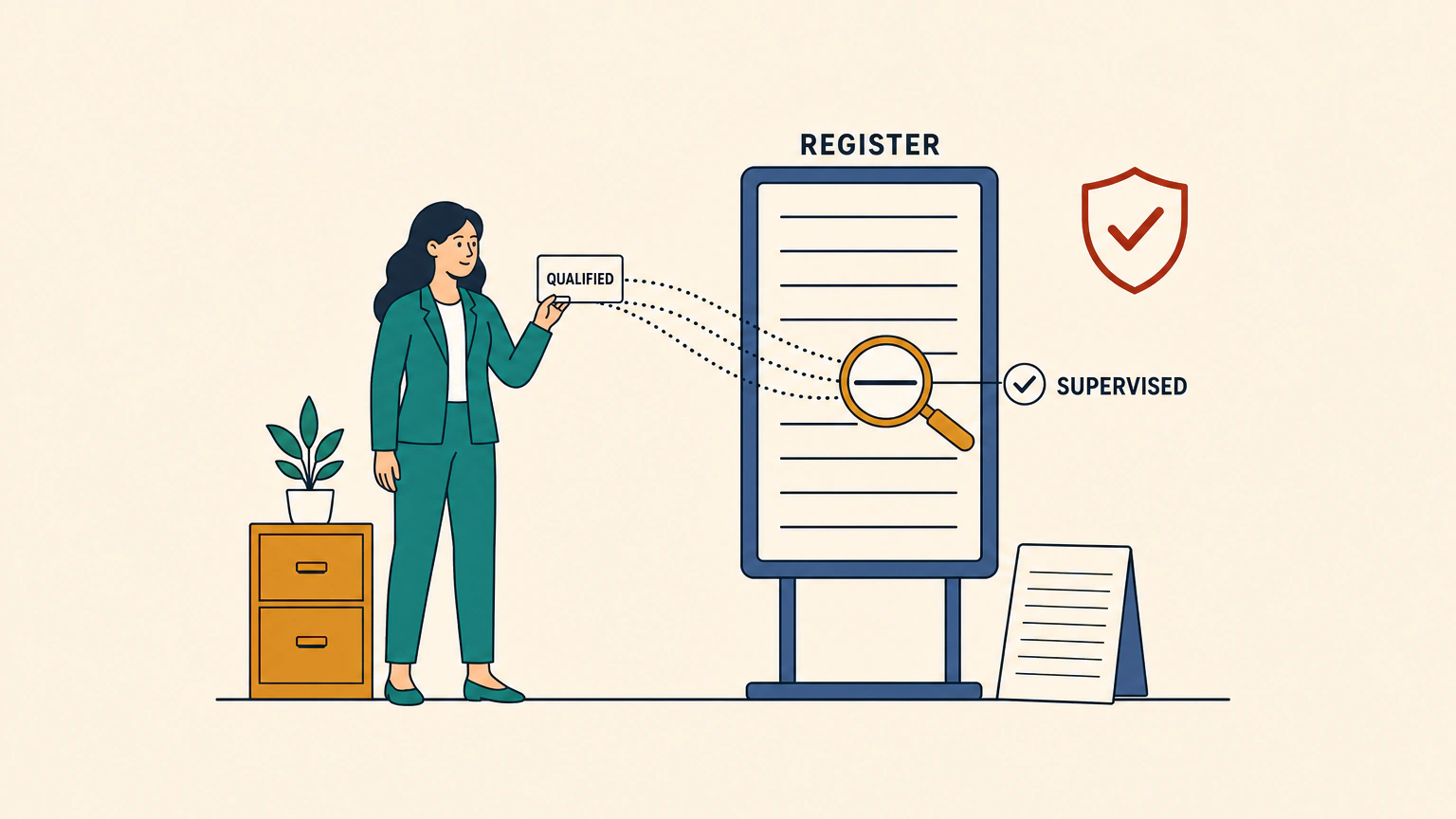
Start with supervision. A firm or sole practitioner that provides accountancy services or tax advice to other people by way of business must arrange supervision under the money laundering regulations, either through one of the 13 accountancy bodies named in the legislation or through HMRC directly. Carrying on without registering first can be a criminal offence, though an accountancy provider may keep trading while HMRC works through an application it has already submitted. That duty covers providers carrying on covered services, including the ones with no professional-body membership. Which is precisely the case that made you uneasy.
There's a second layer now. Since 18 May 2026, HMRC has been opening phased application windows: paid advisers who interact with HMRC generally need to register, subject to statutory exceptions and transition periods.
On this page
- The short answer: two checks, in this order
- Why "accountant" is not a protected title
- Check one in detail: anti-money-laundering supervision
- Check two in detail: the letters, the register and the practising certificate
- New for 2026: when your accountant has to register with HMRC to act for you
- What to ask, what it costs, and what to do if it goes wrong
- Frequently asked questions
The short answer: two checks, in this order
Check one: is the firm supervised under the money laundering regulations?
This is the legal floor. A firm or sole practitioner providing covered accountancy services or tax advice to other people by way of business has to be monitored by a supervisory authority: a professional body, or HMRC where no listed body supervises it.
Ask which, then check. If the firm names a professional body, use that body's official firm or practising-member search where there is one, or contact the body to confirm the firm's anti-money-laundering supervision. Firms supervised directly by HMRC turn up on HMRC's Supervised Business Register once the published file catches up. A directory hit proves only what that directory says it proves. A blank means questions before you send a single document.
Check two: do the letters after the name belong to a real body?
Qualification is voluntary in UK accountancy. The chartered titles are not. Chartered Accountant, Chartered Certified Accountant, Chartered Management Accountant, Chartered Public Finance Accountant and Chartered Tax Adviser may only be used by members of the body that awards each one, and every one of those bodies runs a public member search.
Which means a claimed chartered title takes about a minute to check. Someone claiming no title may still be competent and entirely legal. That's why check one comes first.
Why this order beats the order most guides use
Most guides start with the qualifications. That's fine when the answer comes back yes. It tells you nothing in the case that worried you: the person with no body behind them. Nobody publishes a count of unaffiliated practitioners, so we can't tell you how large that group is.
Supervision turns the problem the right way up. Every provider carrying on covered services must have a supervisor, letters or no letters. What changes is the route you take to verify it, depending on whether HMRC or a professional body supervises the firm.
Why "accountant" is not a protected title
What the government's own register of regulated professions lists
The government keeps a Regulated Professions Register, which lists the professions that really are regulated in the UK. It runs to 281 professions.
Search it for "accountant" and 19 come back. Every one is either a chartered title (Chartered Accountant, regulated by ICAEW, ICAS and Chartered Accountants Ireland; Chartered Certified Accountant, by ACCA; Chartered Management Accountant, by CIMA; Chartered Public Finance Accountant, by CIPFA; Chartered Tax Adviser, by the Chartered Institute of Taxation) or a regulated activity: Statutory Audit, Local Public Audit, Insolvency Practitioner.
What you won't find is a plain "Accountant". The official register of regulated occupations does not contain the job title.
Protected titles versus reserved activities: the distinction that matters
Those two phrases get used interchangeably. They mean different things.
A protected title restricts what someone may call themselves. Use "chartered accountant" without membership of the body that awards it and you have misused a title, however good the work.
A reserved activity restricts what someone may do. Statutory audit, local public audit and acting as an insolvency practitioner are reserved and need authorisation, which is why they sit on that register. Preparing accounts, bookkeeping, payroll and filing a tax return are not, and no qualification is required by law to do them for a client.
What this means in practice when you are choosing
An unqualified person may lawfully prepare your accounts and file your Self Assessment. They may not act as your company's statutory auditor or as your insolvency practitioner. And if they provide covered accountancy or tax services by way of business, they must still be supervised for anti-money-laundering purposes, qualifications or not.
Three questions, then, and a check for each.

Check one in detail: anti-money-laundering supervision
Who has to be supervised, in the regulations' own words
The Money Laundering, Terrorist Financing and Transfer of Funds (Information on the Payer) Regulations 2017 do the defining. An "external accountant" is "a firm or sole practitioner who by way of business provides accountancy services to other persons". A "tax adviser" is one who provides "material aid, or assistance or advice, in connection with the tax affairs of other persons".
HMRC is blunt about what follows. Every business covered must be monitored by a supervisory authority, and HMRC itself supervises "accountancy service providers not supervised by a professional body". That catch-all is what makes the check work for providers within the regulations' scope. Carrying on without registering first can bring a penalty or prosecution. One piece of slack matters: accountancy providers may trade while their applications are processed, unlike money-service and trust or company-service businesses, which must wait for confirmation.
The 13 accountancy bodies named in the legislation
Schedule 1 to those regulations names the bodies that may act as supervisors. It is the definitive list, and shorter than the informal ones in circulation.
| Professional body | Protected title it awards, if any | Recognised supervisory body for statutory audit? |
|---|---|---|
| Association of Accounting Technicians | - | No |
| Association of Chartered Certified Accountants | Chartered Certified Accountant | Yes |
| Association of International Accountants | - | No |
| Association of Taxation Technicians | - | No |
| Chartered Institute of Management Accountants | Chartered Management Accountant | No |
| Chartered Institute of Taxation | Chartered Tax Adviser | No |
| Insolvency Practitioners Association | - | No |
| Institute of Certified Bookkeepers | - | No |
| Institute of Chartered Accountants in England and Wales | Chartered Accountant | Yes |
| Institute of Chartered Accountants in Ireland (Chartered Accountants Ireland) | Chartered Accountant | Yes |
| Institute of Chartered Accountants of Scotland | Chartered Accountant | Yes |
| Institute of Financial Accountants | - | No |
| Institute of Accountants and Bookkeepers | - | No |
Schedule 1 names 22 bodies in all. The other nine are legal-sector bodies.
One entry changed recently. On 30 June 2026, regulation 34 of the Money Laundering and Terrorist Financing (Amendment) Regulations 2026 replaced "International Association of Bookkeepers" with "Institute of Accountants and Bookkeepers" at entry 19. Any list still printing the old name is out of date.
Note what is missing. CIPFA awards a protected title and does not appear in Schedule 1 at all, which is proof that a title and supervisory status are different things. Bookkeeping sits under the same regime, so run check one on bookkeeping services too.
How to search HMRC's Supervised Business Register
If your accountant belongs to no professional body, HMRC should be supervising them, and HMRC publishes the list.
- Open the GOV.UK guidance page "Check if a business is registered for money laundering supervision".
- Download the Supervised Business Register from it. It's a spreadsheet, updated roughly weekly.
- Search the firm's registered name, then its trading name.
- Check that accountancy service provider is among the sectors the entry is registered for.
Each entry carries the registration number, business name, trading name, the first part of the postcode, the date supervision began and those sectors. That's enough to match it against the firm on your invoice.
Pro tip: search both names, not one.
The register carries trading names as well as registered names, and sole practitioners often trade under something that looks nothing like the company on their letterhead. A nil result on one name proves nothing until you have tried the other. A small firm is also sometimes covered by another business's registration, and that's a perfectly fair answer, as long as they can tell you whose.
What supervision does not prove
Supervision is a floor, not a recommendation. HMRC puts it plainly: "Confirmation that a business is registered with us is not an endorsement for you to enter into any commercial transactions with the business."
The register also lags. A registration can take time to appear, and applications still in progress do not show at all, so a supervised practice can be temporarily missing while the file catches up. Careful in the other direction, though: a pending application isn't itself proof that supervision has been granted. Ask who supervises the firm, ask for its number, then check.
Check two in detail: the letters, the register and the practising certificate
Which member registers you can search yourself
Six of the accountancy bodies run public searches. Once you know which body to ask, this is the quickest check there is.
| Body | What the search confirms | Where to search |
|---|---|---|
| ICAEW | Appears in ICAEW's directory of chartered accountants | icaew.com/about-icaew/find-a-chartered-accountant |
| ACCA | Appears in ACCA's public directory | accaglobal.com/gb/en/member/find-an-accountant.html |
| ICAS | Appears in the ICAS directory of CAs | icas.com/find-a-ca |
| Institute of Financial Accountants | Appears in the IFA directory | ifa.org.uk/find-an-accountant |
| Association of International Accountants | Appears in the AIA directory | aiaworldwide.com/find-an-accountant/ |
| Institute of Certified Bookkeepers | Appears in the ICB directory | bookkeepers.org.uk/find-a-bookkeeper |
The other bodies run member or firm searches too. Reach them from the body's own homepage, not from a link an adviser sends you.
One limit is worth holding on to. These directories generally list members in public practice who appear by choice, so an absence is a prompt rather than a verdict. Ask for a membership number and check it with the body direct.
Practising certificates and professional indemnity insurance
Membership and permission to practise are not the same thing. Professional bodies commonly require members in public practice to hold a practising certificate, often with an insurance requirement, but the precise rules vary and the body itself is the one to ask.
Take ICAEW, the clearest published example. Its rules say a member engaged in public practice in the UK needs an ICAEW practising certificate and must comply with its professional indemnity insurance regulations, and that insurance is compulsory for every certificate holder in public practice.
So ask, in writing, for confirmation of a current practising certificate and the limit of their professional indemnity cover. Both are ordinary requests.
If your company needs an audit: the FRC Register of Statutory Auditors
Statutory audit is the one piece of accountancy that is properly locked down. Under the Companies Act 2006, a firm or individual is eligible for appointment as a statutory auditor only if they are a member of a recognised supervisory body and eligible under that body's rules.
There are four such bodies: ICAEW, ICAS, ACCA and Chartered Accountants Ireland. The Financial Reporting Council publishes the Register of Statutory Auditors at auditregister.org.uk, searchable by firm, location, individual and supervisory body. It holds 3,138 firms and 9,023 statutory auditors.
Most small companies are exempt from audit anyway. If yours isn't, the name on your audit report has to appear on that register.
New for 2026: when your accountant has to register with HMRC to act for you
The four registration dates, and which one applies to your accountant
HMRC opened the first registration window on 18 May 2026. A business paid to interact with HMRC about someone else's tax affairs generally needs an agent services account, unless an exception applies. Registration is phased, and the second window covers practices that already hold a Self Assessment or Corporation Tax agent account. The rules can catch tax return specialists as well as general practices.
| Registration window opens | Applies to | What it means for you |
|---|---|---|
| 18 May 2026 | Tax advisers generally | Your adviser should already be registered or applying |
| 18 August 2026 | Advisers who already hold a Self Assessment or Corporation Tax agent account | The date to ask about if your adviser uses one of those older accounts |
| 18 November 2026 | Businesses that only provide third-party payroll services and do not otherwise interact with HMRC | The window for payroll providers that fit this payroll-only category |
| 31 December 2026 | Financial services organisations | Relevant if your tax work sits inside a financial services firm |
Each firm generally gets three months from its window opening to apply, and may keep acting for clients during that period and while HMRC considers a timely application.
The statutory regime commences in four tranches: 18 August 2026, 18 November 2026, 18 February 2027 and 1 April 2027. Anyone holding an Agent Services Account immediately before 18 August 2026 is treated as registered from that date.
What HMRC checks before it lets a firm register
It's worth knowing what this screen actually catches, because nothing like it existed before. A business must give evidence that it is supervised for anti-money-laundering purposes, and it must not:
- have relevant outstanding tax returns or unpaid tax, unless covered by a payment plan;
- be subject to an HMRC decision refusing to interact with it;
- be subject to an anti-avoidance sanction or a stop notice;
- have relevant unspent convictions for fraud or tax offences;
- be formally insolvent;
- be suspended or permanently banned from registering with HMRC.
The conditions reach the people inside the business too. A firm with five officers or fewer must declare all of them. A firm with six or more identifies its decision-makers and names at least five relevant individuals, and none of those individuals may be disqualified from acting as a director, here or overseas.
What happens to you if your accountant does not register
Now the part that lands on you. After the applicable transition period, an adviser who needed to register but did not cannot interact with HMRC on your behalf. No returns, no claims, no correspondence. You or a replacement adviser can still deal with HMRC. HMRC's own impact note says it in one line: "Individuals may be impacted by the measure if their tax adviser can no longer act on their behalf or is suspended."
For the adviser, the sanctions climb steeply. A first prohibited interaction brings a formal compliance notice. Every interaction after that carries a £5,000 penalty. A fifth penalty within two years brings £10,000 and a 12-month ban, and interacting during a ban can make that ban permanent. An adviser suspended for more than 30 days, or banned, must tell their clients within 30 days.
So ask, in writing: which window applies to you, and have you applied? There's no public list of registered tax advisers to check against. Do authorise the firm through your own HMRC account, but be clear what that authorisation is. It confirms who you have appointed. It says nothing about their tax-adviser registration. Windows open in stages through 31 December 2026 and the final cohort's statutory start date is 1 April 2027, so check GOV.UK for the current position.
What to ask, what it costs, and what to do if it goes wrong
The questions to ask before you sign
One email covers the lot. Any firm worth hiring can answer the relevant ones, and every answer gives you something to verify independently.
- Who supervises you for anti-money-laundering purposes: a professional body, or HMRC?
- What is your supervision or registration number, and what name are you registered under?
- Which professional body are you a member of, and what is your membership number?
- Do you hold a current practising certificate for work with the public?
- Do you carry professional indemnity insurance, and to what limit?
- Which HMRC tax-adviser registration window applies to you, and have you applied?
- Which of my jobs, if any, needs a statutory auditor or an insolvency practitioner?
- What is your complaints procedure, and who hears a complaint if I am not satisfied?
Red flags
Red flag: six things worth a second question.
- They cannot or will not name a supervisor for money laundering purposes. Get it in writing before you send any records.
- They use "chartered" or "chartered certified" but do not appear in that body's member register. Those titles are protected, so search the register yourself.
- They refuse to give a membership or registration number. Verify any number they provide with the named body or HMRC. Letterhead alone is not proof.
- They ask for your HMRC login details instead of an agent authorisation. Authorise an agent through your own HMRC account, and never share your sign-in details.
- They say the 2026 HMRC registration does not apply to them and cannot say why. Genuine exemptions exist, so ask which one.
- Their quote sits far below every other quote you have. Ask what is excluded, and ask who will actually do the work.
What accountancy work typically costs in the UK
Price proves nothing on its own. A quote that makes no sense next to everything else you've been quoted is still worth a question.
| Service | National average | Range across listed firms | Sample size |
|---|---|---|---|
| Accountants and auditors | £560 | £362 to £3,938 | 799 cost profiles |
| Tax preparers | £593 | £329 to £3,283 | 937 cost profiles |
| Bookkeepers | £1,546 | £645 to £9,589 | 742 cost profiles |
Those figures are LegalDirectorate.co.uk's own published cost-profile data, a snapshot of the firms listed here rather than a market survey.
And a cheap quote from an unsupervised provider is not the saving it looks like. If they cannot lawfully deal with HMRC for you, you end up paying someone else to do the work again. If your accountant fails a check, our vetted accountants and auditors listings are a reasonable place to start over.
If things go wrong: complaints, and the gap where an ombudsman would be
Your route out depends on check two. If your accountant belongs to a professional body, that body runs a complaints and disciplinary process, and ICAEW, for one, publishes a searchable disciplinary database.
If they're supervised only by HMRC, there's no equivalent scheme and no accountancy ombudsman. That gap is real, and you are right to find it unfair. Compare how complaints work in the legal profession, where an unhappy client has a statutory ombudsman. You have three thinner routes. The firm's own complaints procedure. HMRC, which can suspend an adviser whose behaviour falls below its standard for agents, and which takes reports of unregistered businesses. And the courts, for money you have lost.
Which is the best argument there is for running check one first.
Frequently asked questions
Can anyone call themselves an accountant in the UK?
Yes, and there's no small print softening it. No law reserves the word "accountant". HMRC says the same of tax agents in its own guidance: "anyone can call themselves a tax agent", and "HMRC does not regulate agents". What nobody may do is misuse a protected chartered title, provide covered services by way of business without anti-money-laundering supervision, or carry out a reserved activity such as statutory audit without authorisation.
Is it illegal to work as an accountant without a qualification?
No. Preparing accounts, bookkeeping, payroll and filing tax returns require no accountancy qualification by law. The limits sit elsewhere. A provider carrying on covered services by way of business needs anti-money-laundering supervision, protected titles cannot be misused, and reserved activities such as statutory audit or acting as an insolvency practitioner require authorisation.
What is the difference between a chartered accountant and an accountant?
Accountability, mostly. "Chartered accountant" is a protected title held by members of ICAEW, ICAS or Chartered Accountants Ireland, and it's listed on the government's Regulated Professions Register. "Accountant" is not protected and has no plain-title entry on that register. A chartered accountant has met a body's admission requirements and answers to its rules and complaints process. An accountant may or may not.
How do I check my accountant is registered with HMRC?
Two registrations hide behind that question. For anti-money-laundering supervision, search HMRC's Supervised Business Register. For the 2026 tax-adviser registration there's no public register at all, so ask your accountant which window applies to them. Then confirm the agent authorisation inside your own HMRC account, which is the authoritative record of who may act for you.
What can an unqualified accountant not do?
Three things. They cannot audit a company, carry out local public audit or act as an insolvency practitioner, because those activities are reserved to authorised people. They cannot call themselves a chartered accountant or use any other protected title. And after their 2026 registration window and its three-month application period, they cannot deal with HMRC for you unless registered.
What should I do if my accountant is not supervised for money laundering?
Ask before you assume. They may be covered by another business's registration, or their application may still be processing, and both are answers you can check. If nobody can name a supervisor, stop there. Do not hand over records or payment, report the business to HMRC, and move your work to a supervised firm.
How do I report an accountant to HMRC or to their professional body?
Match the route to the problem. Trading without money laundering supervision goes through the "report tax fraud or avoidance" service on GOV.UK. Conduct as your tax agent goes to HMRC, which can suspend an adviser who falls below its standard for agents. And if they belong to a professional body, complain to that body, which can investigate and discipline its members.
One caveat, and only one: this is general guidance for the UK, not tax or legal advice about your own situation, and the registration dates are still moving, so confirm anything time-critical on GOV.UK before you act. If you want to know who is behind these checks, that is who we are.