


Complain to the firm in writing first. It is the normal first step everywhere in the UK, and skipping it usually gets your complaint sent back. Then go to the right independent body for the nation the firm practises in: the Legal Ombudsman in England and Wales, the Scottish Legal Complaints Commission in Scotland, or the Solicitors Complaints Committee in Northern Ireland. All three are free. The deadlines are not: roughly one year in England and Wales, three years in Scotland, as little as six months in Northern Ireland. Check your clock first.
Please note: we're not your solicitor, and this is general information rather than advice on your own case. Limits change, so check the current position with the relevant scheme, all free to contact, before you rely on a date.
On this page
- Complain to the firm first. This is the normal first step
- Which body handles your complaint depends on where the firm is
- The deadlines, nation by nation
- Service, conduct or negligence: three different routes
- What each body can actually order
- If the argument is really about the bill, that is a separate route
- What the Ombudsman's own figures say about complaints like yours
- Before you complain: the evidence pack
- Frequently asked questions
Complain to the firm first. This is the normal first step
All three schemes expect the firm to get its chance before an independent body steps in.
Put it in writing, and say what you want to happen
Give the dates, say what happened, what you expected, and what you want done about it: a reduced bill, the work finished, a straight explanation. The Scottish and Northern Irish schemes both ask you to attach your letter and the firm's reply, so keep a copy of everything you send.
How long the firm gets to answer you
In England and Wales the firm has eight weeks from the day you complain. Scotland's Commission asks you to allow at least 28 days. In Northern Ireland the solicitor must acknowledge and reply substantively in writing within 28 days, and unexplained silence after that breaches the Law Society's regulations.
What to do if you hear nothing at all
Silence is a common version of this problem. In its 2025/26 data the Legal Ombudsman reported that 25% of consumers reaching it had received no final response. You do not need one: once the firm's window runs out, your scheme can take the complaint.
Pro tip: silence is a green light. You don't need the firm's permission to escalate, and you don't need a final response either. The window running out is the trigger: eight weeks in England and Wales, 28 days in Scotland and Northern Ireland.
Which body handles your complaint depends on where the firm is
The UK is three legal jurisdictions, and complaints are where that bites hardest.
| Where the firm is | Poor service | Misconduct | Cost to you |
|---|---|---|---|
| England & Wales | Legal Ombudsman | Solicitors Regulation Authority | Free |
| Scotland | Scottish Legal Complaints Commission | SLCC receives it and passes conduct to the professional body | Free |
| Northern Ireland | Solicitors Complaints Committee | Law Society of Northern Ireland | Free |
England and Wales: two bodies, and you have to pick
Poor service goes to the Legal Ombudsman. Suspected dishonesty or rule-breaking goes to the Solicitors Regulation Authority. The two publish a joint leaflet to help you choose, and the Ombudsman runs a complaint checker with forms in Welsh. Wales sits in the same system. If the relationship is over, browse solicitors and firms across England.
Scotland: one front door for everything
Scotland removes the choice. Every complaint about a legal practitioner goes to the Scottish Legal Complaints Commission, which decides for itself whether it is service or conduct and passes conduct on. Its guidance says you don't have to work out which yours is. If you want to start again, there are Scottish solicitors by city.
Northern Ireland: what changed on 1 September 2025
Since 1 September 2025, complaints about service go to the Solicitors Complaints Committee, which is independent of the Law Society of Northern Ireland. Conduct stayed with the Law Society. Where the same facts touch both, the Committee calls it a hybrid complaint and says you may need to lodge with the Law Society too. If you need to start again, there are solicitors in Northern Ireland.
The deadlines, nation by nation
Three clocks, and each starts at a different event.
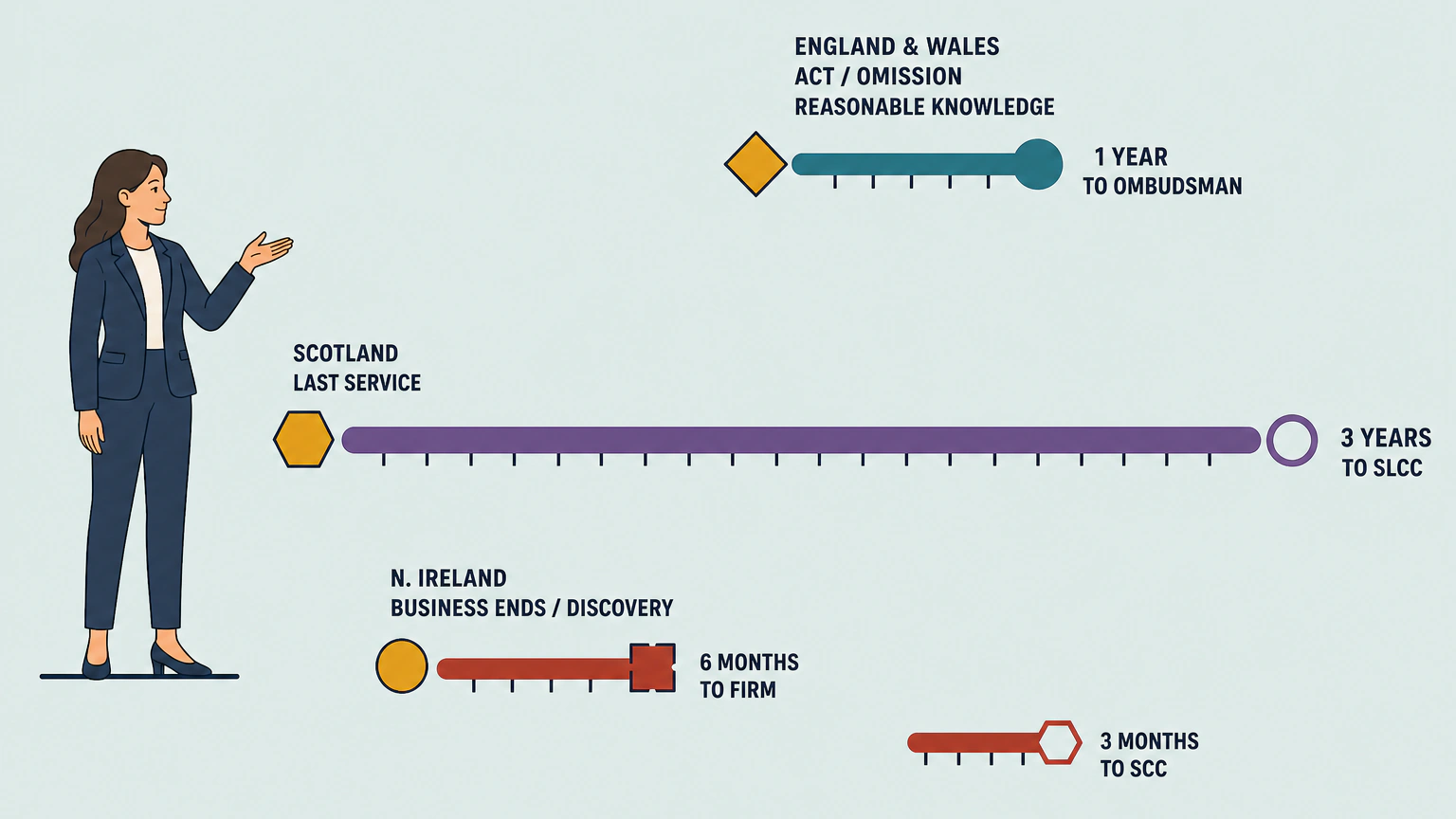
| Where the firm is | Complain to the firm | Firm's window | Outer limit to start | To reach the independent body |
|---|---|---|---|---|
| England & Wales | Normally first | 8 weeks | 1 year from the act or omission, or from when you should reasonably have known | 6 months from the firm's final response, only if that letter carried the required warning |
| Scotland | Normally first | At least 28 days | 3 years from the last service on that piece of work | No second clock; the 3-year limit governs |
| Northern Ireland | Normally first, within 6 months of business concluding or discovery | 28 days | The same 6 months | 3 months from the end of that process, or from expiry of the 28 days |
England and Wales: one year, not six
Rule 4.5 of the Legal Ombudsman's scheme rules gives you one year from the act or omission, or from when you should reasonably have known there was cause for complaint. Rule 4.6 judges that on what you actually knew, not on what advice would have told you.
Red flag: check the date on any guide you read. Several widely read guides still print a six-year outer limit for the Legal Ombudsman, one of them under a recent fact-checked badge. That rule was replaced on 1 April 2023, and the limit is now one year. If you think you're late, send the complaint anyway.
The six-month rule that only counts if the firm warned you
Rule 4.4 is the one almost nobody quotes. The six-month limit running from the firm's written final response applies only if that letter prominently included three things: that the Legal Ombudsman was available if you stayed dissatisfied, full contact details, and a warning to refer within six months. Miss one of the three, and that limit doesn't bind you.
Scotland: three years, measured from the last piece of work
For a service complaint the clock runs three years from the last time the firm gave you a service on that specific piece of legal work. For conduct, three years from the event. Time you were "excusably unaware" of the problem doesn't count. The Commission's own example is a conveyancing defect you only find when you come to sell. Not knowing you could complain is a different thing.
Northern Ireland: six months, then three more
Complain to the firm in writing within six months of your business concluding, or of discovering the problem if that is later. Once the firm's process ends you have three months to lodge a Form 1 with the Committee. If the solicitor never replies, those three months run from expiry of the 28 days.
When a deadline can be stretched, and when it cannot
Rule 4.7 lets an ombudsman in England and Wales extend any limit where that is fair and reasonable, and rule 4.8 says an extension is likely where the limit had not expired when you first complained to the firm. Scotland's test is narrower. Serious illness, or caring for a seriously ill relative, may qualify. Being too busy does not.
Service, conduct or negligence: three different routes
Three different problems, and the wrong destination costs weeks.
| Your situation | What it is | Where it goes | Clock |
|---|---|---|---|
| Delay, silence, unclear costs, instructions ignored | Service complaint | Your ombudsman scheme | The deadlines above |
| Dishonesty, misuse of client money, breach of undertaking | Conduct report | Your regulator | As soon as you can |
| Money lost through a breach of duty | Negligence claim | A professional-negligence solicitor | Ordinary limitation periods |
Poor service: delay, silence, unclear costs
The Legal Ombudsman says it most often resolves complaints about costs that were unclear or not explained in time, delay with no reason given, and poor information. The Northern Irish list runs the same way: undue delay, failure to keep you informed, work done contrary to your instructions.
Misconduct: dishonesty, client money, breaches of undertaking
Conduct is about professional standards rather than your bill, which is why it goes to a regulator. The Solicitors Regulation Authority is blunt: it says it cannot make a solicitor apologise to you or pay you compensation, and it will not step into a fees dispute. Separately, if a firm it regulates owes you money, you may be able to apply to its compensation fund.
Negligence: when it is a claim, not a complaint
A negligence claim is a separate route where a breach of duty caused you loss—a missed limitation date, for instance. Complaints and claims can overlap, but a court claim is usually brought through another solicitor and uses limitation or prescription rules rather than scheme clocks: commonly six years from when the cause of action accrued in England, Wales and Northern Ireland, and a five-year prescriptive period in Scotland, subject to rules that can alter when time starts or expires.
What each body can actually order
The ceilings are the sharpest difference of all, and they run tenfold from top to bottom.
| Where the firm is | Compensation ceiling | Inner limits | Other orders available |
|---|---|---|---|
| England & Wales | £50,000 in total | Covers compensation plus the firm's cost of rectification | Apology; fees limited to any amount including nil, refunded, remitted or waived; rectification |
| Scotland | £20,000 in total | £5,000 of it for inconvenience and distress | Apology; fee or outlay reduction or refund including VAT; compensation for loss; putting work right |
| Northern Ireland | £5,000 | A second £5,000 limit, for negligence loss, is not in force | Apology; bill reduced, refunded or waived; rectification; costs against the solicitor |
England and Wales: up to £50,000, and the fee can go to nil
Section 137 of the Legal Services Act 2007 lets an ombudsman order an apology, limit the fees the firm is entitled to, order a refund, require rectification at the firm's expense, or award compensation. Section 138 caps compensation and rectification costs together at £50,000. The fee direction sits outside that cap and can reduce what you owe to nothing.
Scotland: £20,000, with £5,000 of it for inconvenience and distress
Section 10 of the Legal Profession and Legal Aid (Scotland) Act 2007 caps compensation at £20,000, with an inner limit of £5,000 on the inconvenience-and-distress part. The Commission publishes its own reality check on 2022 to 2025 data: the commonest awards of that kind run £150 to £750, the average is around £900, and reaching £20,000 is very rare.
Northern Ireland: £5,000, plus the power to reduce the bill
Section 38 of the Legal Complaints and Regulation Act (Northern Ireland) 2016 caps compensation at £5,000, and the Committee does not award it in every complaint it upholds. The more useful power is often the bill: the Committee can limit the costs the solicitor is entitled to, and a bill cut that way is legally deemed to be the lower figure.
Cost check: across 943 cost profiles on Legal Directorate, probate and estate administration averages £5,302 (this platform's own aggregate for the firms it lists, measured 16 August 2026, not a UK market average). Set that against a £5,000 ceiling: the ceiling is not always bigger than the bill. Our probate solicitors listings show the range.
What none of them will do
None gives legal advice, a second opinion, or a recommendation of a replacement firm, and none can overturn a court decision or force a firm to keep acting for you. Two of those limits surprise people. The Legal Ombudsman cannot stop a firm suing for outstanding costs while your complaint is investigated, and it cannot insist your file is released while costs are owed.
If the argument is really about the bill, that is a separate route
A complaint asks whether the service was adequate. A bill challenge asks whether the amount is right, on a shorter clock.
England and Wales: assessment under the Solicitors Act 1974
Section 70 of the Solicitors Act 1974 sets a sliding scale. Apply within one month of delivery and the court must order an assessment. After that month it is discretionary. More than twelve months after delivery, after a judgment, or after you have paid, an order needs special circumstances, and more than twelve months after payment it cannot be made at all. Unless the order says otherwise, the solicitor normally pays the assessment costs if the bill is reduced by at least one fifth; otherwise you normally pay them.
Northern Ireland: taxation, and a tight window
Which route you have depends on whether court proceedings were issued. If they were not, you have a statutory right to ask your solicitor to apply to the Law Society for a free remuneration certificate, provided you ask within one month of the bill being issued and have not paid it. If proceedings were issued, or the certificate disappoints, seek an order for taxation through the Taxing Master's Office while the bill is under three months old, extendable to six in proven exceptional circumstances.
Deciding which route to use
A bill you can't understand, or that arrived with no costs information behind it, is usually a service complaint. A bill you understand perfectly and think is too high is an assessment or taxation question. Doing both is sometimes right. The bill clocks are shorter, so protect that deadline first.
What the Ombudsman's own figures say about complaints like yours
The Legal Ombudsman's 2025/26 data, for the year to 31 March 2026, shows how ordinary most complaints are.
Where complaints actually come from
The Ombudsman received 14,259 new complaints, up 37%, and accepted 8,412. Residential conveyancing made up 36% of those and drove almost three-quarters of the year's increase, which matters if your dispute is with conveyancing solicitors. Immigration and asylum rose fastest, up 49%.
What it tells you about your own case
Communication and delay together accounted for 46% of complaint types, poor communication in 24% and delay in 22%. If your complaint is that nobody told you what was happening, it is one of the Legal Ombudsman's most common complaint types, not an unreasonable one. Of complaints reaching an investigation, 72% showed evidence of poor service.
Before you complain: the evidence pack
The Scottish and Northern Irish schemes decide on the documents you send, so gathering this now saves a round of correspondence later.
What to gather, and what to keep a copy of
- Your client-care letter or terms of business, and any costs estimate
- Every invoice and interim bill, with the date each reached you
- Key dates: instruction, when the work should have finished, when the problem arose, when you noticed it
- Your written complaint to the firm, and the date you sent it
- The firm's reply, and whether a final response names the ombudsman, gives contact details and warns about the deadline
- A dated note of every call, with who you spoke to and what was said
- Evidence of money lost, if you claim financial loss rather than distress
- The individual solicitor's name as well as the firm's
What complaining might change about your case
The Scottish Commission publishes the honest version: a solicitor may stop acting for you. That means paying outstanding fees and outlays straight away and finding someone else, which can delay your case and add to its cost. It is a real risk, and it is not a reason to stay quiet. If the work is still live, we'd line up a replacement before you send the complaint.
Frequently asked questions
How long do I have to complain about a solicitor?
It depends on the nation. In England and Wales you have one year from the act or omission, or from when you should reasonably have known there was cause. In Scotland, three years from the last service on that piece of work. In Northern Ireland, six months to complain to the firm, then three months to reach the Committee.
Does it cost anything to complain about a solicitor?
No. The Legal Ombudsman, the Scottish Legal Complaints Commission and the Solicitors Complaints Committee are all free for consumers, and so is a conduct report to a regulator. You do not need a solicitor to complain. The Northern Irish Committee can, however, order a frivolous or vexatious complainant to pay costs towards its time. Cost can also enter on the separate routes: a court assessment, or a negligence claim.
Do I have to complain to the firm first, or can I go straight to the ombudsman?
Complain to the firm first. All three schemes treat that as the normal first step, and a complaint that skips it is usually sent back. The exceptions are narrow: in England and Wales an ombudsman can take one early for exceptional reasons or irretrievable breakdown; Scotland's prematurity test is stated as “usually” requiring a prior written complaint; and Northern Ireland allows an exemption or extension request in limited circumstances.
Can the ombudsman strike off my solicitor or discipline them?
No. The schemes deal with service, and what they order is compensation, a reduced bill, an apology or corrective work. Striking off belongs to each nation's regulator and its tribunal. The Northern Irish Committee can refer a solicitor to the Law Society, and it can report a failure to comply with its directions to the Solicitors Disciplinary Tribunal.
What if my solicitor has overcharged me?
Split it in two. If the bill was never explained, or contradicts the estimate you were given, that is poor service and belongs with your ombudsman scheme. If the amount itself is the issue, use the bill route: assessment under section 70 of the Solicitors Act 1974, or taxation in Northern Ireland.
Can I complain if I am not the client, for example about the other side's solicitor?
Generally not. The Legal Ombudsman's rules require the service to have been provided to you, and the Northern Irish Committee says outright that you cannot complain about someone else's solicitor. Scotland is the exception: it takes third-party service complaints, with a limit of three years from the event.
What happens if my solicitor stops acting for me because I complained?
It can happen, and the Scottish Commission publishes the consequences: you would pay outstanding fees and outlays straight away and find a new solicitor, which may delay your case and increase its cost. A firm that does withdraw should manage it so your case is not harmed.