

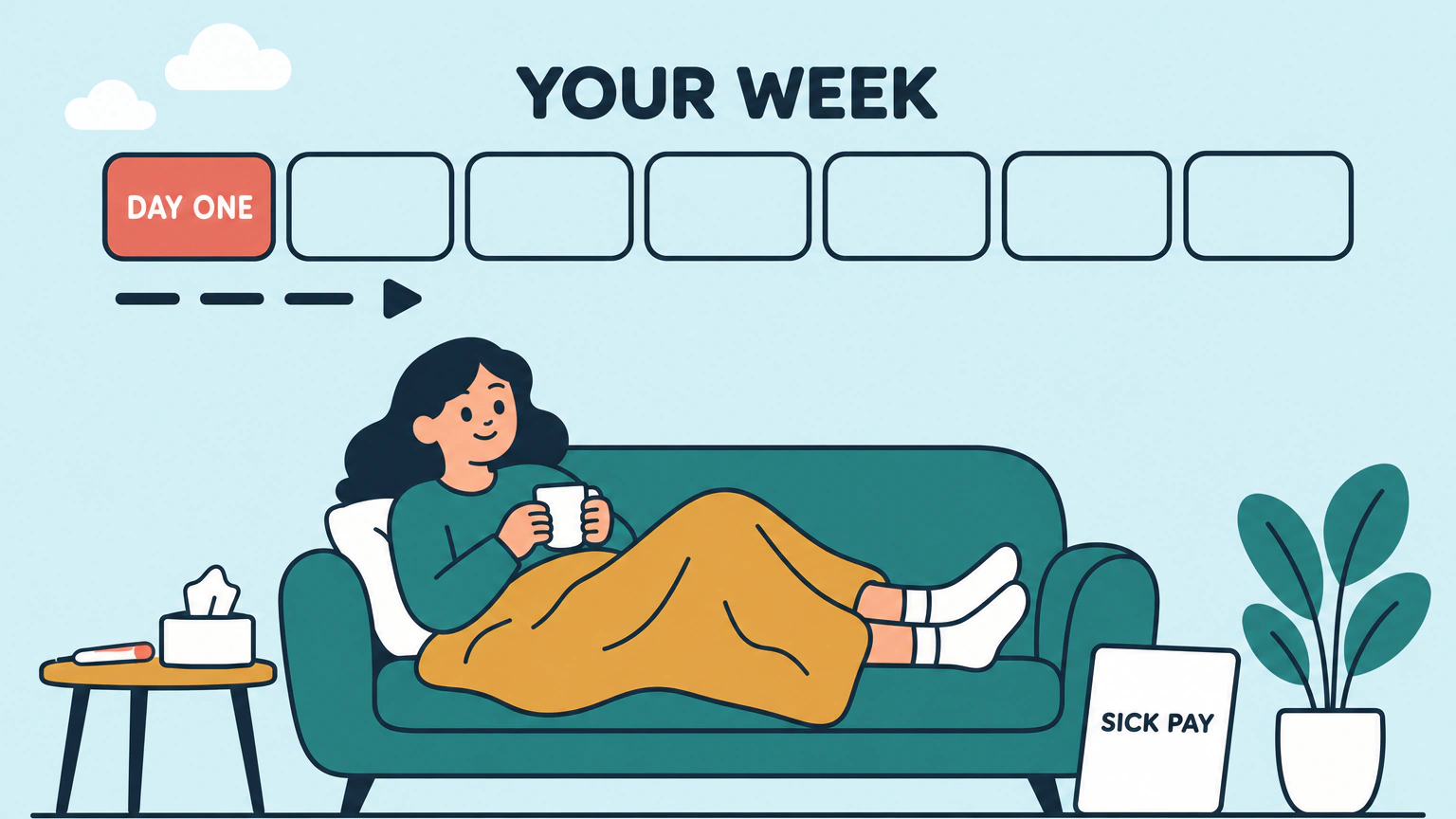
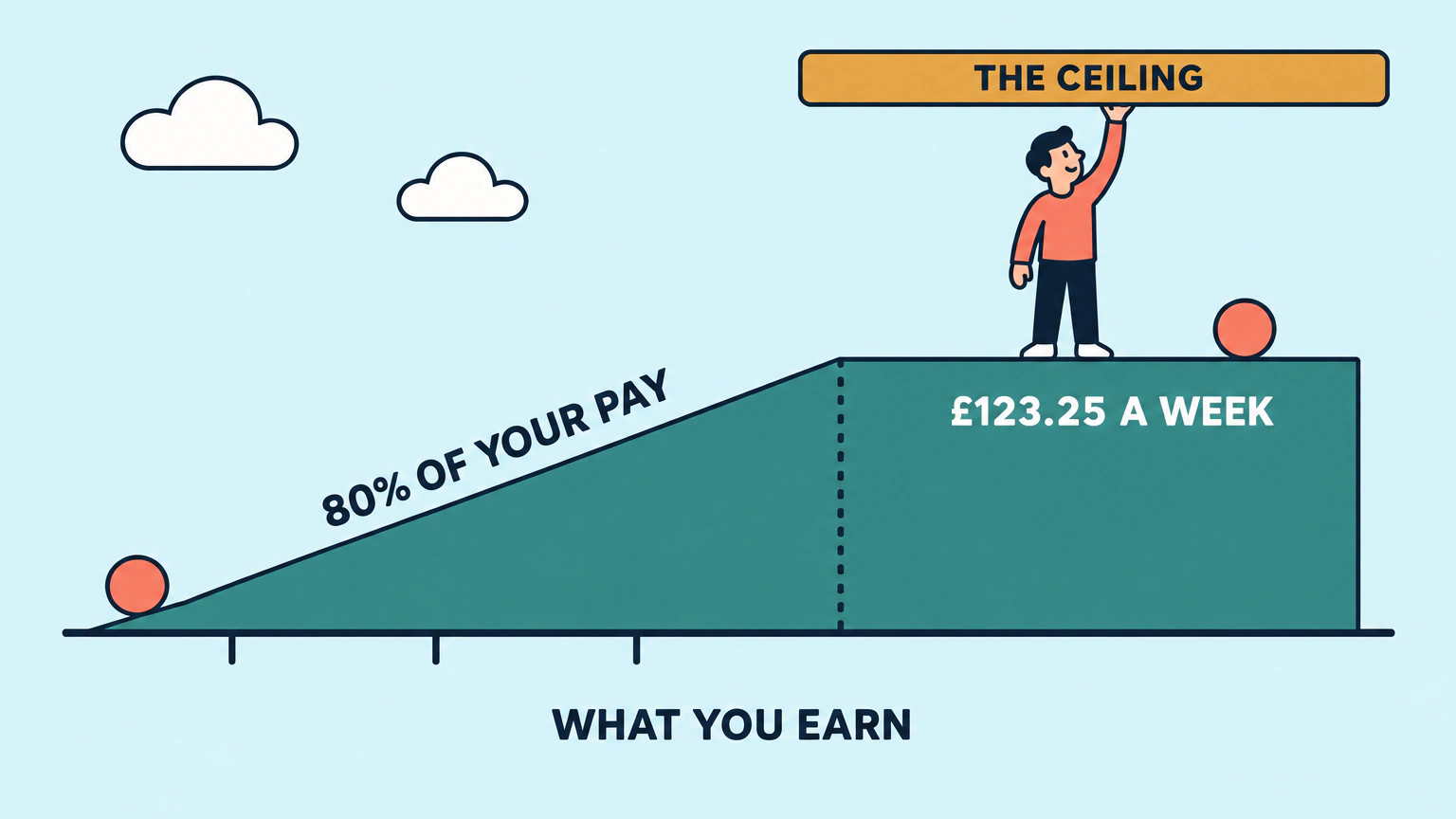
Statutory sick pay is £123.25 a week, or 80% of your normal weekly earnings, whichever of the two is lower. Since 6 April 2026 your employer has to pay it from the first day you're off, rather than the fourth. On a normal five-day week at the full rate, that's £24.65 for each working day you miss.
On this page
- What sick pay is actually worth to you now
- What changed on 6 April 2026
- Whether you qualify at all
- Telling your employer, and proving you are ill
- How long it runs, and the form you get when it ends
- If your employer will not pay you
- Your contract may beat all of this
- Scotland, Wales and Northern Ireland
- Frequently asked questions
What sick pay is actually worth to you now
The two numbers, and which one is yours
The law gives you two figures and tells your employer to pay the smaller one. Section 157 of the Social Security Contributions and Benefits Act 1992 puts it plainly: your weekly rate is "the lower of (a) £123.25, and (b) 80% of the employee's normal weekly earnings".
So take what you normally earn in a week before tax, work out 80% of it, and compare the answer with £123.25. The smaller figure is your weekly rate.
Your normal weekly earnings are your average pay over the eight weeks before you went off sick, and your employer works them out from payroll. You still qualify if you haven't been paid for eight weeks yet.
Tax and National Insurance come off sick pay, or SSP as GOV.UK and HMRC call it, just as they do off wages. If your payslip looks short, check the code on your payslip as well as the sick pay line.
What that comes to for a single day off
Hardly anyone prints the daily figure, but the sum has been in the Act since 1992. Section 157(3) says the amount for any day is "the weekly rate applicable on that day divided by the number of days which are, in the week (beginning with Sunday) in which that day falls, qualifying days". Your qualifying days are simply the days you normally work.
On a five-day week at the full rate, £123.25 divided by five is £24.65 a day. On a three-day week it's £41.09, because Acas says sick pay is "rounded up to the nearest penny". Work fewer days and each one is worth more, because the same weekly amount is shared between them.
| Your normal weekly pay | Your weekly sick pay | Per day on a 5 day week | Per day on a 3 day week |
|---|---|---|---|
| £100 | £80.00 | £16.00 | £26.67 |
| £125 | £100.00 | £20.00 | £33.34 |
| £150 | £120.00 | £24.00 | £40.00 |
| £154.05 | £123.24 | £24.65 | £41.08 |
| £154.06 or more | £123.25 | £24.65 | £41.09 |
Someone on £125 a week, for example, gets £100 a week in sick pay. That's £20 a day on five days, or £33.34 on three.
Earning under about £154 a week changes the answer
Not everyone gets the headline figure. The 80% rule only bites when 80% of your pay comes to less than £123.25, which happens below £154.06 a week. Earn £154.06 or more and you're on the flat rate. Earn £154.05 and you get £123.24, a penny less, which is exactly where Citizens Advice draws the line too.
Below that, the gap opens up quickly. On £120 a week you'd get £96, not £123.25.
For many low earners this is good news, because until April anyone on less than £125 a week got nothing at all. If you earn between £125 and £154.05, though, you used to get the full flat rate and now you'll usually get less. That's a real drop, and it lands at a bad time. Work out 80% of your pay before you decide payroll has made a mistake.
Put your own pay and working days in here, and it'll do the division for you.
What your sick pay comes to
Your usual weekly pay before anything comes off. If you are paid monthly, divide by 4.33 for a rough figure, and your employer will use your last 8 weeks of payslips for the real one.
These are your qualifying days. If your shifts move around, it is the days you and your employer agree you would normally have worked.
£24.65for one working day off sick
Your weekly rate is £123.25, because 80% of what you earn comes to more than that, so the flat rate is the lower of the two. Divided by the 5 days a week you normally work, one day comes to £24.65.
The one-day figure is rounded up to the next penny. Sick pay runs in weeks from Sunday to Saturday. If you're off on all your working days in one of them, that week is paid at your weekly rate.
This is the legal minimum. Check your contract, because plenty of employers pay more, and if they do you get theirs instead.
How the rule works
- If you normally earn £120 a week£96.00 a week
- If you normally earn £154.06 a week£123.25 a week
- If you normally earn £400 a week£123.25 a week
Sick pay is 80% of your normal weekly pay until that comes to £123.25 a week. From £154.06 a week upwards you are on the flat rate of £123.25, however much more you earn. It can last up to 28 weeks.
Rates and rules: Social Security Contributions and Benefits Act 1992, s.157(1) and s.157(3), as substituted by the Social Security Benefits Up-rating Order 2026 (SI 2026/148), art. 8; GOV.UK, Statutory Sick Pay. The same rates apply in Northern Ireland under its own 1992 Act.
What changed on 6 April 2026
Sick pay now starts on your first day off
Waiting days are gone. Until April, sick pay only started once you'd been off for four days in a row, and even then your first three working days went unpaid, so a one-day stomach bug got you no sick pay at all.
Now a single day of sickness is enough. The Employment Rights Act 2025 made the change, in force from 6 April 2026 in Great Britain and Northern Ireland alike. You're paid from your first qualifying day.
If you were already off when the date arrived, you didn't have to start again. Acas says you were entitled from 6 April if it was a qualifying day, even if you hadn't finished your waiting days.
The minimum earnings test has gone
There used to be a floor. If your average pay was under £125 a week, you got no sick pay at all, however ill you were. That floor, the lower earnings limit, went on the same April day.
The 80% rule is the other half of the change. Instead of all or nothing, the payment now follows what you earn, so someone on £90 a week gets £72. The flat rate rose at the same moment, from £118.75 to £123.25.
| The rule | Before 6 April 2026 | Now |
|---|---|---|
| When sick pay starts | Your fourth qualifying day, once your sickness had lasted at least 4 days in a row | The first day |
| Minimum earnings to qualify | £125 a week | No minimum at all |
| The weekly amount | £118.75 flat | £123.25 or 80% of your pay, whichever is lower |
If you were already off sick when the rules changed
There's a safety net for one group. Say you were off sick and already getting sick pay before 6 April 2026, with normal pay between £125 and £154.05 a week. The new rule would have dropped you to 80%. Instead, transitional rules keep you on the flat £123.25 for that absence. Acas says the protection lasts until you go back to work, reach 28 weeks of sick pay, leave the job or start getting statutory maternity pay or maternity allowance, whichever comes first.
The catch is a relapse. If you go back and fall ill again within eight weeks, the new absence links to the old one, but the protection doesn't carry across. You're then on the lower of £123.25 and 80% like everyone else.
Whether you qualify at all
The three things you need to be able to say
The test is short now. You need to be able to say each of these:
- I'm employed for tax purposes.
- I've done some work for this employer.
- I've been off sick for at least one full working day.
"Employed for tax purposes" sounds technical, but in practice it means PAYE. Acas says it covers "anyone who has their tax paid automatically through PAYE", which takes in employees and agency workers. If you're paid through your employer's payroll under PAYE, you're in.
"Done some work" means you've started. Citizens Advice says that if you've accepted a job but not started it, you can't get sick pay until the day you're due to begin.
The situations that still rule you out
A few situations still shut you out, whatever you earn. You can't get statutory sick pay if you're self-employed, in the armed forces, or in legal custody, which Citizens Advice describes as being held by the police or in prison. You can't get it while you're on statutory maternity pay or maternity allowance either.
It's also off the table if your 28 weeks of sick pay ended within the last eight weeks, if you were paid Employment and Support Allowance in the last 12 weeks, or if you're on an agricultural contract from before 1 October 2013, which comes with its own sick pay rules.
Red flag: Two rules on GOV.UK's employer guide catch people out. First: "You cannot count a day as a sick day if an employee has worked for a minute or more before they go home sick." Second, if you work a shift that starts one day and ends the next, and you fall ill during it or after it ends, you get nothing for that shift. Both cost real money and neither is obvious, so check which day your absence is recorded as starting.
Part time, agency, zero hours and two jobs
This is where the April changes land hardest, and mostly in your favour. Citizens Advice's test is simple: if your employer takes tax and National Insurance off your pay, you can get sick pay, including on a part-time, zero-hours or fixed-term contract. GOV.UK confirms that agency workers can qualify too.
With two jobs, you may get sick pay from each employer, and you check each one as if it were your only job. If you can still do one but not the other, say a desk job and a physical one, you could get sick pay from one and normal wages from the other.
Irregular shifts are the tricky part, because sick pay covers only your qualifying days. If your hours move around, Acas says your employer should agree with you which days count. Citizens Advice suggests listing the days you've worked recently and looking for the ones that repeat each week. If you've worked every Tuesday and Thursday for the past eight weeks, those are your qualifying days.
Telling your employer, and proving you are ill
The deadline that can cost you money
Tell your employer you're sick by the deadline they've set, or within seven days if they haven't set one. GOV.UK's employer guide says they can't insist you tell them in person or on a special form.
Miss the deadline and you can lose out. Your employer doesn't have to pay sick pay for the days you were late telling them, unless you had a good reason. In GOV.UK's own example, a worker off sick from a Monday who reports it two days after a five-day deadline loses two days' sick pay.
If you were late for a real reason, such as being in hospital, tell them what it was. Your employer decides whether the reason is good enough, and Citizens Advice says that if you're not happy with their decision, you can take it to HMRC.
Seven days on your own word, then a fit note
For the first week you don't need a doctor. Acas says you can self-certify for up to seven calendar days, weekends included, just by telling your employer you're not well enough to work. If they want it in writing, GOV.UK points you to form SC2.
Once you've been off for more than seven days in a row, counting days you wouldn't have worked, you need a fit note. A GP or hospital doctor, a registered nurse, a pharmacist, a physiotherapist or an occupational therapist can give you one, printed or digital.
If the appointment is the hold-up, Acas's advice is to tell your employer why the fit note is late and when they'll get it. GOV.UK is firm with employers about the money: "You cannot withhold SSP if the employee is late sending you a fit note."
How long it runs, and the form you get when it ends
28 weeks, and how a repeat absence eats into it
Statutory sick pay lasts for up to 28 weeks. For one long illness, that's simple. Repeat absences are less obvious, because of linking.
Two spells of sickness link if they're eight weeks or less apart, and once they're linked the 28-week clock carries on from where it stopped instead of starting again. Acas adds a detail that shows on your payslip. In a linked period the earnings figure from the first absence is used again, so a pay rise since then won't change your sick pay, and neither will a cut.
There's an outer limit, too. GOV.UK says you're no longer eligible once a continuous chain of linked periods has lasted more than three years.
Form SSP1, and the three deadlines your employer is on
SSP1 is the form your employer uses to tell you, in writing, that you're not getting sick pay or that yours is about to end. You can use it to support a claim for Universal Credit or Employment and Support Allowance, which is why the timing matters. Your employer is on a clock in all three situations.
| Your situation | When your employer must send the form |
|---|---|
| You do not qualify for sick pay at all | Within 7 days of your first day off sick |
| Your sick pay ends unexpectedly while you are still ill | Within 7 days of it ending |
| Your sick pay is due to end before your sickness does | On or before the start of the 23rd week |
If your employer knows you'll be off for more than 28 weeks, GOV.UK lets them fill in the form early so you can apply for Employment and Support Allowance before sick pay stops. The GOV.UK version of SSP1 is published for England, Scotland and Wales, and Northern Ireland publishes its own on nidirect.
If your employer will not pay you
Ask for the reason in writing first
Start with your employer, not HMRC. HMRC's dispute team only wants to hear from you once you've tried to sort things out with them.
Ask for the refusal in writing, on form SSP1. That's the document HMRC will want, and Citizens Advice tells you to ask for it before you call. If your employer won't use the form, they still have to explain in writing, and Acas says a letter or an email will do.
It helps to know whose call this is. Plenty of employers use outside payroll providers, so your payslip may come from them, but the decision about your sick pay is still your employer's, and so is the legal duty to pay it. Ring the payroll bureau about a typo. Take a refusal to your employer.
Ringing HMRC, and what to have in front of you
If talking hasn't worked, call HMRC's Statutory Payment Dispute Team on 0300 322 9422 (textphone 0300 200 3212), Monday to Friday, 8.30am to 5pm. You can also write to Statutory Payment Dispute Team, PT Operations, North East England, HMRC, BX9 1AN. HMRC will then ask your employer why it thinks you're not entitled.
Have these in front of you before you dial:
- Your name and address, and your National Insurance number, which Citizens Advice adds to the list.
- Your employer's name and contact details, from a payslip or your contract.
- Your payroll number, printed on your payslip.
- The dates you were off sick, from the first day through each working day you missed.
- What your employer said when you asked for sick pay and for form SSP1, plus any SSP1, letter or email they sent.
Don't sit on it. Citizens Advice says that in England, Scotland and Wales you'll need to contact HMRC within six months of the date you should have started getting sick pay. Call well before then.
What HMRC can actually make your employer do
HMRC can do more than nudge. If your employer still won't pay, HMRC can issue a formal decision on whether you're entitled, and your employer then has 30 days to appeal. If there's no appeal in that window, HMRC's own manual says it should arrange to pay you what's owed directly. If there is one, HMRC waits for the tribunal and pays only if you win and your employer still doesn't pay. It can be slow.
An employer who refuses, or keeps failing, to pay can also be fined up to £3,000. That penalty goes to HMRC, not to you, so it's leverage rather than compensation.
What HMRC can't touch is your job. An employer may dismiss you during sick leave if your illness means you can no longer do your job, but dismissal should be a last resort. They should first look at support, and they must consider reasonable adjustments if you're disabled. Once a long absence turns into talk of capability or dismissal, that's a question for employment solicitors, not a phone line.
We're not your solicitor, and none of this is advice on your own case. If your job is on the line, talk to one, and you can see how we rate firms before you choose.
Your contract may beat all of this
Check your contract before you do any sums, because statutory sick pay is only the floor. Some employers pay more. Acas says that when they do, it must be written into your contract or a workplace policy, so look there and in your staff handbook.
Contractual sick pay doesn't come on top of the statutory amount. It includes it. In Citizens Advice's example, contractual sick pay of £457.88 a week is £123.25 of statutory sick pay plus an extra £334.63. And it can't be less than your statutory rate.
If a long absence starts turning into talk of leaving, read up on a settlement agreement before you sign anything, including who pays for the legal advice that goes with it.
Scotland, Wales and Northern Ireland
The answer is the same everywhere in the UK: £123.25 or 80% of your pay, whichever is lower, from your first day off.
England, Scotland and Wales share one law, the 1992 Act, with no separate Scottish or Welsh version. Northern Ireland has its own 1992 Act, but the Employment Rights Act 2025 changed it in the same words on the same day, and its rate section now reads exactly as Great Britain's does.
Two practical details differ here. The GOV.UK version of form SSP1 is published for England, Scotland and Wales, while Northern Ireland publishes its own on nidirect. And Northern Ireland's workplace advice body is the Labour Relations Agency, not Acas.
If you work in the Republic of Ireland, none of this applies. It's a different country with its own scheme.
Frequently asked questions
How much is statutory sick pay a day?
It's your weekly rate divided by the number of days you normally work that week, rounded up to the next penny. At the full £123.25, that's £24.65 a day on a five-day week and £41.09 on a three-day week. If you earn less than £154.06 a week, start from 80% of your pay instead. On £120 a week and three working days, that's £32 a day.
Do you still lose the first three days of sick pay?
No. Since 6 April 2026 there are no waiting days, so sick pay starts on your first qualifying day off, even for a single day of illness. The change came from the Employment Rights Act 2025 and applies across the UK. If you were already off sick before that date, Acas says you're paid from 6 April, as long as it was a qualifying day.
Can my employer stop my sick pay?
Only for a reason the rules allow. Sick pay ends when you go back to work, reach 28 weeks or stop qualifying, and your employer can hold back pay for days you reported late without a good reason. They can't withhold it because your fit note is late. If it stops while you're still ill, they must send form SSP1 within seven days, and you can challenge that with HMRC.
What happens when statutory sick pay runs out?
Your employer sends you form SSP1, on or before the start of the 23rd week if your sick pay is due to end before your illness does. You can use it to support a claim for Universal Credit or Employment and Support Allowance. Check how long any contractual sick pay runs, too. Citizens Advice says you can't get statutory sick pay again until eight weeks after those 28 weeks ended.
Can you get statutory sick pay if you are self employed?
No. Statutory sick pay comes from an employer, and Acas is clear that workers who pay their own tax through self assessment aren't eligible. If you're self-employed and too ill to work, look at Universal Credit or Employment and Support Allowance instead. If you also have a PAYE job on the side, that employer may still owe you sick pay for the days you'd have worked there.
Is statutory sick pay different in Scotland or Northern Ireland?
No. It's £123.25 a week or 80% of your pay, whichever is lower, in all four nations, and it starts on your first day off everywhere. Scotland shares one law with England and Wales. Northern Ireland has its own Act, changed in identical words on the same day. The practical differences covered here are Northern Ireland's own SSP1 form and the Labour Relations Agency in place of Acas.