


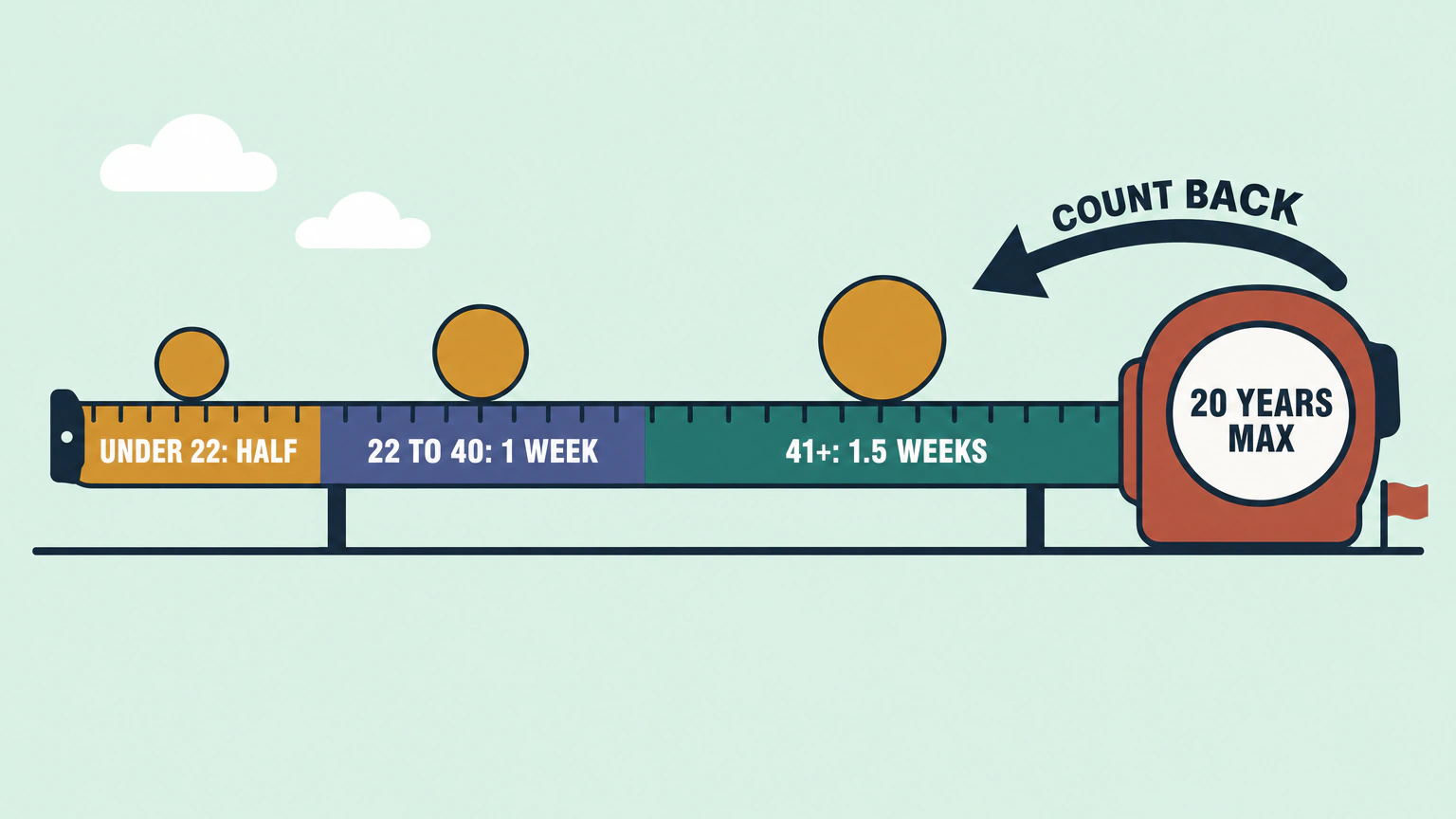
Statutory redundancy pay is half a week's pay for each full year you worked under 22, a week's pay for each year from 22 to 40, and a week and a half for each year from 41, counted back from the day your job ends and stopping at 20 years. Your week's pay is capped at £751 if your job ends on or after 6 April 2026 (£783 in Northern Ireland), so the most anyone can get is £22,530, or £23,490 in Northern Ireland.
That's the whole formula. The sums are simple. It's the inputs that can quietly go wrong.
On this page
- The formula, in plain numbers
- Worked examples to hold your letter against
- What counts as a week's pay
- How notice can add a year, or get you over two years
- Whether you qualify at all
- Northern Ireland: the same formula, a higher cap
- Is redundancy pay taxed?
- If the money is wrong, late or missing
- Frequently asked questions
The formula, in plain numbers
Three things set your figure: your age, your years and your week's pay
Working out redundancy pay comes down to three facts about you. Your age sets the rate for each year, from half a week's pay up to a week and a half. Your years are full years of continuous service, and only the last 20 count. Your week's pay is your gross pay for a normal week, up to the cap. You need at least two years' service to get anything.
GOV.UK runs an official calculator that does the multiplying, and we'd use it rather than a spreadsheet. But it takes your answers on trust. It can't tell you which week's pay belongs in the box, which date counts as the end, whether notice should stretch your service, or whether you qualify in the first place.
Get one of them wrong and the answer is wrong too.
Your years are counted backwards from the day your job ends
This step catches people out. Each year is paid at the age you were during that year, not the age you are now. The Act's own words are "reckoning backwards from the end of that period". You start at your last day and walk back a year at a time, until you run out of years or reach 20.
Acas uses this example. You're 45, with 22 full years. The four years since your 41st birthday pay a week and a half each, which is 6 weeks. The next 16 years, all between 22 and 40, pay a week each. The two oldest years don't count, because only the last 20 do. Total: 22 weeks, or £6,600 at £300 a week.
Counting from the end means the 20-year limit always drops your earliest years, and those are never paid at a higher rate than your later ones. Count forwards by mistake and you'd drop your best years instead.
How many weeks you're owed, at a glance
Find your age on the day your job ends, then your full years of service, and read the number of weeks where they meet. At 50 with 10 years' service, for instance, it's 14.5 weeks.
| Your age when your job ends | 2 years | 5 years | 10 years | 15 years | 20 years or more |
|---|---|---|---|---|---|
| 25 | 2 | 4 | n/a | n/a | n/a |
| 30 | 2 | 5 | 9 | n/a | n/a |
| 35 | 2 | 5 | 10 | 14 | n/a |
| 40 | 2 | 5 | 10 | 15 | 19 |
| 45 | 3 | 7 | 12 | 17 | 22 |
| 50 | 3 | 7.5 | 14.5 | 19.5 | 24.5 |
| 55 | 3 | 7.5 | 15 | 22 | 27 |
| 61 or over | 3 | 7.5 | 15 | 22.5 | 30 |
n/a means you'd have had to start work before 16. Multiply your figure by your week's pay, capped at £751 (£783 in Northern Ireland).
The last column holds for any length of service past 20 years, because nothing earlier counts.
What the £751 cap does if you earn more
If your gross weekly pay is above £751, which is roughly £39,052 a year, the formula uses £751 instead. Below that, it uses your real figure. In Northern Ireland the cap is £783.
Which year's redundancy pay cap applies depends on your relevant date. That's the day your notice runs out, or the day your job ends if you weren't given notice. If it falls on or after 6 April 2026, the £751 figure applies. If your job ended between 6 April 2025 and 5 April 2026, the cap is £719 (£749 in Northern Ireland), and the most anyone could get in Great Britain was £21,570.
For a payment in lieu that ends the contract immediately, use that earlier end date for the cap. Statutory notice can still extend your service calculation. Some calculators online still run on last year's figure.
Worked examples to hold your letter against
These five cases are worked through to pounds, with the Northern Ireland total beside the one for England, Scotland and Wales. In all five, the job ends on or after 6 April 2026. Find the one closest to yours and check that your letter follows the same steps.
| Your situation | Weeks owed | Week's pay used | Total in England, Scotland and Wales | Total in Northern Ireland |
|---|---|---|---|---|
| Aged 45, 22 full years, £300 a week | 22 (only the last 20 years count) | £300 | £6,600 | £6,600 |
| Aged 50, 10 full years, £900 a week | 14.5 | £751 in GB, £783 in NI | £10,889.50 | £11,353.50 |
| Aged 61, 25 full years, £1,200 a week | 30, the most anyone gets | £751 in GB, £783 in NI | £22,530 | £23,490 |
| Aged 24, 3 full years, £450 a week | 2.5 | £450 | £1,125 | £1,125 |
| Aged 35, let go 2 days short of 2 years with pay in lieu, £520 a week | 2, because a week of statutory notice carries you to 2 years | £520 | £1,040 | £1,040 |
What counts as a week's pay
On a fixed salary, it's your normal weekly pay
If your pay for your normal hours doesn't change from week to week, your week's pay is what your contract pays for a normal week, before tax. There's no averaging. If you're paid monthly, multiply your gross monthly pay by 12 and divide by 52 for a rough weekly figure. On £2,500 a month, that's about £577.
Being laid off or put on short-time working just before redundancy doesn't drag the figure down. Citizens Advice says your pay is "based on your usual weekly pay when you did your normal hours", unless you agreed a permanent change to your hours.
A pay cut you agreed to help the business through is less clear. Citizens Advice says only that your redundancy pay "could be affected", and that it "depends whether you agreed to change your contract or not". If you're asked to sign a temporary cut now, we'd get advice first.
If your hours or pay go up and down, it's a 12 week average
Where your pay varies with the work you do, as with commission or piece rates, or you have no normal hours at all, your week's pay is an average over 12 weeks. Any week with no pay in it is skipped, and an earlier week takes its place.
The 12 weeks end at what the law calls the "calculation date". In most cases that's the day you got your notice, which is how GOV.UK and Citizens Advice put it. There's one refinement. If your employer gave you more notice than the legal minimum, the 12 weeks end later, at the date the minimum notice would have had to start for your job to end when it did. If you were paid in lieu, they end on the day your job ended.
You may have read about a 52-week look-back. That's for holiday pay, not redundancy. Zero-hours contracts use the same 12-week average, with one extra hurdle: whether gaps between shifts broke your continuity.
Overtime, commission and time on family leave
Overtime counts only when your contract makes you work it. Acas calls this "guaranteed overtime", which your employer must offer and you must work. Citizens Advice puts it from the other side: overtime usually isn't included "unless it was regular and you had to do it as part of your job". Voluntary overtime usually stays out, however often you did it.
Commission that varies goes into the 12-week average. So do contractual bonuses, Acas says.
If you're on maternity, paternity, adoption, shared parental or other family leave when you're made redundant, your figure is based on your normal contractual weekly pay, not the lower pay you've been getting on leave.
How notice can add a year, or get you over two years
Paid in lieu of notice? Your statutory notice still counts
Sometimes your employer ends your job straight away and pays you instead of letting you work your notice. Sometimes they give you less notice than the legal minimum. Either way, the law adds your statutory notice to your service when it counts your years.
Statutory notice is one week if you've worked there for at least a month but under two years. From 2 to 12 years it's one week per full year, and after that it's 12 weeks. Acas gives the example of someone with 8 years and 11 months' service. They're owed 8 weeks' notice, which takes them to 9 years and 1 month, so they're paid for 9 years, not 8.
Two limits apply. Only the statutory minimum is added, not a longer notice period in your contract. And it only works when your employer ends the contract, not when you resign.
When one week of notice takes you past the two year line
Here's the case that's easiest to miss. Say you started on 1 October 2024 and your employer let you go with pay in lieu on 28 September 2026. That's two days short of two years, and you may be told you don't qualify. It's a hard thing to hear, and it may not be true.
With under two years' service, your statutory notice was one week. One week from 28 September runs to 5 October 2026. For the two-year test, and for counting your years, your job is treated as ending on 5 October. Your two years were complete on 30 September, so you qualify. At £520 a week, that's £1,040 instead of nothing.
So before you accept "you don't qualify", check the dates. If you were paid in lieu or given short notice, and fell short by no more than your statutory notice, write back and say so.
Whether you qualify at all
Two years' continuous service, and what breaks the count
You need two years' continuous employment ending with the relevant date. You also need to be an employee, not self-employed. Part-time weeks count in full, so three days a week for two years is still two years.
A previous redundancy payment can reset the count. If your employer paid you redundancy pay before and then took you back on, continuity is treated as broken on that payment's relevant date. Years before you turned 18 do count, at the under-22 rate, because the old bar on them went in 2006.
Some groups sit outside the scheme altogether. GOV.UK's list includes Crown servants, members of the armed forces or police services, share fishermen and former registered dock workers. And dismissal for misconduct isn't redundancy at all.
Turning down another job, and the four week trial
If your employer offers you suitable other work, starting within four weeks of your old job ending, and you unreasonably turn it down, you lose the payment. Suitability turns on things like the pay, status, hours and location, and on your own circumstances.
If the new job is different from your old one, you get a four-week trial in it. If it turns out not to suit you, you can leave during the trial and keep your right to redundancy pay, as long as you tell your employer before the four weeks are up. A longer trial for retraining has to be agreed in writing before it starts.
Red flag: before you say yes to a new job. A try-out in a new role that starts before your employer has given you notice isn't the four-week statutory trial. The Employment Appeal Tribunal said so in 2019. If you move during consultation and later walk away, that can be treated as resigning, with no redundancy pay. Before you start anything new, ask your employer to confirm in writing the date your notice was given and the date your trial begins.
What the Employment Rights Act 2025 changes, and what it leaves alone
Redundancy pay still needs two years' service. The section of the 1996 Act that says so hasn't been touched.
Two things have changed, or are about to, in Great Britain. From 1 January 2027 you can claim unfair dismissal after six months' service, where your job ends on or after that date. That matters if you think you were picked unfairly for redundancy.
The second change is already here. When 20 or more people are to be made redundant at one establishment within 90 days, the employer has to consult collectively. If it fails to, a tribunal can make a protective award. For dismissals taking effect on or after 6 April 2026, that award can reach 180 days' pay, up from 90.
Northern Ireland isn't covered by this Act.
Northern Ireland: the same formula, a higher cap
If your job is in Northern Ireland, the sums work the same way under a different law, the Employment Rights (Northern Ireland) Order 1996. The age bands, the 20-year limit and the two-year minimum are all identical. The cap is higher, at £783 a week, so the most you can get is £23,490.
Two other things differ. Unfair dismissal already needs only one year's service there, and claims go to an industrial tribunal rather than an employment tribunal. If you'd like someone local to look at your letter, we list firms in Northern Ireland.
| England, Scotland and Wales | Northern Ireland | |
|---|---|---|
| The law | Employment Rights Act 1996 | Employment Rights (Northern Ireland) Order 1996 |
| Service you need | 2 years | 2 years |
| Age bands and 20 year limit | Half, one and one and a half weeks a year | The same |
| Weekly pay cap, job ending on or after 6 April 2026 | £751 | £783 |
| Most you can get | £22,530 | £23,490 |
| Cap if your job ended 6 April 2025 to 5 April 2026 | £719 | £749 |
| Time to claim | 6 months from the relevant date | 6 months from the relevant date |
| Service needed for most unfair dismissal claims | 2 years, falling to 6 months where your job ends on or after 1 January 2027 | 1 year |
Is redundancy pay taxed?
Statutory redundancy pay isn't taxed. GOV.UK puts it plainly: "Statutory redundancy pay under £30,000 is not taxable." It does count towards that £30,000 threshold, which covers all your termination payments from the same job added together. Because statutory pay tops out at £22,530 (£23,490 in Northern Ireland), it never gets there on its own.
An enhanced package can. Extra redundancy money may be paid under a settlement agreement, and whatever your termination payments add up to beyond £30,000 is taxed as income.
Pay for notice you don't work, holiday pay and wages you're owed are different again. They're taxed like normal pay, whatever the letter calls them. If your total is heading over £30,000, it's worth talking to a tax adviser before you sign anything.
If the money is wrong, late or missing
Ask for the written breakdown the law says you're owed
When your employer makes a redundancy payment, the law says they must give you a written statement showing how they worked it out. Failing to do that without a reasonable excuse is a criminal offence. If you didn't get one, you can ask for it in writing and give them at least a week to send it.
When it arrives, hold it against these seven points:
- The date it treats as the end of your job, and whether your statutory minimum notice was added to it if you were paid in lieu.
- Your date of birth, and your age on that end date.
- The number of full years it counts, and that it stops at 20.
- How many of those years it pays at a week and a half, a week and half a week.
- The week's pay it used, and whether that is your normal contractual pay or a 12-week average.
- That the week's pay is capped at £751 (£783 in Northern Ireland), not last year's figure.
- That notice pay and holiday pay are separate lines, not folded into the redundancy figure.
The deadlines, and the ones that change on 1 October 2026
You have six months from the relevant date to claim statutory redundancy pay. A letter to your employer claiming it within that time is enough to keep your right alive. Miss that, and a tribunal can still allow a claim made in the next six months if it thinks that's fair. We wouldn't count on it.
Before most tribunal claims in Great Britain, notify Acas. It can pause the clock. In Northern Ireland, notify the Labour Relations Agency instead. The redundancy pay deadline itself isn't moving, but the deadlines for claims that often sit beside it are, for jobs ending on or after 1 October 2026.
| What you're claiming | Job ends before 1 October 2026 | Job ends on or after 1 October 2026 |
|---|---|---|
| Statutory redundancy pay, anywhere in the UK | 6 months from the relevant date | 6 months, no change |
| Enhanced redundancy pay promised in your contract, England and Wales | 3 months from the day your job ends | 6 months |
| Enhanced redundancy pay promised in your contract, Scotland | 3 months | 3 months |
| Unfair dismissal, including unfair selection, England, Scotland and Wales | 3 months | 6 months |
We're not your lawyer, and a figure this size is worth a second pair of eyes. If the sums don't match or a deadline is close, one of the employment solicitors we list can check your letter quickly, and you can see how we rate firms first.
If your employer is insolvent, or simply won't pay
In Great Britain, the insolvency practitioner gives you a CN number. Use it to apply to the Redundancy Payments Service within six months of dismissal. It covers statutory redundancy pay, up to 8 weeks' wages and 6 weeks' holiday pay, each capped at £751 a week. Claim notice pay once your notice would have ended. GOV.UK says payment usually takes up to 6 weeks. In Northern Ireland, follow the insolvency practitioner's instructions and use the NI online service. Its weekly cap is £783.
If your employer isn't insolvent and simply refuses, the same fund can still pay. It isn't only for companies that have gone under. The law's condition is that you've taken "all reasonable steps, other than legal proceedings" to get the money, and a tribunal claim can be one of those steps. In practice, Citizens Advice says you'll need a tribunal decision first. That's slow, and it's unfair that the chasing falls to you, but a refusal isn't the end of it. Northern Ireland has its own Redundancy Payments Service.
If the business is insolvent, follow the insolvency practitioner's instructions to apply to the Redundancy Payments Service. Otherwise, claim from your employer in writing and keep a dated copy.
Frequently asked questions
Do I get redundancy pay if I've worked less than two years?
Not statutory redundancy pay, but check your dates first. If you were paid in lieu or given short notice, your statutory notice is added to your service for the two-year test, and one week can carry you over. Your contract might still give you enhanced redundancy pay, so read it. The move to six months for unfair dismissal in 2027 doesn't change the two-year rule for redundancy pay.
Is redundancy pay taxable in the UK?
Statutory redundancy pay isn't taxable. It counts towards a £30,000 tax-free threshold shared with any other termination payments from the same job, and anything above that is taxed. Notice pay, holiday pay and wages you're owed are taxed like any other earnings through PAYE. If your last pay looks short, check the tax code on your final payslip as well as the figures.
Do I get notice pay on top of redundancy pay?
Yes. Notice pay is a separate sum. GOV.UK says "As well as statutory redundancy pay", your employer should either pay you through your notice period or pay you in lieu of notice, and it should show up as its own line. If your employer ends your job without the notice you're owed and won't pay for it, that's the kind of claim wrongful dismissal solicitors handle.
Is redundancy pay worked out differently in Scotland?
No. Scotland uses the same Act as England and Wales, with the same age bands, the same 20-year limit and the same £751 cap. One difference sits outside the formula. A claim for enhanced redundancy pay under your contract keeps a three-month tribunal deadline in Scotland, while England and Wales move to six months for jobs ending from 1 October 2026. Only Northern Ireland has different figures.
Can I get redundancy pay on a zero-hours contract?
Yes, if you're an employee with two years' continuous service. Citizens Advice says "People on zero-hours contracts might be entitled to redundancy pay". Your week's pay is the average of the last 12 weeks you were paid, skipping weeks with no pay. The hard part is whether gaps between shifts broke your continuity, which turns on your own facts, so get advice. Any notice pay is a separate sum.
Is there an age limit for redundancy pay?
No. There's been no upper age limit since October 2006, so you can get statutory redundancy pay at 66 or 70 on the same terms as anyone else. Years you worked before 18 count too, at the half-week rate. And every counted year from 41 on earns a week and a half, which is why older workers with long service get the most.
When should my redundancy pay arrive?
There's no fixed legal date. nidirect says your employer "will normally pay you either on the last day of your notice period, shortly afterwards, or on your next pay day". Citizens Advice says it should be paid the same way as your wages. If the money doesn't arrive and your employer isn't insolvent, claim it in writing within six months of the relevant date. If it is insolvent, apply to the Redundancy Payments Service as the insolvency practitioner directs.