

On this page
- The short answer: your landlord now needs a reason, and the reason sets the clock
- What actually changed on 1 May 2026
- Every notice period, by the reason your landlord gives
- The twelve month rule, and the date that counts
- If your landlord says they are selling or moving in
- Serious rent arrears: the threshold moved, and Universal Credit is discounted
- Check the notice before you do anything else
- Where to get help, and when it is worth paying for it
- Frequently asked questions
The short answer: your landlord now needs a reason, and the reason sets the clock
If a notice has just landed on your mat, start here. Since 1 May 2026 a landlord in England can't ask you to leave without naming a legal reason, and the reason they name sets your clock. Four months if they want to sell up or move in. Four weeks for serious rent arrears. Two weeks for most other breaches of the tenancy.
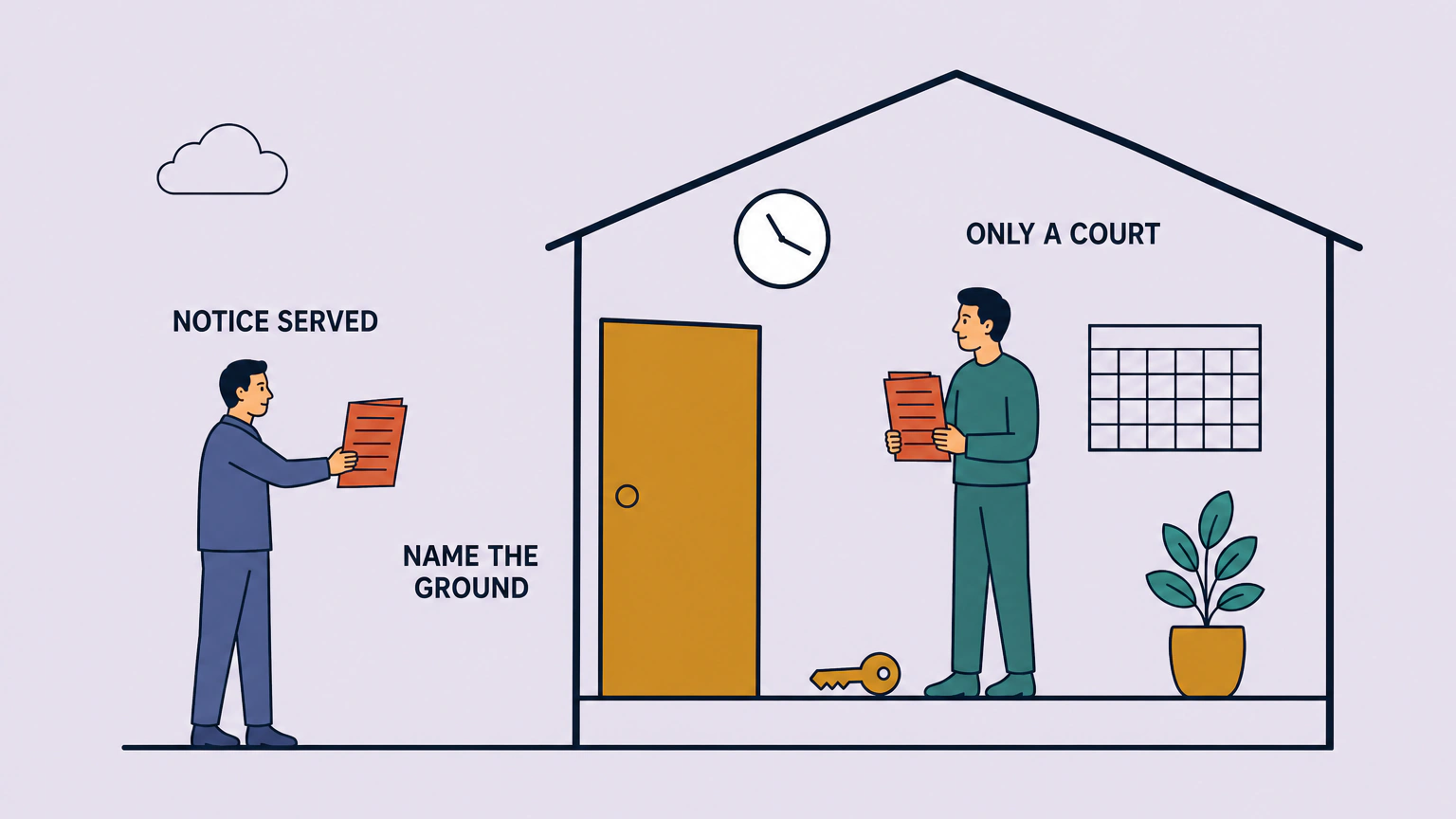
A notice is not an eviction. It's the opening move in a process that runs through a county court, and only a judge can order you out. You don't have to leave on the date the notice names, and staying past it is neither a crime nor a breach of your tenancy.
That is the shape of the eviction notice period rules in England. Wales, Scotland and Northern Ireland run separate systems, with their own tenancy types and notice periods.
What actually changed on 1 May 2026
Almost everything a private tenant was told about eviction before then is out of date, and so is much of what's still published about it. Three changes do the heavy lifting.
Section 21 is gone for private tenancies in England
Section 21 was the no-fault route: two months' notice, no reason given, and a court with almost no room to refuse. The Renters' Rights Act 2025 switched off the whole chapter of the Housing Act 1988 that contained it, for private assured tenancies, on 1 May 2026. GOV.UK's guidance for tenants puts it flatly: "From 1 May 2026 you can no longer be evicted using the 'no fault' section 21 process, even if your tenancy agreement says you can."
Every new possession notice against a private tenant now runs on a numbered ground under section 8. A section 21 or old-rule section 8 claim preserved by the transitional rules can still continue. Assured tenancies of social housing let by private registered providers also remain under the old rules, and the government says the changes won't reach them until 2027 at the earliest.
Your tenancy is periodic now, whatever your old contract said
For tenancies under the new rules, fixed terms have stopped working. A term that fixes an end date now has no effect, and the tenancy runs as a rolling periodic one instead, with periods matching your rent periods. Most existing assured shorthold tenancies converted automatically on 1 May 2026. So if you've been hunting your agreement for an end date, check whether the new rules apply before relying on it.
This part is squarely in your favour. You can end the tenancy yourself on at least two months' notice in writing, and you don't need a reason either. Your landlord can agree to accept less, though that agreement has to be written down, and on a joint tenancy it needs all of you. One thing to watch if you share: a notice given by only one joint tenant still ends the tenancy for everyone.
A notice is not an eviction
Four things have to happen before anybody can make you leave, and a notice is only the first.
- The notice. Your landlord serves a section 8 notice naming a ground and giving particulars of why it applies.
- Expiry. The notice period runs out. Nothing happens automatically on that date, and the tenancy continues.
- The court claim. Your landlord applies to the county court for a possession order. They have twelve months from serving the notice to do it, and after that the notice is spent.
- Enforcement. If a judge makes an order and you still haven't left, a county court bailiff or a High Court enforcement officer carries it out. The tenancy ends when the order is executed.
A landlord who skips those stages and changes the locks is committing a criminal offence under the Protection from Eviction Act 1977, and so is one who makes your life unbearable to push you out. If papers have arrived from the court rather than from your landlord, you're past the notice stage and into a civil claim, which is where civil litigation solicitors start to earn their keep.
Red flag: Four things mean something has gone wrong today, not in four months. Locks changed or your belongings moved while you were out. A demand to leave made only by text or face to face. A notice that names no ground at all. Pressure to sign anything that hands the tenancy back. In every one of those cases, don't leave, and ring your council's out-of-hours homelessness line the same day.
Every notice period, by the reason your landlord gives
Find the ground number printed on your notice, then read across. These periods apply to private-landlord notices served on or after 1 May 2026. An earlier notice may still run under the old rules. The ground also tells you whether the judge has a choice.
| Ground | What your landlord has to be claiming | Notice you must be given | Does the court have to order possession? |
|---|---|---|---|
| 1 | They, or a close family member, will live there as their only or main home | 4 months | Yes, mandatory |
| 1A | They intend to sell or grant a long lease, unless yours is a legacy assured tenancy | 4 months | Yes, mandatory |
| 2 | A lender is repossessing and needs the property empty in order to sell it | 4 months | Yes, mandatory |
| 4A | Student let in an HMO, ending with the academic year | 4 months | Yes, mandatory |
| 6 | Demolition or substantial redevelopment that cannot be done around you | 4 months | Yes, mandatory |
| 7 | The tenancy passed to you under a will or intestacy, usually where you did not already live there | 2 months | Yes, mandatory |
| 9 | Suitable alternative accommodation is available for you | 2 months | No, discretionary |
| 8 | Serious arrears: 3 months unpaid if you pay monthly, 13 weeks if weekly or fortnightly | 4 weeks | Yes, mandatory |
| 10 | Some rent was unpaid when the notice was served and when the claim began | 4 weeks | No, discretionary |
| 11 | You have persistently paid late, whether or not you owe anything now | 4 weeks | No, discretionary |
| 12 | You have broken a term of the tenancy other than paying rent | 2 weeks | No, discretionary |
| 14 | Nuisance or anti-social behaviour by you, a resident or a visitor | None, court straight away | No, discretionary |
| 7A | Serious anti-social behaviour proved by a conviction or a court finding | None, court straight away | Yes, mandatory |
Schedule 2 carries other grounds, mostly for agricultural, supported and social housing lets. Whatever number your notice gives, it should still say what that ground is.
The four month grounds: selling, moving in, the lender, redevelopment
These grounds carry the longest notice periods in the table. Ground 1 covers a landlord who wants the property as a home for themselves, their partner, a parent, grandparent, sibling, child or grandchild, or their partner's child or grandchild. Ground 1A covers a genuine intention to sell, or to grant a lease of more than 21 years. It is unavailable if the tenancy was entered into before 1 May 2026 and was not an assured shorthold tenancy immediately before that date. Ground 2 belongs to a lender repossessing and needing the place empty to sell it. Ground 6 covers demolition or works too substantial to carry out around you.
"Mandatory" is the word doing the damage. If your landlord proves the ground and clears any other legal bars, the judge has to make a possession order. Deposit-protection failures can still block most grounds. That doesn't make the ground true. Relying on a ground your landlord doesn't reasonably believe can succeed is itself unlawful. So the argument on these four is rarely about reasonableness. It's about whether the ground is genuine and whether the notice and claim meet the other legal requirements.
The four week grounds: serious arrears and the rest
Rent arrears run on four weeks' notice, and three grounds cover them. Ground 8 is the serious one and it is mandatory. Grounds 10 and 11 sit in the discretionary half of Schedule 2: Ground 10 for rent unpaid when the notice was served and still unpaid when the claim began, Ground 11 for a pattern of paying late even if you're square today.
That split creates two very different hearings. On Ground 8, the arrears must be at the threshold on both dates and the ground is mandatory. On Grounds 10 and 11, an order follows only if the judge thinks it reasonable, so the court can weigh circumstances beyond the arrears. A landlord can name all three at once, so read your notice to see which one is carrying the claim.
The two week grounds, and the two with no waiting period
Two weeks is the period for breaking a term of the tenancy other than rent (Ground 12) and for letting the property deteriorate through neglect or damage (Ground 13). Both are discretionary.
Grounds 14 and 7A work differently. Your landlord still has to serve a section 8 notice naming the ground, but the notice can name the day it is served, so a court claim can start immediately. Ground 7A is mandatory and needs something already proved elsewhere: a relevant conviction, a court finding that an injunction was breached, or a closure order. Ground 14 is the discretionary anti-social behaviour ground, and it makes the court weigh named factors. The effect the nuisance has had on other people, and any continuing effect it is likely to have. What would happen if the conduct were repeated, and whether you have co-operated with your landlord's attempts to get it stopped. In a house in multiple occupation the court has to pay particular attention to the people you share with.
The twelve month rule, and the date that counts
Grounds 1 and 1A usually protect your first year. Ground 1A has a narrow exception where the property is subject to compulsory acquisition. The statute tests the first-year rule against the relevant date in the notice, not the service date.
Why the date in the notice is the date that counts
The statutory condition is that your tenancy began at least one year before "the relevant date". And Schedule 2 defines the relevant date, for these grounds, as the date specified in the notice, not the day the notice was served.
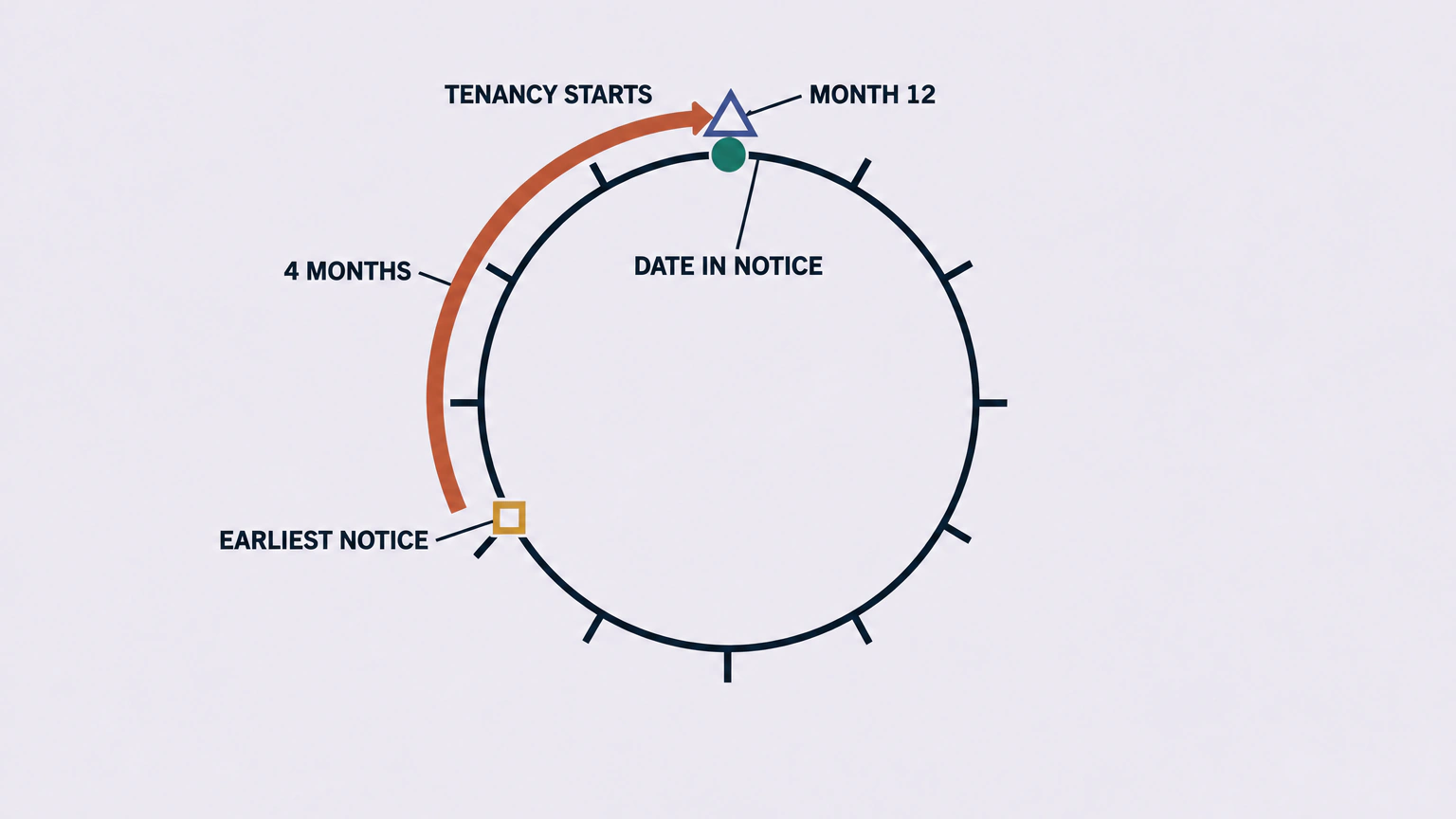
Work it through. Your tenancy started on 15 January. In the middle of September your landlord serves a notice on Ground 1A naming 15 January the following year as the earliest date they can go to court. Four months from mid September lands on that date, and so does your first anniversary. The notice arrived inside your first year, and it is still lawful, because the date it names is not before your first anniversary.
For the first-year rule, check the date printed inside as the earliest date proceedings can begin. If that date falls before your tenancy's first anniversary, Ground 1 fails and Ground 1A usually does too. The service date still matters because the notice must give you the full four months. A notice served in month eight is not automatically void, so don't let that assumption cost you time to prepare.
Redevelopment has a six month rule, not a twelve month one
Ground 6, the redevelopment ground, usually carries a shorter version of the same protection. The tenancy normally has to have begun at least six months before the relevant date, not twelve. A compulsory-acquisition route is an exception. If your notice claims demolition or major works, check the six-month condition rather than assuming it runs for twelve months.
If your landlord says they are selling or moving in
If selling or moving in is the reason on your notice, the law follows your landlord after you've gone.
They cannot re-let it, and they cannot even advertise it
Once a landlord relies on Ground 1 or 1A, a restricted period starts running. It begins when the notice is served and usually ends twelve months after the earliest date stated for proceedings on Ground 1 or 1A. On a notice that gives the four-month minimum, that is roughly sixteen months from service. A possession order made on another ground ends the restriction early.
During that window the landlord must not let the property on a tenancy of 21 years or less, and must not allow anyone to occupy it under a licence for money. Nor may they market it for either, or authorise an agent to do so. Advertising alone breaks the rule, which is what makes it checkable from your phone.
The exceptions are narrow. On Ground 1, the family member named in the ground can move in. On Ground 1A, the buyer can be let in under a licence in anticipation of the purchase, and there's a further carve-out for shared owners. Outside those, breaking the ban is a criminal offence, and your council can impose a financial penalty of up to £40,000 instead of prosecuting.
What to do if your old flat reappears on a letting site
Screenshot the listing with the date visible, and capture the whole page rather than the photograph. Note the address, the asking rent and the agent's name, and check whether it went up inside the restricted period. Keep your copy of the notice, because the date printed in it fixes when that period ends.
Then report it to the private sector housing team at the council for the area the property is in, not the council where you now live. Be clear with yourself about what they can do: investigate, fine and prosecute, none of which gives you your old home back. What it does is turn a suspicion into a formal record, and that record can matter if you're also asking a council for homelessness help.
Serious rent arrears: the threshold moved, and Universal Credit is discounted
Under the old rules, Ground 8 could bite at two months' arrears for monthly rent and eight weeks for weekly rent. For private-landlord notices served on or after 1 May 2026, it takes three months' unpaid rent if you pay monthly, or thirteen weeks if you pay weekly or fortnightly. That gives you more time to bring the arrears below the threshold.
The arrears also have to be at that level twice: on the day the notice was served, and again on the day of the hearing.
Then the clause that deserves its own paragraph. If you get help with housing costs through Universal Credit, any arrears that exist only because that payment hasn't reached you yet are ignored when the total is counted. A delayed payment is not your debt for this purpose. Bring evidence of the delayed payment to the hearing.
Put those together and there's a practical move. Paying the balance below the threshold before the hearing can defeat Ground 8. Your landlord might still rely on Grounds 10 and 11 if they were named, or ask the court to add them. Those grounds are discretionary, so your circumstances can count. It isn't a guarantee, but it can turn a mandatory arrears case into a discretionary one.
Check the notice before you do anything else
A defect in the notice is worth finding early. Some defects can stop a claim, while a judge can overlook missing notice on some grounds. If the landlord must serve a fresh notice, the clock starts again.
- Is it in writing, on Form 3A or on another form that has substantially the same effect? An oral demand to leave is not a section 8 notice.
- Does it name a ground, by number or by wording, and does it give particulars of why that ground applies?
- Is the date it names at least as far ahead as the table above requires for that ground?
- If the ground is 1 or 1A, is the date it names at least twelve months after your tenancy began, unless the notice explains a Ground 1A compulsory-acquisition exception?
- If the ground is 8, do you actually owe three months' rent, or thirteen weeks if you pay weekly, ignoring anything unpaid only because a Universal Credit housing payment has not arrived?
- Is the notice dated, and is it less than twelve months old? A landlord has twelve months from service to start a court claim.
For a private assured tenancy in England, the government publishes Form 3A, often called a section 8 notice. The rules also allow a form with substantially the same effect. Compare yours with the current GOV.UK form, but don't assume a different layout makes it invalid.
Where to get help, and when it is worth paying for it
Free first, and better than most people expect. Legal aid for possession proceedings isn't means-tested: government-funded advice and representation through the Housing Loss Prevention Advice Service is open to anyone facing possession, from the moment written notice arrives, whatever you earn. On a hearing day, get there half an hour early and ask the usher for the housing adviser. If you may lose your home within 56 days, your council must assess whether it owes you homelessness help. Shelter and Citizens Advice also publish tenant-side guidance on section 8.
Paying someone earns its money in three situations. A defended hearing, where you're contesting the facts. A disrepair counterclaim, where what you're owed offsets what you owe. And any discretionary ground, where the whole argument is about what a judge thinks is reasonable, and somebody who does this weekly will frame it better than you can. If that's where you are, landlord and tenant solicitors are the right speciality, and you can browse solicitors by city in England to find one near your court. We set out how we pick the firms we list on our who we are page.
We are not your solicitor. A possession claim is one of the few things where an hour with one early is usually cheaper than the alternative.
Whoever you instruct, diarise every date they give you. Possession work turns on deadlines. If someone you instruct misses one, our guide explains how to complain about a solicitor. Today's job is smaller: find the ground number on your notice, find the date printed inside it, and check both against the notice period for that ground.
Frequently asked questions
Can my landlord still evict me for no reason?
Not with a new notice. Since 1 May 2026 a private landlord in England normally has to name a legal ground for possession and explain why it applies. A section 21 claim preserved by the transitional rules can still continue.
How long do I have to leave after I get a section 8 notice?
It depends on the ground. Four months for selling, moving in, the lender or redevelopment. Two months for some tenancies inherited under a will, or where suitable alternative accommodation is offered. Four weeks for rent arrears. Two weeks for other breaches. On the anti-social behaviour grounds there is no waiting period before a court claim, but notice is still required.
My landlord says they are selling. Can they do that in my first year?
Usually not. Ground 1A normally requires your tenancy to have begun at least a year before the earliest court date in the notice. A compulsory acquisition is a narrow exception. The notice can arrive earlier, but it must still give you four months. Ground 1A is unavailable if the tenancy began before 1 May 2026 and was already assured rather than assured shorthold.
Does the notice have to say which ground my landlord is using?
Yes. The court can't make a possession order on a ground unless that ground and particulars of it were specified in the notice, though a landlord can ask permission to add or alter grounds later. A notice that just asks you to leave, with no ground and no reasons, isn't a valid section 8 notice.
What happens if I just stay after the notice runs out?
Nothing automatic. Your tenancy continues and so does your rent. Your landlord's next step is to apply to the county court for a possession order, which they have twelve months from serving the notice to do. If an order is made on a mandatory ground, the court can usually give you only fourteen days, or up to six weeks for exceptional hardship.
Is any of this different in Scotland, Wales or Northern Ireland?
Completely different. Wales runs occupation contracts under its own Renting Homes legislation, Scotland runs private residential tenancies, and Northern Ireland keeps a notice to quit system. The grounds, the notice periods and even the name of your agreement change at the border, so none of the England rules carry over. Go to your own nation's housing advice service.