

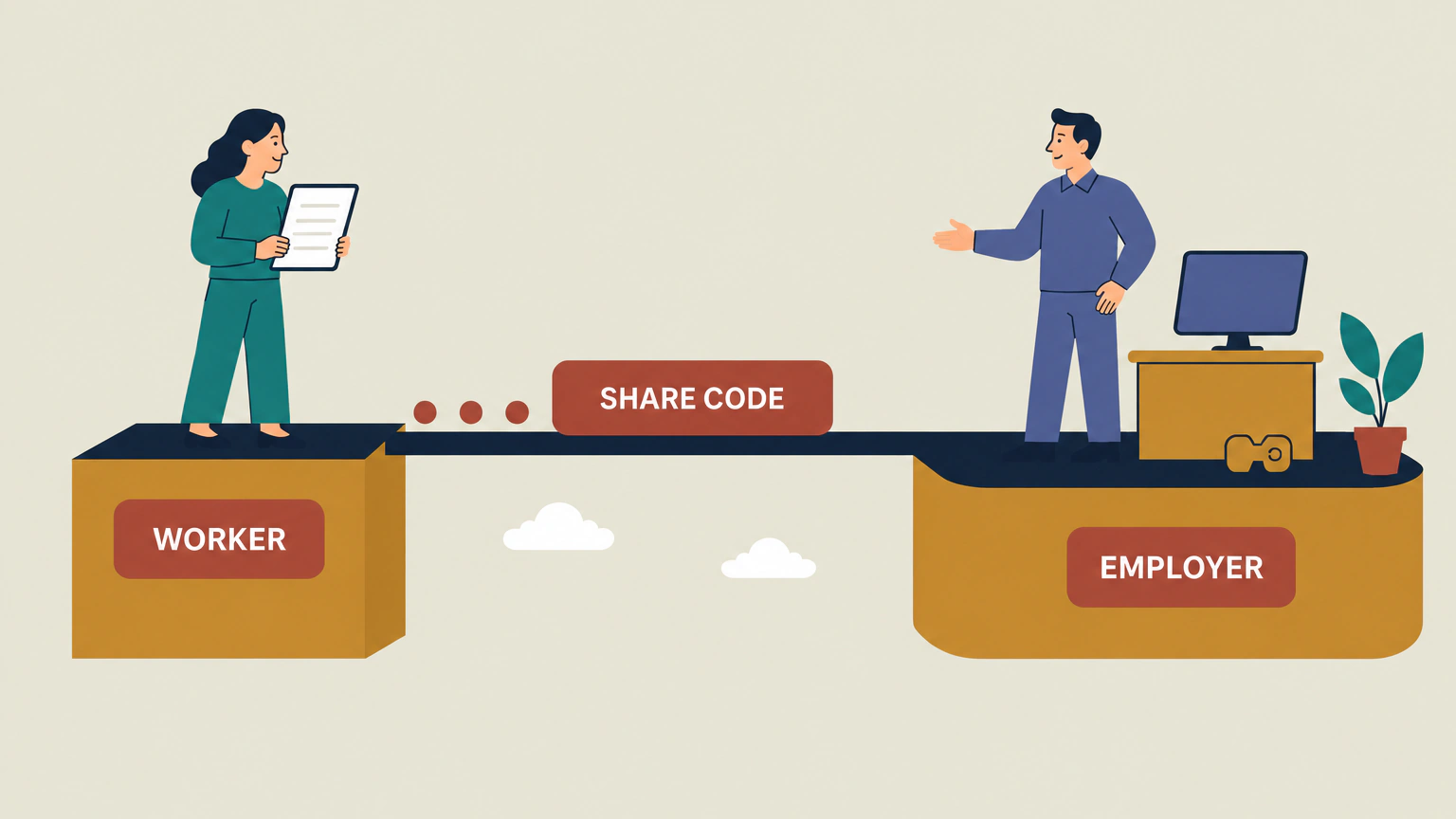
Two people usually run into the share code from opposite ends. One is about to start a job, with a date agreed and an email from HR asking for something they've never heard of. The other runs a small business and can't make a code work.
On this page
- What a share code is, and the letter at the front that decides everything
- How to get your share code
- If you are British or Irish, you usually use documents instead
- What your employer sees, and the check they still have to do
- When there is no share code to give
- What changes on 1 October 2026
- If a job offer is withdrawn because of your documents
- Common questions about right to work share codes
What a share code is, and the letter at the front that decides everything
A share code is nine characters long. You make it yourself from your UK Visas and Immigration account. On its own it does nothing at all. Whoever you hand it to also needs your date of birth before the service will show them anything.
That pairing is deliberate. A code sent to the wrong address is a string of characters, not a leak of your status.
The code also isn't a document. It's a pointer to a live Home Office record. That's why nothing has to be posted, scanned or photocopied, and why an employer on the other side of the country can run the check online.
How long your code lasts, and what happens when it runs out
Your code lasts 90 calendar days from the day it's issued. The employer's guide says you can use it as many times as you need inside that window. One code covers the form, the follow-up email and the meeting where somebody finally opens it.
When it does run out, you make another. GOV.UK says you can get a new code whenever you need one. Don't count the 90 days yourself, though. The service shows you an expiry date, and that's the date that settles arguments.
A code made in June for an application may already have expired by September. Check the date before you send it.
Why a code that starts with R or S will be sent back
The same UKVI account issues share codes for more than one purpose. The letter at the front records which one you picked on the day. Only a code beginning with W proves a right to work.
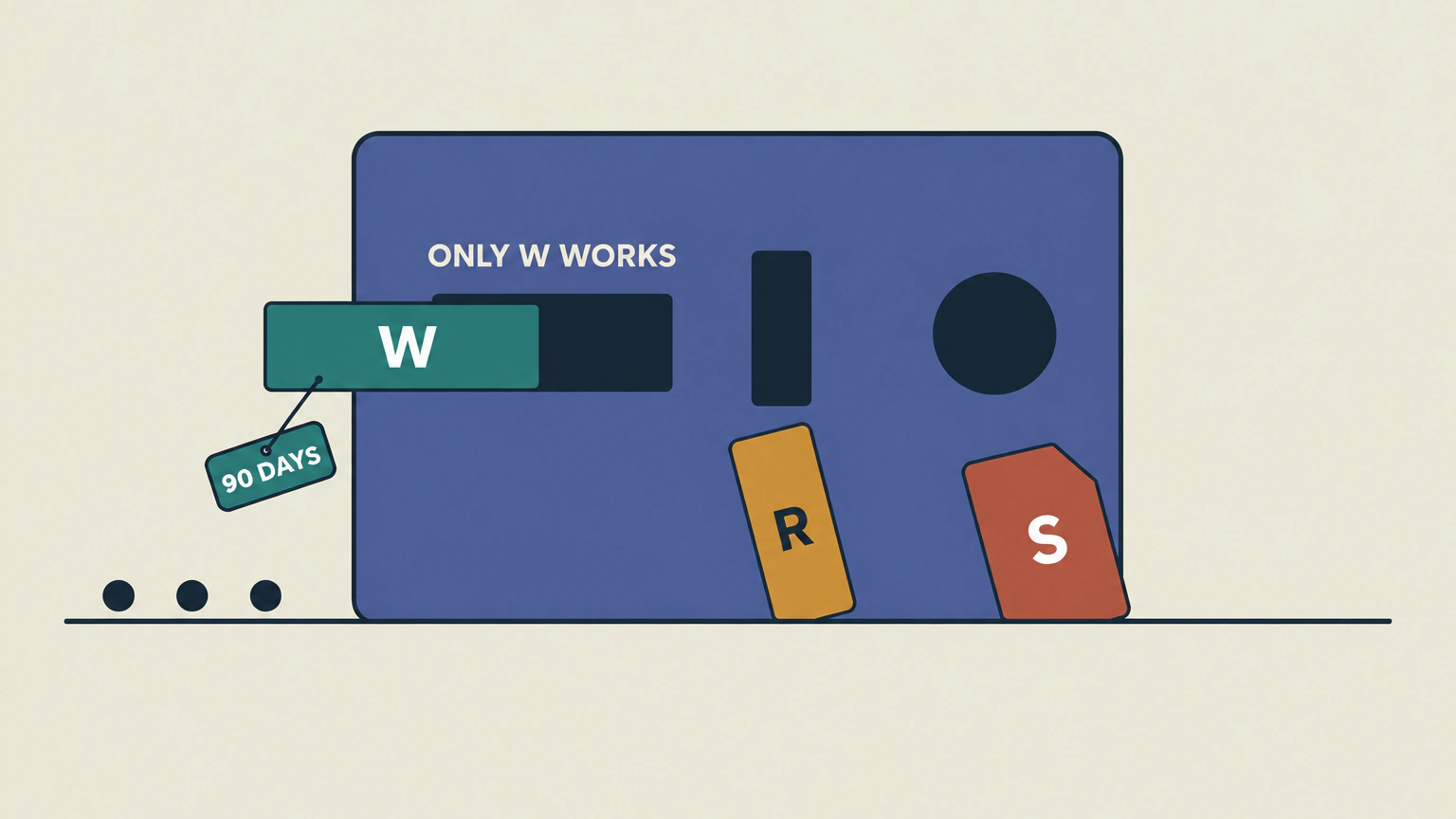
The employer's guide is blunt about it. "You will not be able to accept or use share codes which begin with the letter 'R' or 'S' as these are designed for other services."
The Home Office uses R for right to rent and S for a general immigration status check. Neither works for a right to work check.
The repair is the same whichever wrong letter you're holding. Go back into the service, choose the right to work option, and make a new code.
How to get your share code
You can use the service if you're not a British or Irish citizen. You can also use it if you're a British or Commonwealth citizen with a digital certificate of entitlement, which proves your right of abode.
That second route carries a catch. If your certificate of entitlement is a sticker in your passport rather than a digital one, the service won't make a code. You'd need to apply for the digital certificate first.
To get through the form you'll need either your biometric residence permit number, or your passport or national identity card. You'll also need the phone number or email address you use to sign in. Keep the phone within reach.
Before you send your code, check that:
- The code begins with W, not R and not S.
- The code is nine characters, copied exactly, with no spaces added.
- You generated it yourself from the right to work option, not from another one.
- It is less than 90 days old, and the expiry the service showed you has not passed.
- You have told your employer your date of birth, because the code does nothing without it.
- You have sent them the employer page, not the page you used, because those are different services.
What to do if you cannot get into your UKVI account
Sometimes the problem isn't the code. It's the account. You've changed your phone number, or you've never made an account at all, or the details the Home Office holds don't match the ones you're typing.
There's also a group the system quietly leaves behind. Setting up the account normally means proving who you are with an app on a smartphone. GOV.UK offers another way through for people who can't use one.
Fix the account first, because everything else hangs off it. GOV.UK runs a webchat for eVisa and UKVI account problems. The current employer's guide also publishes a helpline for exactly this, the UKVI Resolution Centre, on 0300 790 6268. If your eVisa loads but won't make a share code, report that as an error rather than trying again.
If you can't get into the account in time, you still have a route. When you hold an eligible immigration document, GOV.UK says you can choose which option you use: "Your employer cannot reject your application because you gave them an eligible immigration document instead of a share code."
One exception catches people out. For 18 months after the expiry date printed on it, an expired biometric residence permit can still get you into the online service. A manual look at that same expired card gives your employer nothing. Where there's no acceptable document at all, your employer goes to the Employer Checking Service instead.
If you are British or Irish, you usually use documents instead
Most British and Irish citizens can't make a share code. A British citizen with a digital certificate of entitlement proving the right of abode is the exception. Everyone else uses the document route.
That means a British passport, or an Irish passport or passport card. It can be current or expired.
A share code and a passport work in opposite directions. The code sends your employer to a live government record. The passport asks them to judge an object in front of them. That distinction travels well past immigration. Whenever somebody's credentials matter, check them on the official register rather than trusting the certificate on the wall.
What you hand over instead
Without a passport there's still a route, and it takes two documents rather than one. The first is a UK or Irish birth or adoption certificate, or a certificate of registration or naturalisation as a British citizen. Alongside it goes an official letter from a previous employer or a government agency showing your name and your National Insurance number. GOV.UK offers HMRC, the Department for Work and Pensions and the Social Security Agency in Northern Ireland as examples. The certificate alone won't do, and neither will the letter.
A third route exists that some employers offer and you can't start yourself: an identity service provider checks your passport on their behalf. Ask whether they use one.
| Your situation | What you give your employer | What your employer has to do next |
|---|---|---|
| British or Irish citizen with a passport or passport card | The passport or passport card. It can be current or expired. | Check it with you present, keep a copy. No repeat check is needed. |
| British or Irish citizen with no passport | A UK or Irish birth or adoption certificate, or a certificate of registration or naturalisation, plus an official letter from a previous employer or a government body showing your name and National Insurance number | Check both documents together. The letter on its own is not enough. |
| You hold an eVisa and can reach your UKVI account | A share code beginning with W, plus your date of birth | Run the check on the employer service. If your permission is time limited, they must check again before it ends. |
| Your biometric residence permit expired within the last 18 months but your permission has not | Your permit number, used to generate a share code online | Run the online check. The expired card on its own is not accepted. |
| You are waiting on an in time application, appeal or administrative review | Tell them, and show whatever the Home Office gave you | Ask the Home Office through the Employer Checking Service and wait for a Positive Verification Notice. |
| You have an Application Registration Card that says work is permitted | The card itself | Ask the Home Office through the Employer Checking Service. The card alone does not give them a defence. |
What your employer sees, and the check they still have to do
Your employer doesn't open the page you opened. They go to a separate GOV.UK service, type in your code and your date of birth, and get a profile page back.
What they see is limited. The service confirms the types of work you're allowed to do and how long you can work in the UK. It shows your photograph, so they can satisfy themselves that you're the person in the record. GOV.UK tells you as much before you make the code: whoever uses it "will see some of your personal details", and you're shown what those are. It isn't your case file or your correspondence with the Home Office.
Once that check clears, you're through the right to work step. The next code you'll have to read correctly is the tax code on your first payslip.
Why watching you open your own eVisa is not enough
A perfectly reasonable employer who has already seen your status on your phone will still ask you for a code. Nobody explains to workers why.
An employer only gets what the law calls a statutory excuse, their defence against a civil penalty, if they run the check themselves. The guide leaves no room for a shortcut: "It is not sufficient to view the details provided by the prospective or existing employee on the migrant part of the service." Reading over your shoulder buys them nothing.
Two more duties follow. They have to check that the photograph on the result is you, in person or by video call. They have to keep a copy of the check while you work there and for two years after you leave.
Their exposure also runs on two separate tracks. One is a civil penalty for each worker. The other, where an employer knew or had reasonable cause to believe, is up to five years in prison and an unlimited fine. Neither track is about suspecting you. Both are what your employer is covering themselves against.
When there is no share code to give
Sometimes the honest answer is that there's no code to send, and the scheme has a route for that. You may be waiting on an in-time application, an appeal or an administrative review. You may hold an Application Registration Card marked to say that work is permitted. You may have arrived here before the late 1980s and have no paperwork for a status you've held for decades. Or the digital route may simply have failed, with a technical fault on your eVisa.
One boundary is worth naming, because we checked the UK scheme rather than its neighbours. Jersey, Guernsey and the Isle of Man run their own. A status letter from one of them sends your employer down the Employer Checking Service route rather than the online one.
In each of these, the next move belongs to your employer. If your permission itself is genuinely in doubt, rather than just your paperwork, that's the moment to speak to an immigration solicitor.
The Employer Checking Service, and why only your employer can use it
You can't ask the Home Office to check your own status through this service. Only your employer can make the request.
They supply your full name, date of birth, nationality, job title, hours worked per week and your home address in the UK. They add their own business name, business type and contact details. They also have to tell you they're doing it. The Home Office "aims to provide a response within five working days of receiving a valid request".
What a Positive Verification Notice actually buys your employer
If the answer comes back positive, your employer gets a Positive Verification Notice. It gives them "a statutory excuse for six months from the date specified in the Notice". A follow-up check has to happen before those six months run out. Which is why somebody in this position gets asked again roughly twice a year. It isn't doubt creeping back in. It's a clock.
One case runs against the grain, and it matters if it's yours. If your employment began before 29 February 2008 and has run without a break ever since, the guide tells employers not to contact the service at all. A Negative Verification Notice there says nothing about your status. It means the employment sits outside the civil penalty scheme.
What changes on 1 October 2026
Until now these rules have been about employment. On 1 October 2026 they reach three further kinds of working arrangement. Section 48 of the Border Security, Asylum and Immigration Act 2025 comes into force that day, and the commencement regulation says so in a line: "Section 48 ... comes into force on 1st October 2026."
| How you work | Covered before 1 October 2026 | Covered from 1 October 2026 |
|---|---|---|
| Employee on a contract of employment | Yes | Yes |
| Worker engaged under a worker's contract rather than a contract of employment | No | Yes |
| Individual sub-contractor, where someone else holds the main contract | No | Yes |
| Listed on an online matching service that charges a fee or commission for matches | No | Yes, and the platform itself is liable |
| Genuinely in business on your own account, working for your own clients | No | No |
One limit matters for anybody already working. For these new arrangements, the draft guidance limits civil penalties to work that started on or after 1 October 2026. Nothing in the change reaches backwards into an engagement you've had for years. If you're a small employer, or you run a platform that matches people with customers, this is the month to take advice from a business solicitor rather than the month after.
What it means if you deliver, drive or subcontract
Three groups should expect a question they've never been asked. People who pick up work through a platform that charges a fee or commission for matches. Individual sub-contractors working under somebody else's main contract. And anyone engaged under a worker's contract rather than a contract of employment.
The carve-out is real, and narrower than it looks. If you're genuinely in business on your own account, and the other party is a client or customer of that business, you're outside the scheme.
Two practical points. First, substitution is squarely in scope. Who actually turns up to do the job matters: the draft guidance puts the employer on the hook where the contract lets one person send somebody else in their place. Second, if you're going to need a code, make it before the date rather than after. A code made now still has most of its 90 days left when the rules change.
If a job offer is withdrawn because of your documents
This part is unfair, and you're right to be angry about it. An employer running these checks must not treat one nationality differently from another. The Home Office publishes a statutory code of practice on avoiding unlawful discrimination while preventing illegal working, and it spells out what that means day to day. An employer can't make digital evidence a condition of the job and then refuse a manual check for somebody without it.
Four things an employer must not do
- Insist on a share code from a British or Irish citizen who offers an accepted document instead.
- Refuse valid original immigration documents because they would rather have a code.
- Treat applicants of one nationality differently from another when running these checks.
- Check only people who look or sound as though they may be migrants.
If you were treated differently because of race, nationality or another protected characteristic, you may have a discrimination claim. It goes to an employment tribunal in Great Britain, or an industrial tribunal in Northern Ireland. Where a claim is upheld, the code says the tribunal will normally order the employer to pay compensation, "for which there is no upper limit". A discrimination solicitor can tell you whether what happened crosses the line, and an employment solicitor can tell you what a withdrawn offer is worth.
This is general information about how these checks work, not advice about your own status. If your permission to be in the UK is in any doubt, speak to a regulated immigration adviser or solicitor first.
Common questions about right to work share codes
How long does a right to work share code last?
90 calendar days from the moment it's issued. Inside that window you can use the same code as many times as you need, and you can make a new one afterwards. Read the expiry date the service shows you rather than counting days yourself. Don't reuse a code you made for another purpose, because it won't work for a right to work check.
Can a British citizen get a right to work share code?
Yes, but only in one narrow case. A British citizen with a digital certificate of entitlement proving the right of abode can use the service. Most British citizens use a current or expired passport instead. Without a passport, a UK birth or adoption certificate or a certificate of naturalisation will do, plus an official letter showing your name and National Insurance number.
Do I have to pay for a share code?
You do not need to pay to set up a UKVI account or access your eVisa. You make the code yourself through the GOV.UK service, and your employer runs its own check on a separate page.
What do I do if my share code has expired?
Make a new one from the same GOV.UK service, using the same UKVI account. You can get a new code whenever you need one. An expired code is an inconvenience rather than a crisis. Send the new code to your employer along with your date of birth, and check the first character is still W before you press send.
My share code starts with S. Can my employer use it?
No. Only a code beginning with W proves a right to work. The Home Office tells employers they can't accept or use one beginning with R or S, because those were built for other services. It says nothing bad about your status. Go back into the service, choose the right to work option, and make a fresh code with the right letter at the front.
Can I ask the Home Office to check my own status?
Not through the Employer Checking Service. Only the employer can make that request, supplying your details and their own business details, and they must tell you they're doing it. The Home Office aims to answer within five working days. What you can do is view your eVisa in your UKVI account, and report an error if what it shows about you is wrong.