

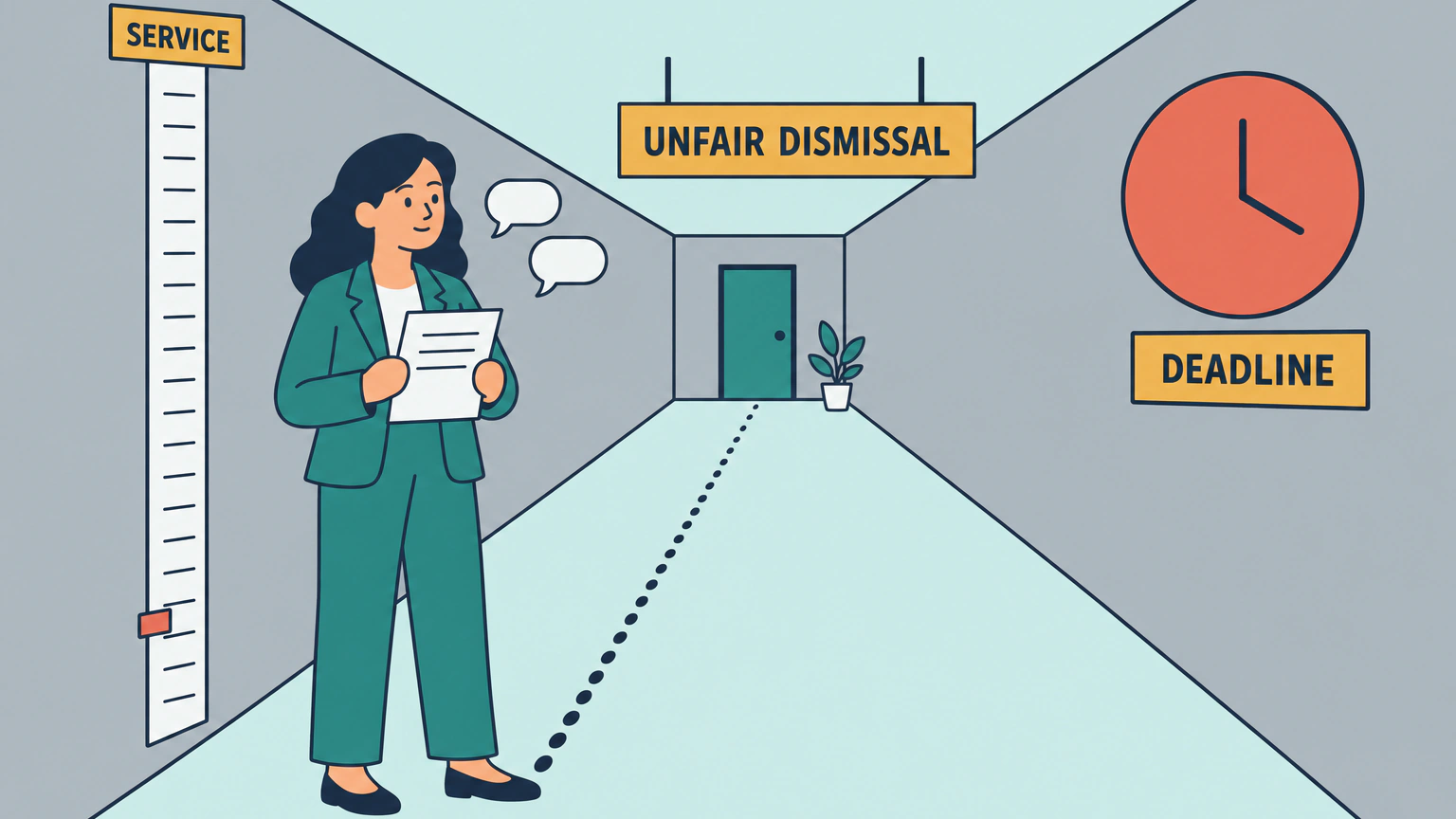
In England, Scotland and Wales you can usually claim unfair dismissal once you've worked for your employer for two years, or for six months if your job ends on or after 1 January 2027, and some reasons, such as whistleblowing or pregnancy, need no service at all. You must contact Acas within three months less a day of the day your job ends, or six months less a day if it ends on or after 1 October 2026. Northern Ireland keeps a one-year rule and three months.
Those dates decide almost everything else: your exact deadline, what a claim could be worth, and what you should do this week.
On this page
Can you claim? Three things decide it
Were you an employee?
Only employees can bring an unfair dismissal claim. GOV.UK's rule starts with "You must be classed as an employee". Workers, the self-employed and agency temps on a contract for services are shut out of this one, although a worker can still have a discrimination or pay claim.
A quick test helps. An employment contract, tax taken through PAYE, set hours and paid holiday usually mean you're an employee. The label on your contract isn't the last word, though, and an adviser can check it if you're unsure.
Being dismissed also covers more than being sacked. It includes being made redundant, having a fixed-term contract not renewed, and resigning because your employer seriously broke your contract.
How long you'd worked there when the job ended
For an ordinary claim you need two years' continuous service if your job ends before 1 January 2027. If it ends on or after that date, six months is enough.
The date that matters is what the law calls the effective date of termination. In plain words, it's the last day of your notice if you worked it or were sent home during it. If you were told to go straight away, it's that day, even if you were paid in lieu of notice.
Two details settle a lot of borderline cases. First, the day your job ends decides which rule you get, not the day you were told. Someone given four weeks' notice on 10 December 2026, ending on 7 January 2027, gets the six-month rule. And someone who started on 2 July 2026 and is still employed on 1 January 2027 has six months' service that day.
Second, if your employer ended your job with less than the week's notice the law requires, that week is added back when your service is counted. That can carry someone who is just short over the line.
Northern Ireland works on one year, and that isn't changing.
| Where you work | Job ends before 1 January 2027 | Job ends on or after 1 January 2027 |
|---|---|---|
| England, Scotland or Wales | 2 years | 6 months |
| Northern Ireland | 1 year | 1 year |
| Any reason on the automatically unfair list | None | None |
Your job 'ends' on the last day of your notice, or the day you were told to go if you left straight away.
The reasons that need no service at all
Some reasons are so plainly wrong that the law protects you from your first day. If the main reason for your dismissal is one of them, you can claim however long you've worked there. It's often called automatic unfair dismissal. And the reason your employer writes in the letter isn't the end of it. A tribunal looks at the real reason.
Two other claims need no service. Discrimination because of a protected characteristic, such as race, sex, disability or pregnancy, is a separate claim under the Equality Act 2010, and discrimination solicitors deal with exactly this. Wrongful dismissal, which is usually about notice pay you didn't get, doesn't need service either.
The 2025 Act adds more day-one reasons, including dismissal for refusing certain changes to your contract. Those aren't switched on yet.
You can claim from your first day if the main reason you were dismissed was that you:
- were pregnant, or took or asked for maternity, paternity, adoption, shared parental, parental or carer's leave, or time off for a dependant
- raised a health and safety concern, acted as a safety representative, or left a workplace you reasonably believed was in serious and imminent danger
- blew the whistle by making a protected disclosure about wrongdoing
- complained in good faith that your employer had broken one of your legal employment rights, such as unlawful deductions from your pay, whether or not you turned out to be right
- refused to give up a working time right, such as rest breaks or paid holiday, or refused to break the Working Time Regulations
- insisted on being paid at least the minimum wage
- asked for flexible working
- joined or were active in a trade union at an appropriate time, or refused to join one
- were summoned for jury service or went to serve. This protection can fail if, after your employer warns that your absence is likely to seriously harm the business, you unreasonably refuse or fail to ask for excusal or deferral
- held particular political opinions or affiliations
The full list is longer. From 1 January 2027 a spent conviction joins it.
How a tribunal decides whether it was fair
The reason your employer has to prove
Once you have the service, the burden starts with your employer. It has to show why it dismissed you, and that the reason is one the law treats as potentially fair. There are five:
- capability or qualifications, which usually means performance or health
- conduct, meaning misconduct
- redundancy, where the job has genuinely gone
- a legal bar, such as losing a driving licence the job needs
- "some other substantial reason", a reason of real weight that fits none of the others
A fair reason only gets your employer halfway. The tribunal then asks whether dismissing you was reasonable, bearing in mind how big your employer is and what resources it has.
That's why being dismissed "for no reason" is a real problem for an employer once you've got the service, and why your first practical move is to ask for the reasons in writing.
Whether they went about it fairly
For conduct and performance dismissals, tribunals judge the process against the Acas Code of Practice on disciplinary and grievance procedures. It doesn't cover redundancy, or a fixed-term contract simply running out.
Breaking the Code isn't a claim on its own. The Code says so itself: "A failure to follow the Code does not, in itself, make a person or organisation liable to proceedings." So if you're short of the service, a sloppy process won't get you to a tribunal by itself.
If you do win, the Code has teeth. The tribunal can raise your award by up to 25% if your employer unreasonably ignored it. It can also cut your award by up to 25% if you unreasonably ignored it yourself, for example by skipping an appeal you were offered.
Gross misconduct can justify dismissal without notice for a first offence. The Code still insists that "a fair disciplinary process should always be followed, before dismissing for gross misconduct." A dismissal with no process at all is very hard for an employer to defend.
For a conduct or performance dismissal, check whether your employer:
- looked into what happened before deciding anything
- told you in writing what the problem was, with enough detail for you to answer it
- held a meeting, went through the evidence, and let you give your side
- let you bring a colleague or a trade union representative to that meeting
- usually gave you a written warning first, unless it was gross misconduct
- gave you the decision in writing and offered an appeal, heard where possible by someone not involved before
Your deadline, and the Acas step that pauses it
Three months less a day, or six
The unfair dismissal time limit starts on the day your job ends, and your claim has to reach the tribunal before that period runs out. If your job ends before 1 October 2026, that period is three months. If it ends on or after 1 October 2026, it's six months. The trigger is the day the job ends, not the day you were told.
Acas gives this method: "add on 3 calendar months then take off 1 day." Use six months where the new rule applies. If the later month has no matching day, use its last day instead. A job ending on 15 September 2026 gives you until 14 December 2026. One ending on 15 October 2026 gives you until 14 April 2027.
One thing catches people out. Acas is blunt about it: "Going through grievance, disciplinary or appeal procedures does not change your time limit." Your appeal can carry on, and so does the clock.
Northern Ireland stays at three months less a day.
| Where you work | Job ends before 1 October 2026 | Job ends on or after 1 October 2026 |
|---|---|---|
| England, Scotland or Wales | 3 months less a day | 6 months less a day |
| Northern Ireland | 3 months less a day | 3 months less a day |
| Interim relief for whistleblowing and some other reasons, England, Scotland or Wales | 7 days | 7 days |
How early conciliation stops the clock
Before you can file a claim, you have to tell Acas and get an early conciliation certificate. Conciliation is free. A conciliator talks to you and your employer separately to see whether you can settle, and the process can last up to 12 weeks. That's been the limit for anyone who contacted Acas from 1 December 2025, so a guide that still says six weeks is out of date.
While conciliation runs, your clock stops. It stops from the day after you contact Acas until the day you get your certificate. If your deadline would then fall inside that stretch, or within a month after the certificate, you get until one month after the certificate instead.
Here's how that works with real dates. Your job ends on 20 October 2026, so six months less a day runs out on 19 April 2027. You contact Acas on 5 November 2026 and receive your certificate on 10 December 2026, so the 35 days from 6 November to 10 December don't count, and your deadline moves to 24 May 2027.
The certificate number goes on the ET1, the tribunal's claim form. Acas itself admits that "Working out the exact time limit can be complicated." Put your own dates in and the sums are done for you.
Red flag: Don't wait for your appeal. Your employer's appeal, grievance or disciplinary process doesn't pause the tribunal clock. Contact Acas inside your time limit even if the appeal is still running, and carry on with both.
Work out your deadline
Put in your own dates. It works out the rule that applies to you, adds any time your clock was paused, and tells you whether your service is enough for an ordinary claim.
Your deadline and your service rule both depend on the day your job ends. In England, Scotland and Wales, if it ends before 1 October 2026 you have three months less a day to contact Acas, and from 1 October 2026 six months less a day. You need two years' service if it ends before 1 January 2027, and six months if it ends on or after that date. In Northern Ireland it's one year's service and three months less a day. Early conciliation pauses the clock, and you always get at least a month after your certificate.
Your first day working for this employer.
If you worked your notice or were sent home during it, it's the last day of the notice. If you were told to go straight away, even with pay in lieu, it's the day you were told.
That date has already passed. Speak to an adviser today.
You don't need any service if the main reason was on the automatically unfair list, and discrimination and wrongful dismissal claims don't need it either.
If your job had ended on or after 1 January 2027, six months would have been enough.
Your job ends in the last week of 2026. If you got less than a week's notice, the week the law adds could take your end date into 2027, when six months is enough. Ask an adviser about this quickly.
Dismissed for whistleblowing, trade union reasons or as a health and safety or employee representative? You can ask the tribunal for interim relief, but only within 7 days of your job ending.
This works out ordinary unfair dismissal only. Other claims, like discrimination or unpaid notice, can have different deadlines.
If you've missed it, or it's urgent
Miss the deadline and a tribunal can still accept your claim, but only in a narrow case. You'd have to show it wasn't "reasonably practicable" to claim in time, and then claim within a reasonable further period. Treat that as a door that's usually shut, not a plan.
Some cases are urgent in the other direction. If you were dismissed for whistleblowing, for trade union reasons, or for acting as a health and safety or employee representative, you can ask the tribunal for interim relief. That can keep your contract running until the case is decided. But the application must reach the tribunal within 7 days of your job ending. Acas says you might not need to contact it first for this one.
We're not your lawyer, and a deadline is the one thing in this process you can't get back. If your dates are close or your reason is complicated, an employment solicitor or Citizens Advice can check them quickly. If you'd like to know who's behind these dates first, here's how we work.
What an unfair dismissal claim is worth
A tribunal can order your employer to take you back, but that's rare in practice. So most claims are about money, and it comes in two parts.
The basic award
The basic award is worked out exactly like statutory redundancy pay. It uses your age, your years of service up to 20, and a week's pay capped at £751. That puts the most it can be at £22,530. The age bands are the same ones in our guide to how redundancy pay is worked out, so you can run your own figure there.
If you've already had a redundancy payment for the same dismissal, it comes off the basic award. Some reasons carry a floor, too. If you were dismissed for acting as a health and safety, working time or employee representative, as a pension trustee, or for trade union reasons, the basic award can't be less than £9,157.
The compensatory award, and what can shrink it
The compensatory award is where the real money sits. The law tells the tribunal to award what it considers "just and equitable in all the circumstances" for the loss the dismissal caused you. That covers lost pay up to the hearing and a sensible estimate after it, lost pension contributions and benefits, and reasonable costs of looking for work.
Four things can shrink it:
- not looking for work, because you're expected to keep your loss down
- your own conduct, if it helped cause the dismissal
- the Acas Code adjustment, which can cut an award as well as raise it
- the chance that a fair process would have ended in dismissal anyway, which cuts the award by that percentage (lawyers call it a Polkey deduction, after a 1987 House of Lords case)
Then the reality check. In 2023/24, tribunals reported 646 unfair dismissal awards, and the median was £6,746, according to the Department for Business and Trade. Plenty of claims never reach a hearing. They settle through Acas or in a settlement agreement, which can include a contribution towards your independent advice. A tribunal hearing is held in public, and a settlement can cover more than money.
The cap, and why it's coming off
Until 1 January 2027, the compensatory award in England, Scotland and Wales can't be more than £123,543 or 52 weeks' gross pay, whichever is lower. For jobs that ended before 6 April 2026 the figure was £118,223. Dismissals for whistleblowing or a health and safety reason aren't capped at all.
Unless you earn more than about £2,376 a week, the 52 weeks is the limit that bites. On £700 a week, the limit is 52 × £700 = £36,400. On £2,500 a week, 52 weeks comes to £130,000, so £123,543 is the figure that applies.
For jobs ending on or after 1 January 2027, the cap goes entirely. Be clear about what that means. The tribunal still only awards what you can show you lost, and the government's own factsheet says few awards reach the current cap anyway. The £751 ceiling on the basic award is a different limit, and it stays.
| When your job ends, and where | Most the compensatory award can be |
|---|---|
| 6 April 2026 to 31 December 2026, England, Scotland or Wales | £123,543 or 52 weeks' gross pay, whichever is lower |
| On or after 1 January 2027, England, Scotland or Wales | No limit |
| Dismissed for whistleblowing or a health and safety reason, England, Scotland or Wales | No limit |
| On or after 6 April 2026, Northern Ireland | £123,785 |
What changes on 1 October and 1 January
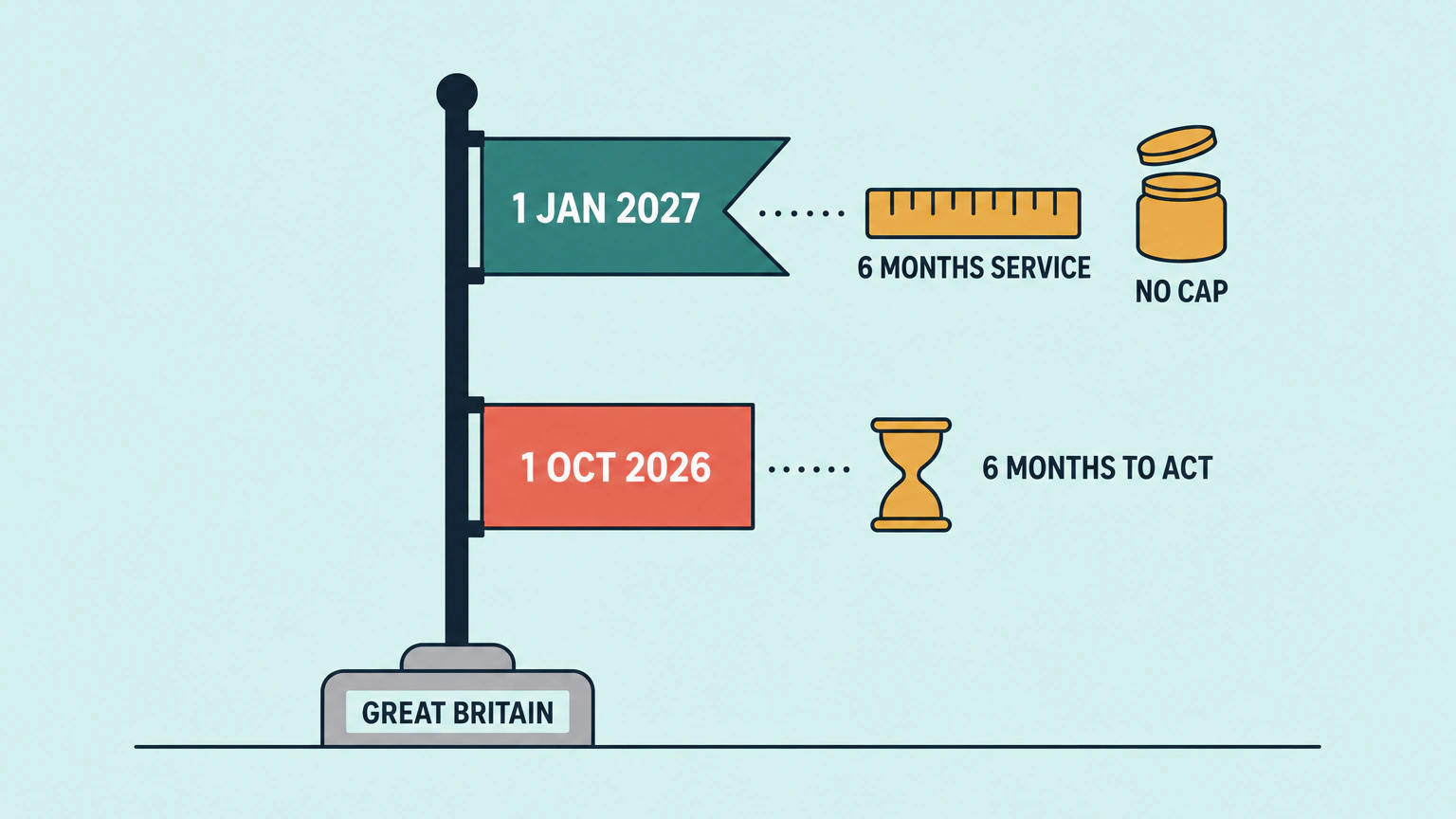
If you came here from the news, here's the short version. From 1 October 2026, a job ending on or after that date gets six months less a day to start a claim, not three. From 1 January 2027, a job ending on or after that date needs six months' service instead of two years, and the cap on the compensatory award goes, even if your notice was handed to you in 2026. The right to written reasons for your dismissal moves from two years' service to six months on the same day. A spent conviction also joins the list of reasons that need no service at all.
Plenty stays exactly as it is. The fairness test is the same, the basic award is the same, and only employees can claim. The changes apply in England, Scotland and Wales only.
If you work in Northern Ireland
Northern Ireland has its own law, and none of the 2025 Act's changes reach it. You need one year's service for an ordinary claim. The time limit is three months less a day, with no October change. Early conciliation goes through the Labour Relations Agency rather than Acas, and it pauses the clock in exactly the same way, including the one-month minimum after your certificate. Claims are heard by industrial tribunals.
The money limits differ as well. The compensatory award is capped at £123,785, with no 52-week alternative. A week's pay for the basic award is capped at £783, which puts the most a basic award can be at 30 × £783 = £23,490.
Choose Northern Ireland in the deadline calculator and it switches to these rules. For help close to home, start with solicitors in Northern Ireland.
What to do this week
The anger is fair, but the next few days are about dates and paper. None of these steps commits you to a claim. Each one protects the claim you might want to make later.
- Write down three dates: the day you started, the day you were told, and the day your job ended or will end.
- Ask your employer in writing for the reasons you were dismissed. With two years' service (six months if your job ends on or after 1 January 2027) they must reply within 14 days, and if you were pregnant or on maternity or adoption leave you should get them without asking.
- Appeal through your employer's process if one is offered, and set out your grounds in writing.
- Contact Acas, or the Labour Relations Agency in Northern Ireland, well inside your time limit, even if the appeal hasn't finished.
- Keep copies of your contract, staff handbook, letters, emails, payslips and any notes of meetings.
- Look for work and keep a record of every application, because a tribunal expects you to try.
- List what you've lost: pay, pension contributions, benefits such as a company car, and the costs of job hunting.
- Get advice: your union, Citizens Advice, a law centre, or an employment solicitor. If you're paying, check what a solicitor charges before you book.
Common questions about unfair dismissal
Can I claim unfair dismissal with less than two years' service?
Not for an ordinary claim if your job ends before 1 January 2027 in England, Scotland or Wales. If it ends on or after that date, six months is enough, even if you were told in 2026. Whatever your service, you can claim if the main reason was on the automatically unfair list. Discrimination and wrongful dismissal claims don't need any service either.
Can I claim unfair dismissal while I'm on probation?
Probation doesn't change your rights either way. Citizens Advice puts it plainly: "Being on probation doesn't give you any specific legal rights." What counts is your service. The government says around 40% of businesses use probation, and "the vast majority are six months or less". So from 1 January 2027, protection will usually start about when probation ends. The automatically unfair reasons cover you from day one, probation or not.
How much compensation do you get for unfair dismissal?
It comes in two parts. The basic award follows the redundancy pay formula and tops out at £22,530. The compensatory award covers what you lost, such as pay, pension and job-hunting costs. Most awards are modest. In 2023/24, tribunals reported 646 unfair dismissal awards, with a median of £6,746. Your own figure depends on your pay, your age and how quickly you find work.
When is the cap on unfair dismissal compensation being removed?
For jobs that end on or after 1 January 2027 in England, Scotland and Wales. Until then, the compensatory award can't exceed the lower of £123,543 or 52 weeks' gross pay. The day your job ends is what counts, not the day you were told. Northern Ireland isn't changing, and it keeps its £123,785 cap.
What's the difference between unfair dismissal and wrongful dismissal?
Unfair dismissal is a claim under employment law about why you were dismissed and how it was done. Wrongful dismissal is a breach of contract claim, usually for notice pay you weren't given. For wrongful dismissal, Acas says "it does not matter how long they've worked for their employer". It's usually worth less, because it's mostly notice pay, but you can bring both, and wrongful dismissal solicitors handle the contract side.
Can I claim unfair dismissal if I resign?
Only if you resigned because your employer seriously broke your contract, which the law treats as a dismissal. That's called constructive dismissal, and the same service rule and deadline apply. Acas is frank about the risk: "Resigning is a big step to take, and a constructive dismissal claim can be difficult to win at an employment tribunal." Raise a grievance and get advice before you hand in your notice.
Can I claim unfair dismissal if I was made redundant?
Yes, if the redundancy wasn't genuine or the way you were chosen was unfair. GOV.UK says: "Redundancy is a form of dismissal and is fair in most cases. If the reason you are selected for redundancy is unfair then you will have been unfairly dismissed." Being picked for an automatically unfair reason needs no service. For the money side, see how redundancy pay is worked out.
Does it cost anything to take my employer to a tribunal?
Not to make the claim. GOV.UK says: "You do not have to pay a fee to make a claim to an employment tribunal." Acas early conciliation is free too. You could be ordered to pay your employer's costs if the tribunal decides you acted unreasonably. For most people, the real cost is their own solicitor, if they use one.