

On this page
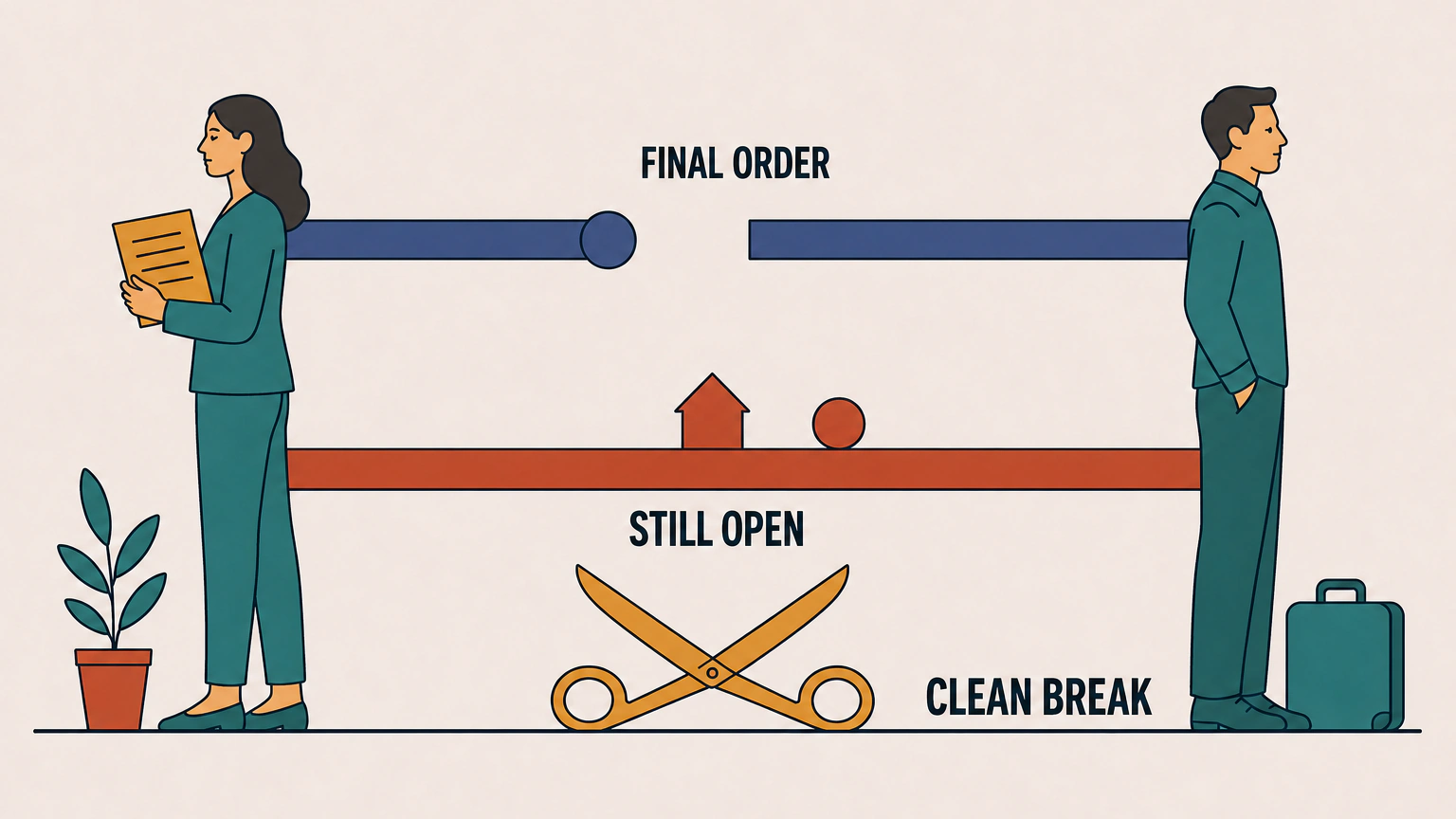
- Your final order ended the marriage. It did not touch the money.
- Most people leave divorce without a financial order
- The order you need, and what the court charges for it
- The timing traps that can cost you money
- What a clean break does not settle by itself
- Scotland and Northern Ireland do this differently
- Frequently asked questions
- What to do this week
Your final order ended the marriage. It did not touch the money.
The envelope comes, you open it, and whatever else is in there, some of it is relief. It's over.
Then months later somebody at work mentions that their ex came back for a share of a redundancy payment, and the floor tilts.
Here is what nobody says clearly at the start. Your final order ended the marriage. It did not end your ex's right to claim against your money, and in England and Wales that right stays open until a judge dismisses it. A financial order with clean-break terms does that. If you both agree, the court can approve one as a consent order for a £62 fee. Roughly two in three couples leave divorce without a court order.
Divorce and money are two separate pieces of court business. Different tracks, different forms, and finishing one does nothing to the other.
What the final order actually does
It dissolves the marriage. That's the whole of its job. On the day it is sealed you stop being married and are free to marry someone else.
What doesn't change that day: every financial claim either of you could make against the other. Maintenance, a lump sum, a share of the house, a slice of a pension. All of it survives untouched, because the divorce was never the thing that dealt with it. If you split the savings between yourselves and shook hands, you have an arrangement. Only an order shuts the door.
Red flag: four things that feel final and are not. - A written agreement the two of you signed and no judge has seen. It may be the starting point for a consent order. Keep it, but have the court order drafted properly. - A solicitor's letter recording what you agreed. Same answer. Good evidence of the deal, and not an order dismissing anybody's claims. - Years going by quietly. Delay is something a court weighs, never a bar. Wyatt v Vince ran nineteen years from decree to application. - Your ex remarrying. Remarriage can block fresh maintenance, lump-sum and property claims by the person who remarries. It does nothing to yours.
How long the money claims stay open
There's no deadline. Not a long one, not a generous one. None.
The Supreme Court said so plainly in Wyatt v Vince, where a wife who had divorced in 1992 applied for financial orders in 2011: "Consistently with the potentially life-long obligations which attend a marriage, there is no time-limit for seeking orders for financial provision or property adjustment for the benefit of a spouse following divorce." The Matrimonial Causes Act lets a court make those orders on granting the divorce "or at any time thereafter".
The husband asked for the claim to be struck out. The court refused and sent it on to be heard, while saying openly that her delay "appears to be inordinate" and might reduce or wipe out whatever she would otherwise have got.
Nineteen years, after a marriage that had lasted barely two.
Most people leave divorce without a financial order
If you've done nothing, you're in the majority by a wide margin.
The Nuffield Foundation's Fair Shares study is the first properly representative look at what happens to money on divorce in England and Wales, and its headline finding is blunt. Around 100,000 couples divorce each year, and only about a third leave the marriage with a court order of any kind, most of those made by consent. Two thirds walk away with the claims still open.
Only 32% of divorcees used legal services on their financial arrangements at all, the same study found, and of those who did not, 42% said they had been put off by fear of the cost. That's not recklessness. It's people avoiding an expense they couldn't size, at the cost of something much larger.
The second reason is gentler. An amicable divorce feels like a settled one, so going to court reads as escalation. But a consent order is not a fight. It is a judge reviewing the terms you agreed and deciding whether to approve them, usually with no hearing at all.
Amicable is how you feel about each other. Settled is what a court has dismissed. Only one of them survives a change of heart, a new partner, or a lottery ticket.
The order you need, and what the court charges for it
Which route you're on is decided by one question: whether the two of you agree. Not by how much you own, and not by how messy it was.
| Route | What you actually do | Court fee | How long | What is still open afterwards |
|---|---|---|---|---|
| Nothing signed | Divide things between yourselves and rely on the divorce | None | n/a | Claims may remain open, but remarriage can bar some applications |
| Consent order without a clean break | A judge approves the split you agreed | £62 | No fixed court timetable; usually no hearing | Whatever the order does not dismiss, commonly future income claims |
| Consent order with a clean break | The same order, plus the clauses dismissing future claims between you | £62 | No fixed court timetable; usually no hearing | No future financial claims between the two of you. Child maintenance sits outside it |
| Contested financial order | Apply on Form A, disclose on Form E, then follow three stages with possible extra FDR appointments | £321 | First appointment usually 12 to 14 weeks after you apply; later stages can be months apart | Whatever the order does not dismiss or finally determine |
Both fees are the court service's published figures for England and Wales, and both sit on GOV.UK. What a solicitor charges to draft the paperwork sits on top and varies by firm, which is why there is no column for it.
A consent order, if you agree
A consent order sets out what the two of you decided and asks a judge to make it binding. It covers pensions, property, savings and investments, and can carry maintenance arrangements too.
Three things go to the court together: the signed draft order with two photocopies, a statement of information (Form D81), and a notice of an application for a financial order (Form A) from one of you. Send them with the £62 fee to HMCTS Financial Remedy, PO Box 12746, Harlow CM20 9QZ. If you're on benefits or a low income, ask about help with court fees first.
There's usually no hearing. A judge reads it and approves it if they think it's fair. If they don't, they can send it back for changes.
What your consent order needs to deal with before you sign it:
- The family home: who keeps it, who is bought out, by when, and what happens to the mortgage
- Every other property, savings account, investment and business interest, each one named and valued
- Each pension, by scheme and current value, and whether any of them is being shared
- Any lump sum, the date it is paid, and what happens if it is not paid on time
- Whether maintenance is being paid at all, for how long, and whether it can later be extended
- The clean break clauses themselves, dismissing all future claims between the two of you
- Debts, including the ones in a single name, and who is responsible for each
Pro tip: ask what the £62 is on top of. When you take a quote from divorce solicitors, ask three things before you agree to anything. Is the court fee included or extra? Does the price cover preparing Form A and Form D81 as well as the order itself? And what happens to the price if the judge comes back with questions?
A financial order, if you do not
If you can't agree, you ask the court to decide. The contested route starts the same way: Form A, to your local financial remedy court, with the £321 fee.
Then comes disclosure. Both of you complete Form E, a full financial statement covering property, debts, income and an estimate of your future living costs. It's laborious, and it's the point: a judge cannot divide what nobody has counted.
Three stages follow. A first appointment, usually 12 to 14 weeks after you apply, where the judge works out what still needs deciding. Then a financial dispute resolution appointment, meant to help you settle before it goes that far. Then a final hearing, if it comes to that. If you settle at the FDR stage, there is no final hearing.
GOV.UK sets out plainly what a judge weighs: how long you were married, your age, ability to earn, property and money, living expenses, standard of living, financial needs and responsibilities, role in looking after the family, and any disability or health condition. Children's arrangements are settled first, and the reason for the divorce is not taken into account at all. If your finances are tangled up with a business, a second property or children living between two homes, this is where family law solicitors earn their fee.
Clean break is not another word for consent order
This distinction is easy to miss, and it decides whether you are finished.
A consent order records what you agreed. A clean break is the part of a financial order that dismisses future financial claims between you. A consent order can include clean-break terms, but it does not have to.
The court is required to think about it. Section 25A(1) of the Matrimonial Causes Act 1973 puts a duty on the judge to consider whether the financial obligations of each party towards the other can be terminated "as soon after the making of the order as the court considers just and reasonable". GOV.UK puts the same point in corridor language: the judge will usually try to arrange a clean break.
Usually is not always. If you're holding an order already, look for the clauses dismissing claims. If you can't find them, ask.
The timing traps that can cost you money
Two risks here, and neither is about the terms of your deal. Taking the final order too soon can have financial consequences, especially for pensions. Remarrying before you apply can bar some applications altogether.
After the conditional order, before the final order
The divorce runs on a timetable set by section 1 of the Matrimonial Causes Act 1973, rewritten when England and Wales moved to no-fault divorce on 6 April 2022. Neither of you can confirm you want to carry on until 20 weeks have passed from the start of proceedings, unless the court shortens that period in a particular case. The divorce cannot be made final until six weeks after the conditional order unless the court shortens that period too. GOV.UK tells applicants to wait at least 43 days, which is six weeks and one day, before applying for the final order.
For the usual final financial split, the court cannot approve a consent order before the conditional order. And GOV.UK warns, twice on its money and property guide, that if you ask after the final order "there may be financial consequences, particularly for pensions". On its divorce guide it says so flatly: "If you want a legally binding arrangement for dividing money and property you must apply to the court for this before you apply for a final order or decree absolute."
So the sequence is conditional order, money order in, then final order. It's tempting to grab the final order the moment you're allowed to. Wait.
If you remarry first, some financial claims are barred
This one is harsh, and if it has already happened to you, you're right to be angry about it.
Section 28(3) of the Matrimonial Causes Act 1973 says that where either party to a dissolved marriage remarries or forms a civil partnership, "that party shall not be entitled to apply", by reference to that divorce, for a financial provision order in their own favour or for a property adjustment order against the other. Maintenance, lump sums, the transfer of a house. Gone, for the person who remarried.
The timing is easy to miss: you meet someone kind, you marry them on a Saturday in April, and on the Monday some financial claims you did not know you still had are barred.
The bar bites on the entitlement to apply, which is why the sequence matters. In Wyatt v Vince the Supreme Court put the point the other way round: it was "in the absence of her remarriage (which would have precluded her doing so)" that it remained open to the wife to start her applications in 2011 or at any time. So if a new marriage is anywhere on your horizon and you may need maintenance, a lump sum or a property order, get the Form A application in first and plan the wedding second. The application has to be started before remarriage; it does not have to be resolved first.
What a clean break does not settle by itself
A clean break ends future financial claims between the two of you. It does not itself settle child maintenance, and a pension is shared only if the financial order says so.
| What is at stake | Ended by a clean break? | Why |
|---|---|---|
| Spousal maintenance | Yes | The order dismisses the claim and bars a further application |
| Lump sums and property claims | Yes | Dismissed by the order, and a lump sum or transfer order is not in the list of orders a court can later vary |
| Pension sharing | Only if the order says so | A pension can only be shared by a court order, so it has to be written in |
| Child maintenance | No | A private agreement cannot bar CMS; a new maintenance order normally delays an application for one year |
| Anything not written into the order | No | A court dismisses what the order dismisses, and nothing else |
Child maintenance carries on
A clean break deals with the adults. It does not, and legally cannot, end the children's claim on their parents.
A private agreement cannot block a CMS application. If a child maintenance order is in force, though, CMS normally cannot take an application until the order has been in force for a year. After that, either parent can apply for a CMS calculation. A private arrangement between reasonable people is usually better and cheaper. It is just not a closed door.
If what is really keeping you awake is who the children live with rather than the savings, that's a different application entirely, and child arrangements solicitors are the people to ask.
A pension needs an order of its own
A pension can only be shared by a court order. The Fair Shares study states that rule in a footnote.
An agreement that gives you a share of a pension does not split it, however carefully the agreement was signed. Only a pension sharing order made by a court can create that share.
The timing trap hurts most here, because pensions are the specific thing GOV.UK names when it warns about applying too late.
Scotland and Northern Ireland do this differently
All of that is England and Wales law. If you divorced elsewhere in the UK, that timetable is the wrong one for you.
Northern Ireland never moved to no-fault divorce. It still runs on the Matrimonial Causes (Northern Ireland) Order 1978: a petition rather than an application, a decree nisi rather than a conditional order, a decree absolute rather than a final order, and normally at least six weeks between the last two. The court can shorten that period in a particular case. You still have to prove one of five facts, adultery and behaviour and desertion among them, and article 5 bars any petition before two years have passed from the date of the marriage. Consent orders exist there too, under article 35A, but the route into them differs enough that a Belfast reader should be on nidirect's family courts pages.
Scotland: the window closes when the decree is granted
Scotland catches people out, because it works close to the opposite way round.
Under section 12(1) of the Family Law (Scotland) Act 1985 a court can order a capital sum or a transfer of property on granting decree of divorce, or within whatever period the court specifies when it grants the decree. It's not the open-ended right the English rule gives. The window is tied to the decree, and if the court has not been asked to specify a period, the moment can pass.
So the instruction for a Scottish reader is the opposite: sort the money out inside the divorce action, before decree rather than after. Citizens Advice Scotland is a sensible free starting point, and there are solicitors across Scotland who handle exactly this.
Frequently asked questions
Do I need a financial order if we agreed everything ourselves?
Almost certainly yes. An agreement between the two of you, however friendly, is not a legally binding court order and does not stop either of you claiming later. A consent order takes what you already agreed and makes it binding, usually without a hearing, for a £62 court fee. Agreeing was the hard part.
Can I still get a financial order after my final order has been granted?
Usually. In England and Wales there is no general time limit, but a court order may already have dismissed the claims and remarriage can bar some applications. Applying afterwards can also be worse than applying before: GOV.UK warns there may be financial consequences, particularly for pensions. If your divorce is still running, get the money order in before you take the final order.
How much does a consent order cost in total?
The court's fee is £62 and that part is fixed. On top sits whatever a solicitor charges to draft the order and prepare Form A and Form D81, which varies by firm and by how complicated your finances are. Ask for a fixed quote in writing.
How long does it take to get a consent order approved?
There is no fixed court timetable, but there is normally no hearing. A judge reads the papers and, if the terms look fair, seals the order. For the usual final financial split, the court cannot approve it before your conditional order. Questions or requested changes add time.
Can my ex claim money years after the divorce?
Yes. There is no time limit on financial claims after divorce in England and Wales, which the Supreme Court confirmed in Wyatt v Vince, where a wife applied nineteen years after her decree absolute. Long delay counts heavily against the person claiming and can reduce or eliminate what they get. Only a court order dismissing the claim bars it.
Is a clean break order the same as a consent order?
No, and this is the confusion worth clearing up. A consent order records what the two of you agreed. A clean break is the part of a financial order that dismisses your future financial claims against each other. A consent order can include clean-break terms, but not every consent order does.
Can a consent order be changed once the judge has sealed it?
Partly. Maintenance orders are on the list of orders a court can vary under section 31 of the Matrimonial Causes Act 1973, so payments can be raised, lowered or ended. Capital orders such as a plain lump sum or a property transfer are not on that list. Setting a sealed order aside is a separate application.
What to do this week
Three moves, in order.
Work out which of the four routes you are on. If no judge has dealt with the finances, claims may still be open however long ago the divorce was. Remarriage can bar some applications, so check that before assuming every claim survives.
If you are on the consent order route, get a fixed quote for drafting, and ask what the £62 is on top of. If you instruct a firm and the draft then sits for months with nothing happening, that delay is a complaint in its own right, and here is how to complain about a solicitor.
If you are near your final order, or anywhere near remarrying, deal with that first. Taking the final order first can have financial consequences, particularly for pensions. Remarrying before you apply can bar some applications.
We are not your solicitor, and a consent order is the one piece of divorce paperwork worth paying someone to draft. If you'd rather have a person than a form, start with divorce solicitors who quote fixed fees for this job.