

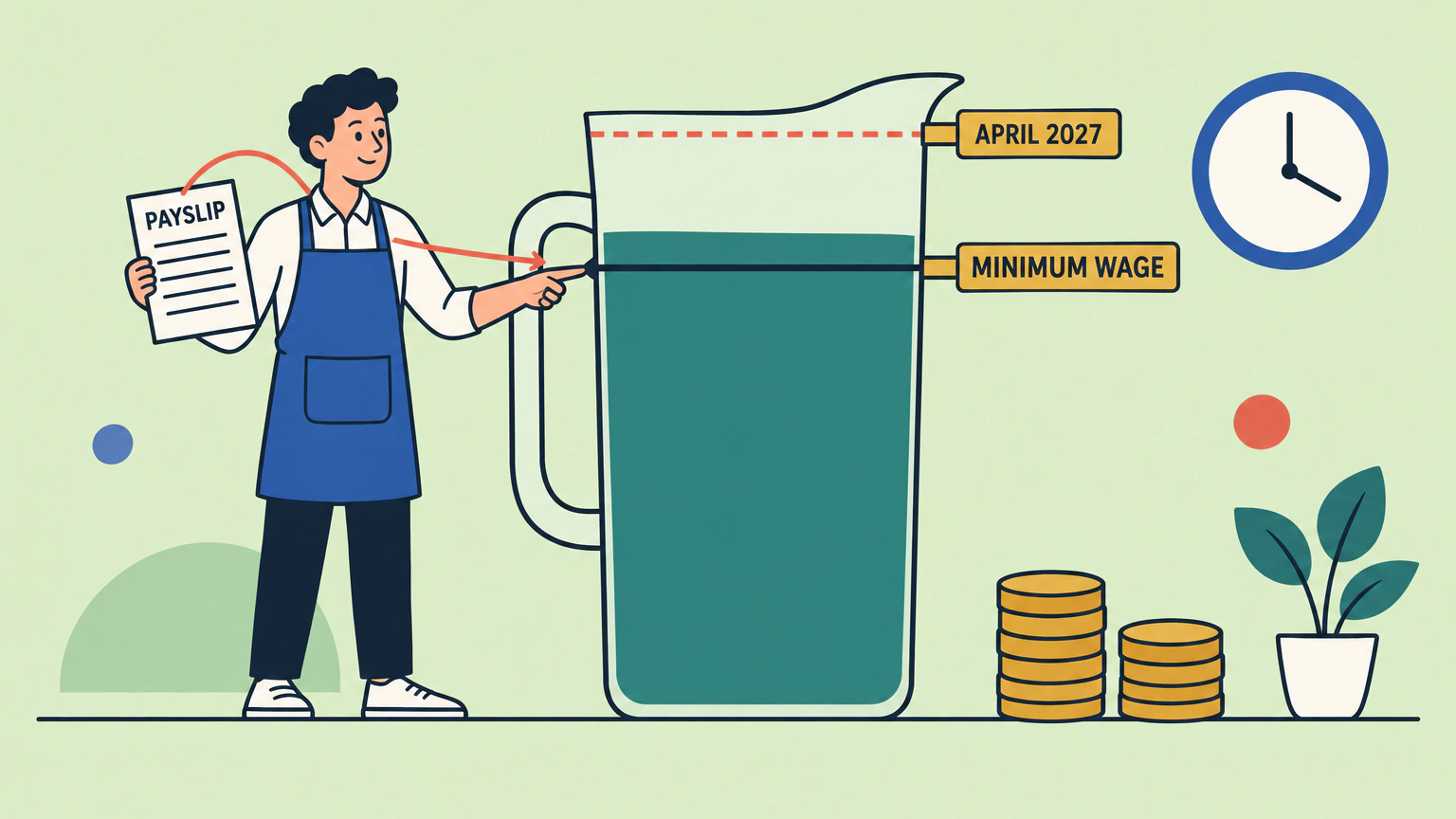
From 1 April 2026 the minimum wage is £12.71 an hour if you're 21 or over, £10.85 at 18 to 20, and £8.00 for under-18s and for apprentices under 19 or in their first year. From 1 April 2027 those rise to £13.21, £11.27 and £8.31. The rates are the same in England, Scotland, Wales and Northern Ireland, and you check yours by dividing the pay that counts by every hour you worked in the pay period.
The April 2027 figures were set at the Budget on 28 October 2026. The harder question is whether your own pay clears the line, and that's where we'll spend most of our time.
On this page
The minimum wage rates for 2026, and the rise in April 2027
On 28 October 2026 the government accepted the Low Pay Commission's recommendations in full, so every rate rises by about 3.9% from April 2027. GOV.UK's rates page says the rates change on 1 April every year, but your pay may not move that day. The new rate starts with the first pay reference period (the week or month your pay covers) that begins on or after 1 April. If your monthly period runs from the 16th, you keep the old rate until 16 April. That's the date to get right if you're an employer setting next year's rates, and it's everyday work for payroll providers.
The National Living Wage still starts at 21. The Commission has paused closing the gap for 18 to 20-year-olds, though the government says it wants to bring that age down to 18.
The accommodation offset, the most an employer can count as pay for housing it provides, is £11.10 a day (£77.70 a week) from April 2026 and £11.53 a day from April 2027.
There's no separate minimum salary in the UK. A salary has to work out at your hourly rate or better, so each band comes with a yearly figure.
| Who | From 1 April 2026 | A year at 37.5 hours a week | From 1 April 2027 | A year at 37.5 hours a week |
|---|---|---|---|---|
| Aged 21 and over (National Living Wage) | £12.71 | £24,784.50 | £13.21 | £25,759.50 |
| Aged 18 to 20 | £10.85 | £21,157.50 | £11.27 | £21,976.50 |
| Under 18, above school leaving age | £8.00 | £15,600.00 | £8.31 | £16,204.50 |
| Apprentice under 19, or in the first year | £8.00 | £15,600.00 | £8.31 | £16,204.50 |
A year is 52 weeks at the hourly rate, before tax and National Insurance. The April 2027 rates were announced at the Budget on 28 October 2026.
Which rate is yours
Three things decide it: your age, whether you're an apprentice, and whether the law covers you at all.
Your age, and when a birthday moves you up
Your band follows your age, but a birthday doesn't lift your pay on the day. Turn 18 or 21 and the higher rate starts from your next pay reference period, so a payslip can look wrong the week after your birthday and still be legal.
The under-18 rate needs you to be above school leaving age, and each nation sets its own. In England and Wales it's the last Friday in June if you'll be 16 by the end of the summer holidays. In Scotland it's after 31 May if you turn 16 between March and September, or the start of the Christmas holidays if you turn 16 between October and February. In Northern Ireland it's after 30 June if you turn 16 during the school year. With a birthday from 2 July to 31 August, it's 30 June the next year.
Below that age there's no minimum wage at all.
Apprentices and the first year rule
You're on the apprentice rate if you're under 19, or if you're 19 or over and in the first year of your apprenticeship. Once you're 19 or over and past that first year, you get the rate for your age. GOV.UK's example is a 21-year-old apprentice, who is owed at least £8.00 an hour in the first year and at least £12.71 after it. That's a jump of £4.71 an hour, so check it arrived. The move comes from the next pay reference period after the anniversary, exactly like a birthday.
Who the minimum wage doesn't cover
A contract that pays less than the minimum isn't legally binding, so you're still owed it, whatever you signed. Part-time, casual, agency and piece workers are all covered. So are trainees, workers on probation and disabled workers.
The main groups left out are the genuinely self-employed, company directors, volunteers and voluntary workers for charities, family members living in the employer's home, students on a required placement of up to a year, people on a Jobcentre Plus work trial of up to six weeks, the armed forces, prisoners and people living and working in a religious community. If you're not sure which side you're on, the Acas helpline will tell you.
One rate across the UK, except on the farm
The minimum wage in England is the minimum wage everywhere else too. The National Minimum Wage Act 1998 "extends to Northern Ireland", and nidirect says it makes no difference "where you work in the UK". So a 21-year-old in Glasgow, Cardiff, Belfast or Leeds is owed the same £12.71. There's no London rate in law.
Farm work is the exception. Scotland, Wales and Northern Ireland each keep a body that sets farm workers' minimum pay. In England, farm jobs started since 1 October 2013 get the National Minimum Wage with no separate farm rate, and older contracts keep the Agricultural Minimum Wage only if they say so.
Scotland's 2026 Order pays £12.71 to farm workers of every age, so a 17-year-old on a Scottish farm is owed the adult rate unless they're an apprentice. Wales had no new Order for 2026, so its 2025 Order carries on, and GOV.WALES says a future Order could consider backdated payments. If you work on a Northern Ireland farm, one warning: nidirect's farm table still shows the 2025 grades. Go by DAERA's April 2026 figures, which are the ones we print here.
| Nation | Farm workers' minimum from April 2026 | Who sets it |
|---|---|---|
| England | The National Minimum Wage for your age. Workers employed before 1 October 2013 keep the Agricultural Minimum Wage if their contract says so. | No separate farm rate for jobs started since 1 October 2013 |
| Wales | The 2025 Order continues because no 2026 Order was agreed. Grades A and B get the National Minimum Wage for their age. Apprentices get £8.00 in year one, then the rate for their age. Grade C £13.48, Grade D £14.79, Grade E £16.23. | Agricultural Advisory Panel for Wales |
| Scotland | £12.71 for workers of every age. Apprentices under 19 or in their first year £8.00. Qualified workers get at least £1.91 an hour on top. | Scottish Agricultural Wages Board, Order No. 73 |
| Northern Ireland | Grade 1 trainees £8.00 under 18, £10.85 at 18 to 20 and £12.71 at 21 and over. Grade 2 £13.30, Grade 3 £13.66, Grade 4 £13.89, Grade 5 £14.44. | Agricultural Wages Board for Northern Ireland, Order No. 106 |
Where the National Minimum Wage for your age is higher than a farm rate, you get the higher figure. Farm rates usually change each April, separately from the national rates.
How to check your payslip against the minimum wage
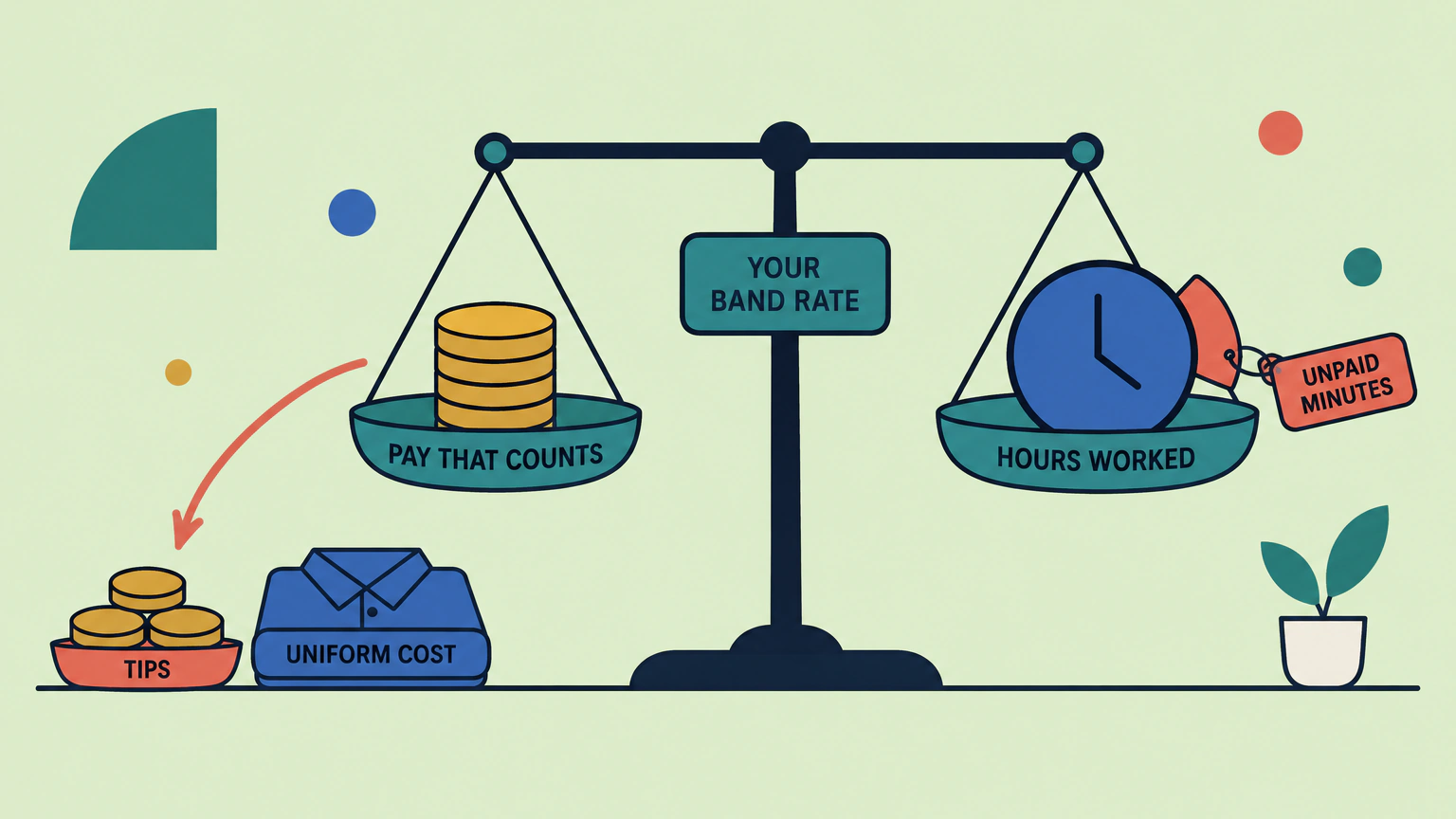
The minimum is an average over each pay reference period, so one thin shift doesn't settle anything. Start with your gross pay, the figure before tax and National Insurance come off. GOV.UK runs an official calculator for workers that does the sum for you, but it only knows what you tell it. So it helps to understand the three moves: take out what doesn't count, add the hours you worked but weren't paid for, and divide.
Pay that counts, and pay that doesn't
Basic pay counts, and so do bonuses, commission and performance pay.
Tips, gratuities, service charges and cover charges don't, however they're shared out. Nor does the premium part of overtime, shift or bank holiday pay. If your basic is £12.80 and Saturdays pay £14.00, only £12.80 an hour counts for the Saturday hours.
Allowances for unsocial hours, London weighting or being on call are out too, unless they've been built into your standard pay. So are loans, advances, expense refunds and redundancy pay.
No benefit in kind counts, whether that's meals, a car or vouchers. The one exception is housing, up to the accommodation offset. Pay you give up through salary sacrifice doesn't count either, so a sacrifice scheme can't take you below the line.
Deductions that drag your pay below it
Some costs come straight off the pay that counts. The main one is anything the job needs that you pay for and don't get back, such as a uniform, tools or safety equipment. Money taken from your wages for your employer's own benefit comes off too, such as a charge for transport it provides to and from work. So does any housing charge above the offset.
GOV.UK's own example is sharp: £13 an hour for 40 hours, less £15 a week to rent a uniform, leaves £505. That divides out at about £12.63 an hour, below the line, though GOV.UK's page prints £12.67.
Other deductions leave your minimum wage pay alone. Those are tax and National Insurance, a pension contribution or union subscription you chose, repaying a wage advance or an accidental overpayment, and a misconduct penalty your contract allows. Canteen meals you choose to buy are safe too, unless the cost is deducted from your wages.
Hours that count, including the ones you weren't paid for
Every extra hour lowers your average, so this is where a payslip that looks fine can stop being fine.
These hours count: time at the workplace working, time you're required to be there and available even if there's no work, training, travelling between assignments (a care worker driving from one client to the next), waiting for transport or to start a job in connection with work, and being on call at or near the workplace unless you're at home.
These don't: your commute between home and your usual workplace, plus rest breaks and holiday unless your salary covers them. Sick leave works the same way, and statutory sick pay has its own rules and figures.
With somewhere suitable to sleep, sleep-in shifts count only when you're "awake for the purposes of working", the Supreme Court's test from Royal Mencap Society v Tomlinson-Blake in 2021. Without it, the whole shift counts.
We'd look hardest at the unpaid minutes at the edges of a shift. If you have to be there for a briefing or to set up, that time counts, and GOV.UK's guidance treats a team meeting and 30 minutes' early arrival in just this way. Each of those minutes adds to what you divide by without adding a penny to what you're dividing. It's easy to miss, and it's unfair.
A worked example, step by step
Say you're 24, on £13.00 an hour for 37.5 hours a week, so you look safely above the April 2026 rate for 21 and over. But you pay £10.00 a week for a uniform you must wear, and there's an unpaid 15-minute briefing before each of your five shifts. The last step is the arrears rule we come to later.
| Step | Your week | Running figure |
|---|---|---|
| Your contract | 37.5 hours at £13.00 an hour | £487.50 gross |
| Take off what doesn't count | £10.00 a week deducted for the uniform you must wear | £477.50 counts |
| Add the hours you weren't paid for | A required 15-minute briefing before each of 5 shifts | 38.75 hours |
| Divide | £477.50 ÷ 38.75 hours | £12.32 an hour |
| Compare with your band | £12.71 an hour at 21 and over from April 2026 | Short by £15.01 for the week |
| If it's settled after 1 April 2027 | Arrears are worked out at the rate in force then, £13.21 | £15.60 owed for that week |
From April 2027 the £13.00 contract rate is itself below the minimum for 21 and over, before any deduction.
National Living Wage or real Living Wage?
The two names sound alike and mean very different things. The real Living Wage is £14.10 across the UK and £15.45 in London. It's voluntary, it's set by the Living Wage Foundation from what it costs to live, and it's for workers aged 18 and over. Nearly 17,000 UK businesses pay it.
The National Living Wage is the legal minimum for anyone 21 and over. Government sets it on the Low Pay Commission's advice, and it carries no London weighting.
So the real Living Wage is a promise an employer chooses to make. The floor the law lets you enforce at 21 and over is still the National Living Wage.
What to do if you're paid less than the minimum wage
If you're not being paid minimum wage, that's unfair, and you're right to be angry about it. Talk to your employer first, then raise a grievance in writing if that fails. The Acas helpline gives free advice on 0300 123 1100, and in Northern Ireland the Labour Relations Agency takes calls on 03300 555 300. Before either step, gather these six things.
- Every payslip you think was short, with the date you were paid. The payday is what starts a tribunal's clock.
- Your contract or written statement, showing your hourly rate and your contracted hours.
- Your own record of the hours you actually worked, including briefings, training and travel between jobs.
- Receipts or payslip lines for anything you paid for the job, such as a uniform or tools.
- Rotas, clock-in records or messages that show when you had to be at work.
- A dated copy of your written request to see your employer's pay records.
Ask to see your pay records
If you reasonably believe you've been underpaid, you can give your employer a written notice asking to see its pay records. Section 10 of the National Minimum Wage Act gives it 14 days to produce them, or a later date you agree. You can copy them, and you can bring someone with you if your notice says so.
If your employer refuses, a tribunal must award you 80 times the hourly minimum wage in force when it makes the award. Refusing is an expensive mistake.
Then there's a lever we rarely see mentioned. At a tribunal or in a contract claim, the law presumes you were underpaid unless your employer proves otherwise. So you start ahead. And because employers must keep these records for six years, yours has little room to say they've gone.
HMRC or a tribunal: you have to pick one
Acas is plain that you can't take the same issue down both routes. The government's complaint form says the same from the other side: "We cannot take your complaint forward if you've already started Tribunal action for a National Minimum Wage issue."
The HMRC route runs through the online Complain about pay and work rights form or the Acas helpline, and it covers all four nations. You can stay anonymous, someone else can complain for you, and you can report an employer you've left. HMRC does this on behalf of the Fair Work Agency, which began operating on 7 April 2026.
A notice of underpayment can reach back six years. It also carries a penalty of 200% of the arrears, at least £100 and capped at £20,000 per worker, which goes to the government, not you. Employers can be named as well. The September 2026 round named about 660, with around £4 million repaid to over 27,000 workers. Citizens Advice is honest about the downside: HMRC "could take a long time", and it's more likely to act when several workers complain.
The tribunal route starts with early conciliation. In Great Britain that means Acas, on 0300 123 1122, and a tribunal can award back pay for no more than two years before the claim, under section 23 of the Employment Rights Act 1996. In Northern Ireland you notify the Labour Relations Agency before an industrial tribunal claim, and Northern Ireland's version of the rule has no two-year cap.
On either route, arrears are paid at today's rate where that's higher than the rate you were underpaid at. That's why the week's £15.01 in our example becomes £15.60 once April 2027 arrives.
The time limits: In England, Scotland and Wales, a tribunal claim for an underpayment paid on or after 1 October 2026 must start within six months less a day of that payday. For an underpayment paid before then, it's three months less a day. Early conciliation through Acas pauses the clock.
In Northern Ireland the limit is three months less a day, and you notify the Labour Relations Agency before you claim. Where the underpayments are a series, the clock runs from the last one.
Here's our call. If your underpayment is recent and inside two years, we'd go to a tribunal, because the claim stays in your hands. One of the employment solicitors in our directory can tell you what it's worth. If it goes back further, or you'd rather your name stayed out of it, HMRC is the route.
We're not your solicitor. If a claim is on the table, a call to Acas for free advice, or to an employment solicitor before the deadline, is worth more than anything we can tell you here.
You can't be punished for asking
Your employer must not treat you worse, cut your hours without good reason, or pass you over because you asked for the minimum wage or became entitled to a higher rate. That's called "detriment", and you can claim for it at a tribunal. If you're an employee and you're dismissed for it, that can be automatically unfair dismissal, and there's no minimum length of service. A worker who isn't an employee may be able to claim the dismissal as detriment instead. Northern Ireland gives the same protection through an industrial tribunal.
Citizens Advice warns that the law may not stop an employer trying it, so keep a dated copy of everything you send.
Minimum wage questions people ask
Is the minimum wage the same in Scotland and Northern Ireland?
Yes. The law covers the whole UK, so the same rates apply in Glasgow, Belfast and Leeds. Farm work is the exception, because Scotland, Wales and Northern Ireland set their own minimums. Northern Ireland also differs in how you claim, through the Labour Relations Agency and an industrial tribunal, but not in the rate.
When does the minimum wage go up?
Every 1 April. The next rise takes the adult rate to £13.21 from 1 April 2027. Your pay moves from the first pay period starting on or after that date, so a monthly period starting on the 16th keeps the old rate until 16 April. A birthday that moves you up a band works the same way.
If the minimum wage goes up, does my pay go up?
Only if your rate would fall below the new minimum for your band. The law sets a floor, not a pay scale. If you're already above the new figure, any rise depends on your contract or what's agreed. Run the payslip check anyway, because a rate that cleared £12.71 can miss £13.21.
Can my employer pay me less than the minimum wage?
Not if you qualify for it. A contract with a lower rate isn't legally binding, and you're still owed the minimum. Your employer can count housing it provides as pay, up to £11.10 a day from April 2026, but no other benefit in kind.
Do tips count towards the minimum wage?
No. Tips, gratuities, service charges and cover charges never count, however they're shared out. Acas gives the example of a 22-year-old on £540 for a 40-hour week, £100 of it tips. Only £440 counts, which is £11 an hour, so that worker is underpaid.
Does the minimum wage include holiday pay?
No. For hourly-paid work, the check uses the hours you worked and the pay for them, and holiday isn't working time for this purpose. Holiday pay has its own rules, and our guide to holiday entitlement covers how much you get.
How much is the minimum wage for a 40-hour week?
At 21 and over it's £508.40 a week before tax from April 2026, or £26,436.80 over 52 weeks. From April 2027 it's £528.40 a week, or £27,476.80. At 18 to 20 it's £434.00 a week from April 2026 and £450.80 from April 2027.