

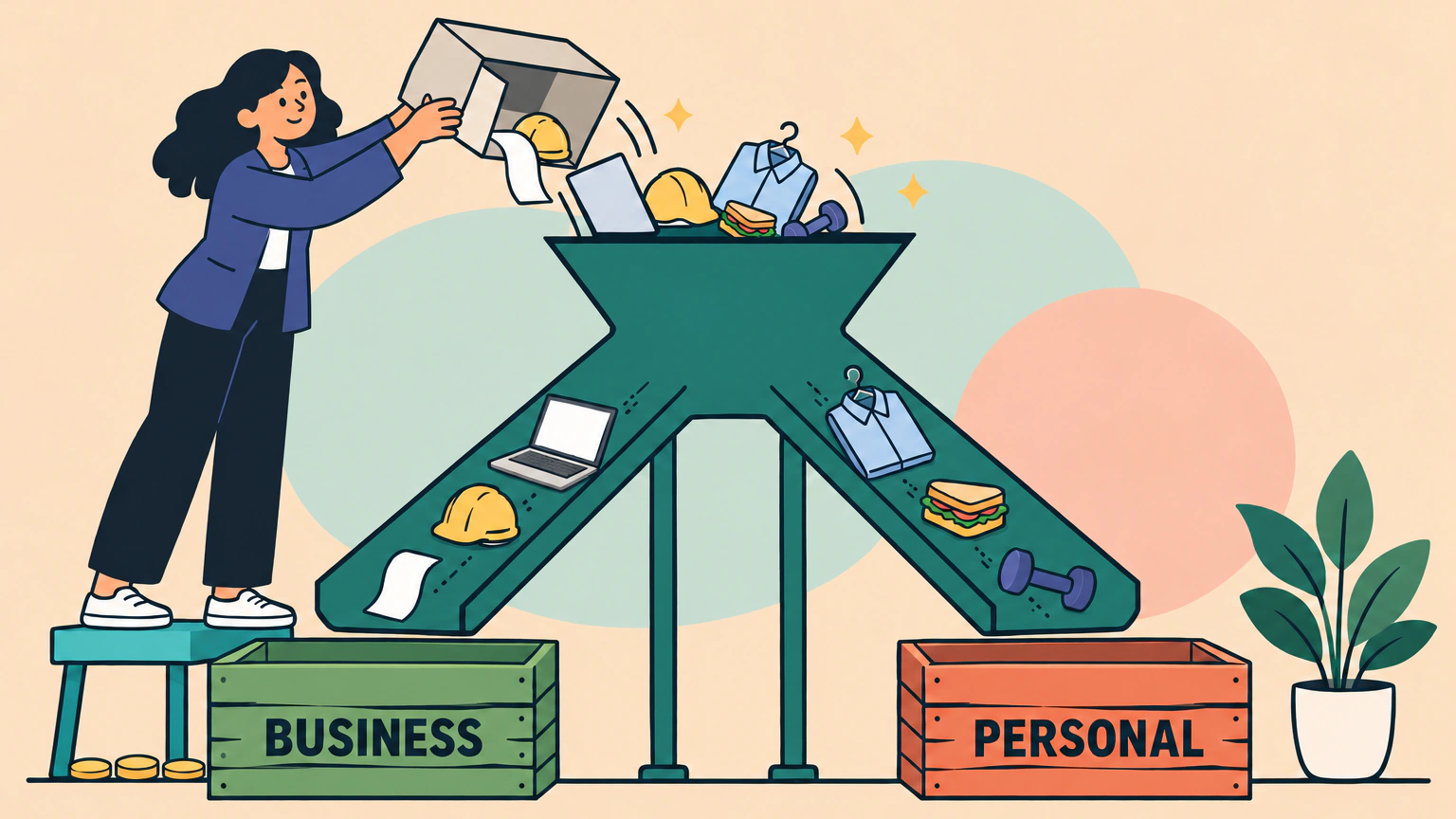
You can claim any cost you pay wholly and exclusively to run your business, plus the business share of things you also use privately, such as your phone, car or home. Or you can skip expenses and take the £1,000 trading allowance instead, whichever leaves less profit to pay tax on. On the 2025-26 return due online by 31 January 2027, car and van mileage is 45p a mile for the first 10,000 business miles. The 55p rate only starts with 2026-27.
This is for sole traders, and for partners in a partnership with no company partners, anywhere in the UK. The rules on what counts are the same in England, Wales, Scotland and Northern Ireland, even though Scotland sets its own Income Tax rates. If you run a limited company, GOV.UK is blunt: you're "not 'self-employed'", and your company pays Corporation Tax instead.
On this page
- The test every cost has to pass
- Real expenses or the trading allowance
- What you can claim, cost by cost
- Which mileage rate goes on which return
- Laptops, tools and vans: cash basis changed the answer
- Costs HMRC won't accept, however you word them
- Where each cost goes on your tax return
- Costs you forgot to claim
- Before you press submit
- Frequently asked questions
The test every cost has to pass
One sentence of law decides almost everything. The Income Tax (Trading and Other Income) Act 2005 bars any deduction for "expenses not incurred wholly and exclusively for the purposes of the trade". In plain English: you paid it to run the business, and for no other reason.
Plenty of costs are mixed, and the same section lets you claim the "identifiable part" that's purely for business. GOV.UK's own example is a year of phone bills totalling £200, with £70 of business calls. You claim £70.
Two things never pass, however you frame them. Money you take out for yourself, which HMRC calls drawings, isn't an expense. Nor are your own National Insurance contributions.
Keep proof of every cost: receipts, invoices, bank statements. You don't send any of it with the return, but HMRC can ask to see it, so it has to exist.
Real expenses or the trading allowance
You get a choice. You can deduct your real expenses, or you can deduct the £1,000 trading allowance from your turnover instead. The allowance replaces all your expenses and capital allowances, so it's one or the other, never both.
You can deduct up to £1,000, but not more than your income. If your turnover for the year is £1,000 or less, the allowance covers all of it, and you may not need to tell HMRC at all. Run two small businesses and you can split the £1,000 between them, as long as the total stays at £1,000.
| Your turnover | Your real expenses | Taxable profit using real expenses | Taxable profit using the allowance | Better choice |
|---|---|---|---|---|
| £900 | £100 | £800 | £0 | The allowance |
| £3,000 | £400 | £2,600 | £2,000 | The allowance |
| £3,000 | £1,500 | £1,500 | £2,000 | Real expenses |
| £2,500 | £3,200 | A loss of £700 | £1,500 | Real expenses |
Taxable profit here is before your Personal Allowance. The allowance can't be more than your turnover, and it can never create a loss.
Below £1,000 of real costs, the allowance usually wins. Above it, the expenses do.
At Budget 2026 the government announced that the allowance, and the point at which you must report trading income, will both rise to £3,000 from 6 April 2027, once the Finance Bill passes. Nothing changes on the 2025-26 return you're filing now.
When the allowance is off the table
GOV.UK bars the trading allowance for the whole tax year if any income comes from these three sources. The first is a company that you, or someone connected to you, owns or controls. The second is a partnership where you or someone connected to you is a partner. The third is your employer, or your spouse's or civil partner's employer. The allowance doesn't apply to partnership trading income at all.
It also can't create a loss. If your costs beat your turnover, claim the expenses so the loss goes on record.
You must register and file even with income under £1,000 in these cases. That means when you want to pay voluntary Class 2 National Insurance, or to claim Tax-Free Childcare or Maternity Allowance based on your self-employment.
What you can claim, cost by cost
GOV.UK sorts allowable costs into ten families: office costs, travel, clothing, staff, things you buy to sell on, financial costs such as insurance and bank charges, business premises, advertising, subscriptions and training.
Training is the one people second-guess. It counts when it improves skills you already use in the business or keeps you current with your industry's technology. It also counts when it builds new skills for changes in your industry, or to support the business, admin skills included. A course to start a new business, or to move into an unrelated line of work, doesn't.
The short self-employment pages have nine expense boxes, and the common costs sort into them.
| Box on the short pages | What you can claim | What you can't claim |
|---|---|---|
| 11 Goods bought for resale or goods used | Stock and raw materials, and the direct costs of making what you sell | Goods you take for yourself or your family |
| 12 Car, van and travel expenses | Fuel, insurance, repairs, servicing, breakdown cover, vehicle tax, parking, train, bus, air and taxi fares, hotel rooms, meals on overnight business trips, or the flat mileage rate. On cash basis, the cost of a van | Travel between home and your usual workplace, private driving, fines, the cost of buying a car |
| 13 Wages, salaries and other staff costs | Staff wages, bonuses, pensions, employer's National Insurance, agency fees, subcontractors | Money you pay yourself, your own pension and your own National Insurance |
| 14 Rent, rates, power and insurance costs | Rent and business rates for premises, water rates, heat, light, power, property insurance, security, the business share of your home or the home flat rate | The private share of your home, the cost of buying premises |
| 15 Repairs and maintenance of property and equipment | Repairs to business premises and equipment. On cash basis, the cost of equipment and tools | Repairs to private parts of your home, buying or improving premises |
| 16 Accountancy, legal and other professional fees | Accountants, solicitors, surveyors and architects working for the business, professional indemnity insurance | Work on your personal tax return, settling tax disputes, legal costs of buying property, fines |
| 17 Interest and bank and credit card financial charges | Bank, overdraft and card charges, interest on business loans, hire purchase interest | Repaying the loan or overdraft itself |
| 18 Phone, fax, stationery and other office costs | The business share of phone and internet, postage, stationery, printing and small office equipment. Software used for less than two years or renewed by regular licence payments. On cash basis, the cost of equipment and software | The private share, though HMRC lets you ignore private use of phone and broadband if it's insignificant |
| 19 Other allowable business expenses | Advertising, website costs, free samples, trade journals and professional subscriptions | Client entertaining, payments to clubs, charities or political parties, ordinary clothing |
Box numbers are from the 2025-26 Self-employment (short) pages, SA103S. If your turnover was below £90,000, you can put one total in box 20 instead. The full pages, SA103F, split the same costs across boxes 17 to 30.
Your car or van: real running costs or a flat rate per mile
Most cars and vans offer two ways to claim, and you choose for each vehicle separately.
The first is actual costs. Add up fuel, insurance, repairs, servicing, breakdown cover, vehicle tax and parking, then claim the business share by miles. Spend £6,000 running a car or van with 75% of its miles on business, and you claim £4,500.
The second is a flat rate per business mile, set for each tax year. It replaces every running cost and the cost of buying the vehicle. You can't use it for a vehicle you've already claimed capital allowances on, or one you deducted as an expense under cash basis. Once you use the flat rate for a vehicle, you must keep using it for as long as that vehicle is in the business.
With the flat rate, parking and train fares still go on top. Under either method, journeys between home and your usual place of work are commuting, and they never count.
There's no flat rate for bicycles. The law covers cars, goods vehicles and motorcycles only, so a bike you ride for work is claimed at what it actually costs.
One trap with leased cars: under traditional accounting, you can't claim 15% of the hire charge if you first leased the car on or after 6 April 2021 and its CO2 emissions are over 50g/km.
Whichever method you pick, keep a mileage log.
Working from home: a flat rate or a share of your bills
The choice comes up again at home: a flat monthly rate, or a share of the real bills. The flat rate is set by the hours you work there, not by what the bills come to, and you need at least 25 hours of business use in a month to qualify.
| Hours you work from home in a month | Flat rate for that month |
|---|---|
| 25 to 50 | £10 |
| 51 to 100 | £18 |
| 101 or more | £26 |
Below 25 hours a month, the flat rate doesn't apply. Claim phone and internet separately, at their business share.
GOV.UK's worked year is 40 hours a month for 10 months, then 60 hours in each of the other 2. That's £100 plus £36, so you claim £136.
The alternative is a reasonable share of what you actually pay for heating, electricity, Council Tax (domestic rates in Northern Ireland), mortgage interest or rent, internet and phone. Divide by the rooms you use for work or by the time you spend working there. In GOV.UK's example, a £1,120 electricity bill in a four-room home, with one room used only as an office, gives a claim of £280. If you only work there one day a week, it's £40.
If your business premises are also your home, as with some guesthouses, there's a separate flat-rate adjustment for that. You use it or the home flat rate, not both.
Clothes, meals, entertaining and gifts
These four trip people up, and each comes with an exception.
Everyday clothing is out, even if you only ever wear it for work. A suit for meetings is still a suit. What you can claim is protective clothing such as safety boots or hard hats, uniforms, overalls or aprons that protect your own clothes, and costumes for acting or advertising.
Meals on an overnight business trip are in. Reasonable meals on deductible journeys also qualify for itinerant traders and on occasional trips outside your usual travel pattern. An ordinary working lunch is out.
You can't claim for taking clients, suppliers or customers out. The short pages print the rule on the form itself, in the label of box 19. An event mainly for your own employees, like an annual staff dinner, is a different matter, and you can claim it.
Gifts carrying your business name or logo count only if their total cost stays within £50 per person per tax year. They can't be food, drink, tobacco or vouchers. Free samples of things you sell count too.
What your accountant charges you
Here you'll meet a contradiction. GOV.UK's expenses guide lists "the cost of preparing and submitting your Self Assessment tax return" as something you can't claim. HMRC's own Business Income Manual gives the fuller picture.
By a long-standing practice the courts have approved, you can claim normal recurring fees for preparing your business accounts and agreeing the tax on your trading profits. What you can't claim is the cost of completing your personal tax return. HMRC says that extra cost is "likely to be minimal" where your personal tax affairs are straightforward. Fees for settling a tax dispute are out as well.
So the two lines don't really clash. GOV.UK's short version describes only the personal-return part.
We'd ask for an invoice that separates the accounts work from the personal return, then claim the business part. If you're hiring an accountant for the first time, check the accountant is actually qualified before you hand over your records. In the UK, anyone can call themselves an accountant.
Which mileage rate goes on which return
This is the trap of the season. The flat rate for the first 10,000 business miles in a car or van was 45p up to 5 April 2026. The Taxation (Energy and Vehicles) Act 2026 raised it to 55p for 2026-27, in a change announced on 21 May 2026 and backdated to 6 April 2026. Miles after the first 10,000 stay at 25p, and motorcycles at 24p. So the return due by 31 January 2027, which covers 2025-26, uses 45p.
| Miles driven between | Return they go on | Cars and goods vehicles, first 10,000 business miles | Cars and goods vehicles, after 10,000 | Motorcycles |
|---|---|---|---|---|
| 6 April 2025 and 5 April 2026 | 2025-26, due online by 31 January 2027 | 45p | 25p | 24p |
| 6 April 2026 and 5 April 2027 | 2026-27, the return after this one | 55p | 25p | 24p |
11,000 business miles in a car comes to £4,750 on the 2025-26 return and £5,750 on the 2026-27 return.
At least one guide dated 2026 prints 55p with no year attached, and another calls 45p out of date. For this winter's return, it isn't.
The 10,000 miles are counted across all the cars and vans you use the flat rate for in the year, not per vehicle. Two vans doing 6,000 business miles each get the higher rate on 10,000 miles and 25p on the other 2,000.
In June 2026 the government said it would set out a review of these rates at Budget 2026. Budget 2026's tax documents now confirm a rise in the rate for miles over 10,000 from 6 April 2027, to be made by regulations. So the rates will move again the year after next.
Laptops, tools and vans: cash basis changed the answer
Since 6 April 2024, cash basis has been the standard way for sole traders and partnerships without company partners to work out their profit. You count money when it actually comes in or goes out. That shift also changed how equipment is claimed.
On cash basis, equipment you buy and keep for the business is an ordinary expense in the year you pay for it. That covers computers, tools, machinery and vans. Cars are the exception. A car stays in capital allowances, unless you use the flat mileage rate for it. HMRC's helpsheet puts tools and equipment under repairs or office costs (boxes 15 and 18), and a van under car and van costs (box 12).
Some capital costs can't be deducted on cash basis at all. They include land, a car, and capital spending on education or training.
If you chose traditional accounting instead, put an X in box 8. Then claim capital allowances, usually the annual investment allowance of up to £1 million, reduced by any private use.
Costs HMRC won't accept, however you word them
These fail however work-related they feel. If one has slipped into your figures, take it out before you file. Each is on HMRC's own lists of costs you can't claim, or fails the wholly and exclusively test.
- Travel between your home and your usual place of work
- Everyday clothes, even ones you only wear for work
- Fines and penalty charges
- Entertaining clients, suppliers or customers
- Money you take out for yourself, which HMRC calls drawings
- Your own National Insurance contributions
- Repaying a loan or overdraft (the interest is fine)
- Gym membership
- Payments to charities, clubs or political parties
- Depreciation in your accounts
- The private share of anything you also use personally
Where each cost goes on your tax return
The short self-employment pages, SA103S, are for smaller businesses. One requirement is turnover below £90,000, counted as if you'd traded for a full year. So £50,000 earned in six months counts as £100,000, and that business needs the full pages.
Below £90,000 you don't have to fill in all nine expense boxes. One total in box 20 will do, and the online return asks the same question in its own words: a single total, or a breakdown.
If you take the trading allowance, enter it in box 10.1 and leave boxes 11 to 20 empty. Put an X in box 8 only if you used traditional accounting. The full pages, SA103F, split the same costs across boxes 17 to 30. Partners are different again: your share of the profit goes on the Partnership pages, so these box numbers aren't yours.
You don't send receipts with the return. You do keep them, for at least five years after the 31 January deadline, which means into January 2032 for the 2025-26 return. If the receipts are the problem, a bookkeeper can turn them into proper records before the deadline rush.
For sole traders, this return also tells HMRC if you meet the income test for Making Tax Digital for Income Tax from 6 April 2027. The threshold is qualifying income over £30,000 for 2025-26. That test adds up your self-employment and property income before expenses, so claiming more doesn't change it. Our guide explains whether Making Tax Digital applies to you.
Costs you forgot to claim
A cost you missed isn't necessarily lost.
Money spent before you started trading still counts, if you paid it for the business in the seven years before it began and it would have been allowable once you were trading. The law treats it as spent on your first day, so it goes into your first year's expenses.
A cost missed from last year can go back in. You can correct a return within 12 months of its deadline, so you can change your 2024-25 return until 31 January 2027.
Older years take a letter. You can claim overpayment relief in writing up to 4 years after the end of the tax year it relates to. For 2022-23, that means by 5 April 2027.
Before you press submit
Run through these six before you file.
- You've claimed the trading allowance or your real expenses, never both.
- Every mile is claimed at the rate for the year you drove it.
- You've taken out the private share of your phone, car and home bills.
- Equipment is claimed the way your accounting method allows.
- You're on the short pages only if your turnover was below £90,000 for a full year.
- Receipts and your mileage log are kept where you'll find them in five years.
Some years need more than a list. A loss, closing stock, a part-year start or a switch of accounting method all change the arithmetic, and that's when we'd hand the return to a tax return specialist. We're not your accountant, and a complicated year deserves one before January, not after it.
Frequently asked questions
Can I claim expenses if I use the trading allowance?
No. The £1,000 trading allowance replaces your expenses and capital allowances, so it's one or the other. If your real costs for the year are more than £1,000, or bigger than your turnover and you want to record a loss, leave the allowance box empty and claim the expenses. If you run two businesses, the £1,000 can be split between them.
Can I claim my phone and broadband as self-employed?
Yes, the business share. Work it out from your bills, business calls against personal ones, and claim that part. HMRC's guidance lets you ignore private use of a phone or broadband line if it's insignificant. The working-from-home flat rate doesn't include phone or internet, so you claim these on top of it.
Can I claim petrol as self-employed?
Yes, for business journeys, as part of your car's actual running costs with the private share taken out. If you use the flat mileage rate for that car instead, the rate already covers fuel, so you can't add petrol on top. Trips between home and your usual workplace are commuting and never qualify.
Can I claim my lunch as self-employed?
Usually not. An ordinary working lunch is personal, and lunch with a client is entertaining, which you can't claim. Meals on overnight business trips qualify. Reasonable meals also qualify on deductible journeys for itinerant traders, or on occasional trips outside your usual travel pattern. Food or drink you give customers as part of the service you sell counts too.
Can I claim a laptop I bought for the business?
Yes. On cash basis, the standard method since 6 April 2024, you claim what you paid as an expense in the year you paid it. On traditional accounting you claim capital allowances instead, usually the annual investment allowance. Either way, cut the claim back to the business share if you also use the laptop personally.
Can I claim costs from before I started trading?
Yes, if you spent the money for the business within seven years before it started, and the cost would have been allowable once you were trading. The law treats it as spent on your first day, so it goes into your first year's expenses.
Do I need to send receipts with my tax return?
No. You don't send receipts or accounts unless HMRC asks for them. You do have to keep them, with your mileage log and bank statements, for at least five years after the 31 January deadline for that year. For the 2025-26 return, that's until at least the end of January 2032.