


On this page
- The short answer, and the one thing worth doing today
- Where the £5,000 figure actually comes from
- What the banks' own pages actually say
- The three things that really decide it
- How to get your institution's answer in writing
- If you do need a grant, what it costs and what it is called where you live
- Frequently asked questions
The short answer, and the one thing worth doing today
You have a death certificate in one hand and a bank statement in the other, and you want to know one thing. Is this balance small enough to deal with without going to court?
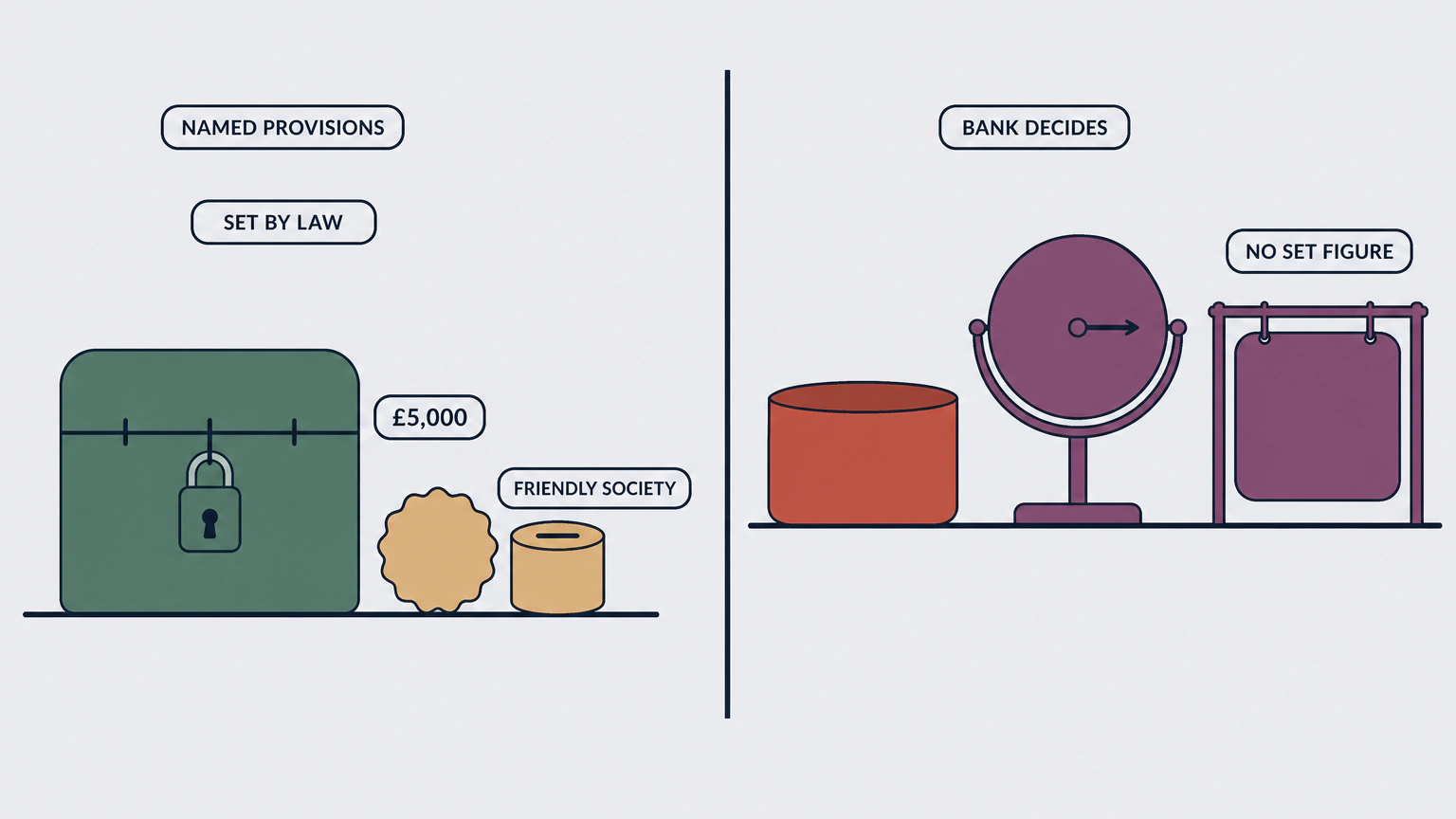
There is no general legal answer, because there is no general legal probate threshold for an ordinary bank account in the UK. Bank probate limits are commercial policy, set by each institution for itself. The £5,000 repeated across half the pages you have read comes from an Act of Parliament passed in 1965, and it does not govern an ordinary high street bank account. GOV.UK says it in five words: "Every organisation has its own rules."
So we opened the bereavement pages of five big names to see what those rules are. One of them, Barclays, publishes a figure. The other four say some version of "we'll tell you what we need", which is honest and no use to you this morning.
Which points at the one thing worth doing today. Ask the bereavement team at every bank, building society and provider the person used what they need to release that particular balance. Put the question in writing. Their reply is the only answer that governs your situation.
Where the £5,000 figure actually comes from
The £5,000 is real. It sits in a real statute and it does a real job. It does not govern an ordinary high street bank account today. That gap between what the figure is and what everyone says it is has cost bereaved families arguments they didn't need to have.
What the Small Payments Act really covers
The Administration of Estates (Small Payments) Act 1965 solves a narrow, old problem. Certain member-run and state-run funds held small amounts for people, often payable on a nomination the member had signed years earlier. Making a family obtain a grant of probate to collect a modest sum from a friendly society could be disproportionate, so the law let those bodies pay small balances without a grant.
The Act raises the ceiling on that shortcut. What it does not do is raise it everywhere. It applies only through the enactments and instruments named in its schedules, and many of those entries have since been repealed. Current £5,000 examples linked to the same framework include friendly societies, co-operative and community benefit societies, National Savings Bank deposits and trade union death benefits. Some older railway and service-payment provisions remain too.
The number is £5,000, and it has been £5,000 since an order made in 1984. We checked the whole family of instruments under that Act. Nothing has raised it since.
Why an ordinary current account is not on that list
Read the current provisions again and notice what isn't there. No ordinary bank or building society is governed by the £5,000 shortcut today. Nothing resembling the current account your mother paid her pension into.
That makes quoting the £5,000 at a bank an empty move. The bank isn't ignoring the law and there's no clause you can cite at it, because the statutory £5,000 shortcut does not apply to an ordinary bank account. It's why a call that opens with "but the legal limit is £5,000" tends to go nowhere polite.
Building societies are the interesting exception, and only historically. The Building Societies Act 1962 did appear on the original list, and Parliament struck the entry out in 1986. The old Post Office Savings Bank and trustee savings bank entries went the same way. Those three retail-deposit entries have all since been removed from it.
One more thing before the number goes to bed. Northern Ireland has its own 1967 Act, and a 2020 order raised a specified set of small-payment provisions from £10,000 to £20,000. They cover a railway provision, co-operative societies, credit unions, trade unions and specified public-service payments. They still do not create a general £20,000 threshold for ordinary bank accounts.
What the banks' own pages actually say
There's no clever method here. We opened the bereavement pages of five large UK institutions and read what each one tells its own customers, which is the same reading anyone can do and the one we run on every figure before it goes on the page at Legal Directorate.
| Institution | Publishes a figure? | Its own wording | Where we read it |
|---|---|---|---|
| Barclays | Yes, £50,000 | "If the person had more than £50,000 across their sole accounts with us, we'll need to see a grant of probate, grant of confirmation or letters of administration." | barclays.co.uk bereavement pages |
| HSBC UK | No | "In some cases, we'll let you know if we also need to see an original or certified copy of the grant of probate or letters of administration. We reserve the right to ask for any further documents if needed." | hsbc.co.uk bereavement FAQs |
| NatWest | No | "Once you've notified us, we'll send you a letter detailing exactly what documents we need." | natwest.com bereavement guide |
| Nationwide Building Society | No | "We will tell you if we need to see proof of probate." | nationwide.co.uk bereavement support |
| TSB | No | Lists a grant of probate, confirmation or letters of administration among the "documents we may need", with no threshold stated. | tsb.co.uk bereavement pages |
One figure from five institutions. It also explains something you may already have noticed: the bank-by-bank tables on comparison sites disagree with each other about the same banks. Some current tables print figures for institutions whose own bereavement pages publish none, so the first source can be impossible to identify. The policy underneath is commercial, it can change, and a third-party table is not the institution's own promise. None of that is dishonest. It just isn't checkable, and you're about to make a decision worth several hundred pounds.
Barclays publishes a number, and it is worth knowing how it is measured
Barclays is the outlier, and its wording repays a slow read: "If the person had more than £50,000 across their sole accounts with us, we'll need to see a grant of probate, grant of confirmation or letters of administration."
Two things inside that sentence get missed. The first is "across their sole accounts", plural. It isn't £50,000 per account. Add up the current account, the savings account and the cash ISA held in that one name at that one bank, and the total is what counts. Three accounts of £20,000 each is £60,000, which is over the line.
The second is the direction the sentence runs. It tells you when a grant becomes necessary. It isn't a promise that everything underneath will be released on production of a death certificate and a smile. Barclays does say plainly that you don't need probate for joint bank accounts, which matters more than the headline figure for most families.
HSBC, NatWest, Nationwide and TSB tell you they will tell you
The other four treat it as a conversation rather than a rule. Nationwide's line is the shortest: "We will tell you if we need to see proof of probate." NatWest says that once you've notified it, "we'll send you a letter detailing exactly what documents we need". TSB lists a grant among the documents it may need and stops there. HSBC reserves the right to ask for further documents if needed.
So the answer arrives after you notify them, not before, and it can reflect the balance, account types and any dispute the institution sees. Publishing no threshold leaves the outcome case-specific. It can cut either way, which is why a written question is worth more to you than any number on any comparison site.
What we could not find out
Three other institutions wouldn't open their bereavement pages to us at all, and we'd rather say so than fill the gap with a figure lifted from somewhere else. If one of them holds the account you're dealing with, nobody outside that institution can tell you its answer. Ask it directly, and get the reply in writing.
The three things that really decide it
Most guides skip this part. For a great many estates the balance never decides anything, because three other facts settle the question first.
How the account was held
Money held jointly usually passes straight to the surviving owner, whatever the sum. GOV.UK's own list says you may not need probate if the person who died "owned shares or money with others", because that "automatically passes to the surviving owners unless they have agreed otherwise". The same goes for property held as joint tenants. Barclays and HSBC both confirm it for their own accounts.
A couple with everything in joint names often finds there is nothing to apply for. The phrase to watch is "unless they have agreed otherwise", which occasionally bites where the money was only ever one person's and the joint arrangement was for convenience. If this has you thinking about your own affairs rather than someone else's, that is a conversation for wills and estate planning solicitors while everyone is well.
Whether a property is in a sole name
If the person owned land or property in their sole name, or held a share as tenants in common, a grant is almost certainly needed to transfer or sell it.
Once that's true, the bank balance stops mattering to the decision, because you're applying anyway. Stop hunting for bank probate limits and start on the application: every institution holding money will accept a grant, including the ones that would never have insisted on one.
The discretion that outlives any published limit
An institution can still ask for a grant below any figure it publishes, and HSBC writes its discretion down: "We reserve the right to ask for any further documents if needed."
The clearest published trigger is a dispute in the family: HSBC says that where it knows a dispute exists over the estate it will not release funds until it has seen the grant. NatWest also says it requires a grant where it holds safe-custody items or one is already being applied for.
None of this is the bank being difficult. That is why the bank checks who is entitled before it pays.
Red flag: stop before signing anything if a limit was quoted to you on the phone and nobody will confirm it in writing; if an indemnity form arrives before anyone has told you the date-of-death balance; if you're being shown a figure from a comparison website as though it binds the institution; or if anyone in the family has started disagreeing about the will or about who is entitled. At that last point the risk of a grant being required rises, and it is time to take advice.
How to get your institution's answer in writing
A phone call gets you an answer. Writing gets you an answer you can hold someone to six weeks later, when the person who gave it has moved teams and nobody can find a note of the conversation. It also settles what the institution will accept before you spend £526 on an application you may not need.
The industry Death Notification Service, if you've used it, tells several institutions that the person has died. It does not ask them your question.
- Say who you are and how you are related to the person who died, and give their full name, date of birth and date of death.
- Give whatever account details you hold, even if that is only a sort code and the last four digits of an account number.
- Ask for the balance as at the date of death, in writing, for every account and product they held with you.
- Ask the direct question: what will you need from me to release this balance, at this amount?
- Ask whether you will accept a small estates indemnity instead of a grant, and please send me the form.
- Ask whether anything else you hold changes the answer, naming ISAs, safe custody items and joint accounts.
- Ask for the reply by letter or secure message, keep it, and repeat with every other institution separately.
What to send, and exactly what to ask for
Have ready the death certificate or a certified copy, proof of your own identity and address, and the will if there is one. The institution will tell you what to send and how. Many now offer an online bereavement form.
Two things trip people up. The first is asking for the current balance instead of the balance at the date of death. Interest, direct debits and refunds keep moving after a death, and the date-of-death figure is the one you need for the estate accounts and the clearest figure to put to the institution.
The second is asking about the estate as a whole. Nobody in a call centre can tell you how another company will behave. Each institution answers only for the money it holds, so ask each one about its own balance.
What signing a small estates indemnity actually commits you to
Where an institution is willing to release funds without probate, it may ask you to sign an indemnity first. NatWest describes it as a document, signed and witnessed, that lets the bank release funds to the executor or next of kin where a grant is not being applied for.
Read what it does. The bank is handing over money without the court's confirmation that you're the right person to receive it, so the form moves risk onto you. NatWest's form says that if a personal representative with a grant later makes a claim, you must repay the money and reimburse the bank's reasonable losses, expenses and other costs. For a modest balance in an uncontested estate that may be a sensible trade. For a large balance, or an estate where anything is unresolved, it can be a great deal of personal exposure in exchange for avoiding the probate application.
We are not your solicitor. If anyone disagrees about the will or about who inherits, that is the point to get one, before you sign an indemnity rather than after.
If you do need a grant, what it costs and what it is called where you live
In England and Wales the fee is fixed and public. Applying for probate costs £526 where the estate is worth more than £5,000, and there's no fee at all if it's £5,000 or less. Copies of the grant cost £2 each when ordered with the application and £16 each afterwards, so count the institutions that want one and order them all at the start. A second application later, if another executor needs to step in, costs £22. On a low income or certain benefits you may be able to get help with the fee, through form EX160.
Doing it yourself is realistic for a simple estate with a clear will. Where there's property to sell, a business, a trust, an intestacy or a family that has gone quiet on each other, probate solicitors earn their fee. Ask for the basis of the charge in writing before instructing anyone, because a fixed fee, an hourly rate and a percentage of the estate produce very different bills on the same job.
The same job, three different names and three different money lines
A grant will normally be taken out in the part of the UK where the person who died was domiciled, not where you live. A son in Manchester dealing with his father's estate in Aberdeen will normally apply in Scotland.
England and Wales issue a grant of probate where there is a will and letters of administration where there is not. Scotland calls the document confirmation and routes the application through the sheriff court. An estate of £36,000 or less counts there as a "small estate", and the sheriff clerk's office will help you prepare the inventory. Take that help: where the clerk prepares it you don't need a bond of caution, and there's no statutory court fee for issuing confirmation in a small estate. Solicitors across Scotland handle the larger ones.
Northern Ireland issues probate or letters of administration through its own probate office, charges a court fee where the assets are worth more than £10,000, and nidirect tells people a grant is almost always needed where the person left around £20,000 in any one account. Solicitors in Northern Ireland work within a separate probate system, and it's worth using one who knows it.
| Where the person who died was domiciled | What the grant is called | The money line | What that figure actually governs |
|---|---|---|---|
| England and Wales | Grant of probate, or letters of administration where there is no will | £526 application fee where the estate is over £5,000; no fee at £5,000 or less | The court fee only. It has nothing to do with whether a bank releases money. |
| Scotland | Confirmation | £36,000 or less is a "small estate" | Which sheriff court procedure applies, whether the sheriff clerk helps, and whether a bond of caution is needed |
| Northern Ireland | Probate, or letters of administration where there is no will | £20,000 for the provisions named in the 2020 small-payments order; court fee where assets exceed £10,000 | The £20,000 applies to named provisions including credit unions and co-operative societies; nidirect separately uses around £20,000 in one account as its general guidance figure |
If you do instruct a solicitor and the bill or the delay turns out to be nothing like what you were told, the complaint deadline is shorter than most people expect and differs by nation: how to complain about a solicitor sets out which clock applies to you.
Frequently asked questions
How much money can you have in the bank before probate is needed?
There is no general legal figure for an ordinary bank account. Each bank sets its own, and only one of the five we checked publishes it: Barclays asks for a grant where the person held more than £50,000 across their sole accounts with it. HSBC, NatWest, Nationwide and TSB publish nothing and tell you what they need after you notify them of the death.
Do joint bank accounts need probate?
Usually not. Money in a joint account normally passes to the surviving account holder by survivorship, whatever the balance. Barclays says its joint bank accounts pass into the survivor's name, and HSBC says it usually would not need a grant where all accounts are joint. The exception is where the owners had agreed the money was not really shared.
Does HSBC have a probate limit?
Not one it publishes. HSBC's own bereavement pages carry no threshold at all. They say HSBC will let you know if it also needs to see the grant of probate or letters of administration, and that it reserves the right to ask for further documents if needed. Figures attributed to HSBC on comparison tables are not from HSBC.
Can a bank still ask for probate if the balance is under its own limit?
Yes, and they say so. HSBC reserves the right to ask for any further documents it needs, and states that where it is aware of a dispute over the estate it will not release funds until it has seen the grant. A published limit can tell you when that institution requires a grant, not when a grant becomes impossible below it.
Do I need probate for Premium Bonds?
Premium Bonds don't follow bank rules. NS&I says it may ask for a grant where the customer's total NS&I savings are £5,000 or over, and it reserves the right to request one at any value. The statutory £5,000 route for National Savings Bank deposits is not the source of that policy, because a Premium Bond is not a National Savings Bank deposit.
How long does a bank take to release the money once it has everything it needs?
HSBC aims to release funds within two weeks of receiving all the documents where the money sits in savings and current accounts, and says investments take longer. Nationwide says closing normally takes up to two weeks. Those are two institutions' own stated aims rather than a general rule, and HSBC separately says it will not release funds while it knows there is an estate dispute.