

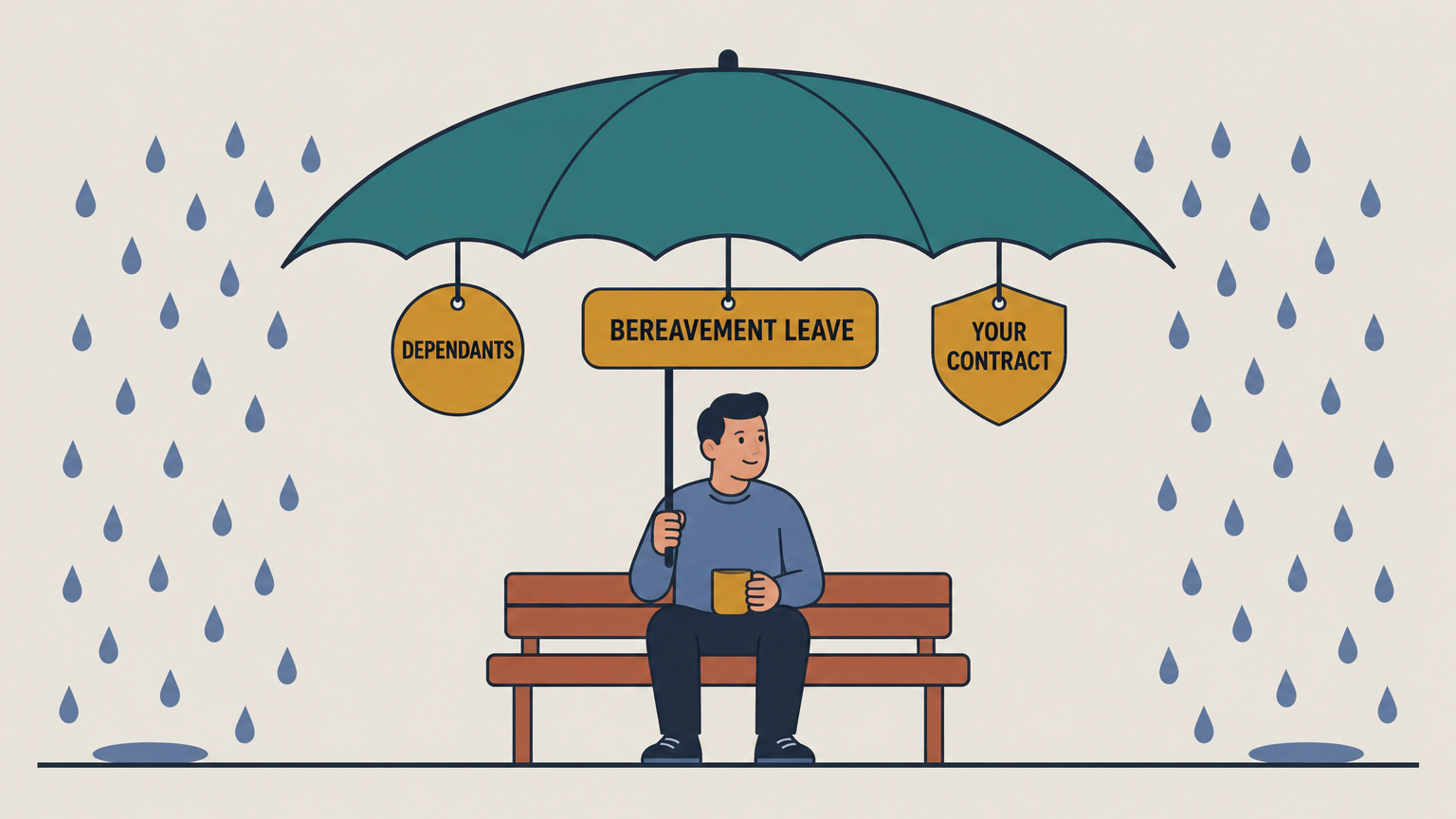
If someone close to you has died, you can almost always take some time off, but the law guarantees less than most people expect. In England, Scotland and Wales any employee can take a reasonable amount of unpaid time off to deal with the death of a dependant, such as arranging and going to the funeral. Parents whose child under 18 dies or is stillborn get two weeks' parental bereavement leave, paid if they've worked there 26 weeks and earn at least £129 a week. Paid compassionate leave beyond that comes from your contract or your employer's policy, Northern Ireland treats bereaved parents more generously, and a wider unpaid bereavement leave right is planned for April 2027.
If you work in Northern Ireland, parental bereavement leave and pay also cover miscarriage, and the pay is a day-one right.
On this page
- Compassionate leave is your employer's word, not the law's
- Who died decides what the law gives you
- Is compassionate leave paid?
- Northern Ireland pays bereaved parents from day one, and covers miscarriage
- The new bereavement leave right and who it covers
- How to ask for time off, and what to get in writing
- If your employer says no
- Compassionate leave questions people ask
Compassionate leave is your employer's word, not the law's
No UK law gives you a right called compassionate leave. GOV.UK uses the phrase only for leave your employer chooses to allow, paid or unpaid. Acas notes that employers may call the same thing compassionate leave, bereavement leave or special leave.
For most workers, underneath those names sit three legal rights: time off for dependants, parental bereavement leave and, since April 2026, bereaved partner's paternity leave. Paid leave beyond the parental bereavement scheme and farm-worker rights in Wales and Scotland comes from your contract or your employer's policy. GOV.UK's own advice is to check your contract, staff handbook or intranet.
Which of the three rights you have depends on one thing. Who died.
Who died decides what the law gives you
Find the person you've lost in the first column and read across. Each row shows the general legal right today in England, Scotland and Wales, whether the law makes your employer pay, and what the planned April 2027 right would add. Then read the section on your right, because the detail decides how much time you get.
| Who died | Your legal right today | Paid by law? | From April 2027 (planned) |
|---|---|---|---|
| Your child under 18, or a stillbirth after 24 weeks of pregnancy | Two weeks' parental bereavement leave, from your first day in the job | Yes, if you'd worked there for 26 weeks up to the end of the week before the week of the death and earn £129 a week or more: £194.32 a week or 90% of average weekly earnings, whichever is lower | No change announced |
| A pregnancy loss before 24 weeks | No statutory leave. Your employer's policy, or sick leave if you're unwell | No | Up to two weeks' unpaid leave, for you and your partner |
| Your husband, wife or civil partner, or a partner you lived with | Time off for dependants: a reasonable amount of time to deal with the death, such as arranging and going to the funeral | No, unless your contract says so | Up to two weeks' unpaid bereavement leave |
| A partner you didn't live with | No legal right. Your employer's policy decides | No, unless your contract says so | Up to two weeks' unpaid bereavement leave |
| Your mother or father | Time off for dependants | No, unless your contract says so | Up to two weeks' unpaid bereavement leave |
| Your son or daughter aged 18 or over | Time off for dependants | No, unless your contract says so | Up to two weeks' unpaid bereavement leave |
| Your brother or sister | Time off for dependants if they lived in your home. Otherwise, no legal right | No, unless your contract says so | Up to two weeks' unpaid bereavement leave |
| A grandparent, grandchild, aunt, uncle, in-law or friend | Time off for dependants if they lived in your home. Otherwise, no legal right | No, unless your contract says so | Not covered |
Northern Ireland has different rules for parents. "Lived in your home" means as part of your household, not as a tenant, lodger, boarder or employee. The government published the April 2027 plan on 22 September 2026, and it still needs regulations. Step, half and adoptive relationships will count under it.
Time off for dependants covers the funeral, not the grieving
This is the right most bereaved employees lean on, and it's narrower than people think. The Employment Rights Act 1996 lets you take time off "in consequence of the death of a dependant". The time must be "reasonable", and no number is attached. Tell your employer the reason as soon as you reasonably can, and how long you expect to be off. GOV.UK says you don't have to do that in writing or give written proof. The time is unpaid unless your contract says otherwise.
For a death, a dependant is your spouse or civil partner, your child, your parent, or a person who "lives in the same household as the employee, otherwise than by reason of being his employee, tenant, lodger or boarder". The Act says "a child", with no age limit. Most lists online add someone who relies on you, such as an elderly neighbour. That wider group counts only for illness, injury and arranging care, so a neighbour you looked after isn't a dependant when they die.
The government's consultation response draws the line. The right covers action "such as making funeral arrangements", but it "does not cover time off specifically for bereavement or to grieve". If you're the executor, the estate will need you for months, and probate solicitors can take much of that work on.
From your first day, your employer mustn't treat you worse, dismiss you or pick you for redundancy for taking or asking for this time. A dismissal for it is automatically unfair. Acas points out one catch: the right belongs to employees, so agency and casual workers may not have it.
Parental bereavement leave if your child has died
Outside farming, this is the only bereavement right in Great Britain that comes with pay. It applies when a child dies under 18 or is stillborn after 24 weeks of pregnancy. GOV.UK lists parents, a parent's partner, adoptive parents and intended parents through surrogacy. Some day-to-day carers also qualify if the child lived with them for four continuous weeks before the death. Paid carers usually do not qualify, though local-authority foster payments and expenses are allowed. Neither does that last group if a parent or someone with parental responsibility also lived there.
You get two weeks from your first day in the job, taken together, as two separate weeks, or as one week only. A week means the days you normally work, so it's two days if you only work Mondays and Tuesdays. All of it has to be taken within 56 weeks of the death.
Notice is light. In the first eight weeks, tell your employer before you'd normally start work on your first day off. After that, give a week's notice. A call, text or email will do, and you never have to prove the death.
The pay is £194.32 a week, or 90% of your average weekly earnings if that's lower. You need 26 weeks with your employer by the end of the week before the week of the death, and average earnings of at least £129 a week. Ask for it in writing within 28 days of the start of the week you're claiming for, and sign a one-off declaration. After a stillbirth, Acas notes, you keep your maternity or paternity rights too.
Northern Ireland pays it from day one and covers miscarriage. NHS staff get at least two weeks at the pay they'd have earned, for a child of any age.
If your partner dies while your baby is under one
Some of you have lost a partner and a co-parent in the same moment. If that's you, we're so sorry.
For deaths on or after 6 April 2026 in England, Scotland and Wales, bereaved partner's paternity leave lets you stay at home with your child. It applies if the child's mother, main adopter or main intended parent dies, and you're the child's father or that person's partner, with the main caring responsibility.
You can take unpaid leave from the day after the death until your child's first birthday, or the first anniversary of an adoption placement. That's up to 52 weeks, in one continuous block. It's yours from your first day in the job, whatever your hours or pay. If the death came less than 14 days before that birthday or anniversary, you can take up to two weeks. It can sit before or after any other parental leave you're entitled to. Northern Ireland has no equivalent right.
Is compassionate leave paid?
Usually not by law. Acas is plain that there's no legal right to paid time off for bereavement, unless you qualify for parental bereavement pay. Farm workers in Wales and Scotland are the one exception.
Your contract decides the rest. If it gives you paid compassionate leave, your employer has to honour it, because employment contracts are, in Acas's words, "legally binding agreements". A contract can include workplace policies too, so a handbook policy may bind your employer. If the policy calls the leave discretionary, your employer decides, but Acas says they should be consistent and confirm the decision in writing. It also warns that refusing time off for a religious ceremony after a death could be religion or belief discrimination. That's a question for discrimination solicitors.
Most HR pages say employers give three to five days. The nearest evidence we found is a 2022 CIPD survey of employers, where three to five paid days was the most common allowance, but at only four in ten firms. Ask HR for the written policy rather than trusting a typical figure.
Where paid bereavement days are written into your terms
Some workers don't depend on a manager's goodwill, because paid bereavement days are written into their national terms.
NHS staff on Agenda for Change terms have section 33 of the NHS Terms and Conditions of Service Handbook. Both its England, Wales and Northern Ireland version and its Scottish one say local policies "should entitle employees to paid bereavement/compassionate leave including for funeral/memorial services". Short emergency leave is expected to be paid. If your request is refused, you're entitled to a written explanation and can appeal through the grievance procedure. Section 23 gives bereaved parents at least two weeks at the pay they'd have earned, for a child of any age, with no eligibility test and no death certificate.
Farm workers in Wales have the Agricultural Wages (Wales) Order 2025, which GOV.WALES says still applies because no 2026 Order has been agreed. The days are paid at your holiday-pay rate. For a child, that rate covers the first four days, or the pro-rated equivalent if you work four days a week or fewer. The statutory parental bereavement rate covers the rest. In Scotland, the 2026 Order gives at least three days' paid absence.
| Who | What the terms give you | Where it's written |
|---|---|---|
| NHS staff on Agenda for Change terms | Your employer's local policy should give paid compassionate leave, including for a funeral or memorial. No national number of days | NHS Terms and Conditions of Service Handbook, section 33 |
| NHS staff whose child dies, at any age | At least two weeks' leave on the pay you'd have earned, with no service test and no death certificate | NHS Terms and Conditions of Service Handbook, section 23 |
| Farm workers in Wales | Two weeks for a child. Four days for a parent, spouse, civil partner or partner you lived with. Two days for a brother, sister, grandparent or grandchild | Agricultural Wages (Wales) Order 2025, articles 40 to 42 |
| Farm workers in Scotland | At least three days' paid absence when your child, parent, spouse or partner you lived with dies | Agricultural Wages (Scotland) Order (No. 73) 2026, article 12 |
In Wales, the four-day and two-day amounts are pro-rated if you work four days a week or fewer, though never below one day. The two weeks for a child aren't.
Holiday and sick leave when you need more time
When the days you've been given run out and you're not ready to go back, holiday and sick leave are the usual bridges. Acas says the time can be agreed as sick leave or, if you ask, as holiday.
You can ask for holiday, but under the Working Time Regulations your employer can refuse it with notice, and the default notice you owe is twice the length of the holiday. Short-notice holiday is a favour unless your contract says otherwise.
If grief leaves you unwell, you're off sick like anyone else. In England, Scotland and Wales, Statutory Sick Pay is £123.25 a week or 80% of your normal weekly earnings, whichever is lower, from your first full day off. You'll need a fit note after more than seven days in a row. Your employer's scheme may pay more. Ask how the time is being recorded, because sickness absence can count against you under some policies. Our guide to how much statutory sick pay you'll get walks through the sums.
Northern Ireland pays bereaved parents from day one, and covers miscarriage
Northern Ireland makes its own employment law, and for bereaved parents it's now ahead of the rest of the UK. Time off for dependants works the same way there, under article 85A of the Employment Rights (Northern Ireland) Order 1996.
Since 6 April 2026, parental bereavement leave and pay also cover a miscarriage before 24 weeks, where the loss happened or was discovered on or after that date. The nidirect guidance includes losses after medical or surgical intervention, such as an ectopic or molar pregnancy. The right belongs to the person who was pregnant and to a partner or intended parent.
The pay is now a day-one right, with no 26-week service test. You still need average earnings of £129 a week, and if you're new, your employer has to make a fair estimate of them. No medical evidence is needed, only a declaration.
Northern Ireland has no bereaved partner's paternity leave, and the planned 2027 right won't reach it. The deadline to complain about refused time off for dependants is still three months minus one day from the refusal, to an industrial tribunal, as Northern Ireland calls it. With the law this different, advice from solicitors in Northern Ireland matters more than usual.
| England, Scotland and Wales | Northern Ireland | |
|---|---|---|
| Leave after a pregnancy loss before 24 weeks | None until the planned April 2027 right, which will be unpaid | Up to two weeks' parental bereavement leave and pay, for losses on or after 6 April 2026 |
| Service needed for parental bereavement pay | 26 weeks up to the end of the week before the week of the death | None, since 6 April 2026 |
| Earnings needed for parental bereavement pay | £129 a week on average | £129 a week on average, and your employer estimates it if you're new |
| Bereaved partner's paternity leave | Up to 52 weeks, unpaid, for deaths on or after 6 April 2026 | No equivalent right |
| Deadline to complain about refused time off for dependants | Six months minus one day from the refusal, if it happened on or after 1 October 2026 | Three months minus one day from the refusal |
In both, the pay is £194.32 a week, or 90% of average weekly earnings if that's lower. Time off for dependants works the same way in both.
The new bereavement leave right and who it covers
Several HR guides still describe the new right as at least one week. That's only the floor written into the Act. The Employment Rights Act 2025 rewrote the parental bereavement provisions into a general bereavement leave right, but legislation.gov.uk shows it in force only "for specified purposes" since 6 January 2026. That means the power to make regulations, not the right itself.
On 22 September 2026 the government published its decision in a consultation response, and said regulations will bring the right in from April 2027. You'll get up to two weeks, based on your usual working pattern, so four days if you work Mondays and Tuesdays. It will apply from your first day in a job, and it will be unpaid. You can take it in single days, within 56 weeks of the death or of the day you learned of it. In the first eight weeks you'll need to tell your employer before you start work that day, or as soon as reasonably possible afterwards. After that, you must give a week's notice. Any form of notice will do, and no evidence will be required.
It will cover a spouse, civil partner or committed partner, whether or not you lived together, a parent, an adult child or a sibling. Biological, adopted, step and half relations count, and so do parental relationships in kinship or foster care.
It will also cover pregnancy loss before 24 weeks, including miscarriage, termination and a failed IVF embryo transfer. That leave is for the person who was pregnant, their spouse, civil partner or partner, the other parent, an intended co-parent and intended parents through surrogacy.
Grandparents, grandchildren, aunts, uncles, cousins, in-laws and friends are left out, though the government says employers should consider going further. The right will apply in Great Britain only. Until April 2027, time off for dependants and parental bereavement leave are what the law gives you, and nothing stops your employer offering more now.
How to ask for time off, and what to get in writing
Keep the first message short. The law asks only that you give the reason as soon as you reasonably can, with your best guess at how long you'll be off. If you can't face the call, Acas says a family member or close friend can contact work for you. You don't owe anyone proof of the death for any statutory right. Ask how the time is being recorded and whether it's paid, and get the answer in writing, which Acas tells employers to do anyway.
Some of the time will go on paperwork, and the banks are usually near the top of the pile. Our guide to bank probate limits explains how banks decide what to release without a grant of probate.
- Tell your manager who died and that you need time off, as soon as you reasonably can.
- Give your best guess at how long you'll be off, and update it if that changes.
- If your child has died, say you're taking parental bereavement leave and when it starts.
- Ask which kind of leave the time is being recorded as, and whether your policy pays it.
- Ask for the answer in an email, so the decision is in writing.
If your employer says no
Start informally with your manager or HR. If that fails, Acas suggests raising a formal grievance.
If your employer unreasonably refuses time off for dependants, you can complain to an employment tribunal. You have six months minus one day from a refusal on or after 1 October 2026, or three months minus one day for an earlier one. In Northern Ireland it's three months minus one day from the refusal. In England, Scotland and Wales you must notify Acas first, and early conciliation pauses the clock. In Northern Ireland the Labour Relations Agency plays that role. A grievance doesn't stop the clock, so watch the date.
Being disciplined, sidelined or dismissed for taking the time is a separate claim, with no minimum length of service. A dismissal for it is automatically unfair, and our guide to unfair dismissal explains how those claims work. If paid leave is written into your contract, refusing it may be a breach of contract.
Acas's helpline is 0300 123 1100, and Citizens Advice explains your rights for free. If you need more than that, employment solicitors can tell you whether a claim is worth bringing.
We're not your solicitor, and if a refusal has already cost you pay or your job, it deserves one. Talk to Acas or an employment solicitor before the deadline runs.
Compassionate leave questions people ask
Can my employer refuse compassionate leave?
Yes, if it's discretionary paid leave, but not the legal minimum. Your employer must allow reasonable time off for dependants after a dependant's death, and parental bereavement leave when a child dies. Leave written into your contract must be honoured. An unreasonable refusal of time off for dependants can go to a tribunal within six months minus one day of a refusal on or after 1 October 2026. In Northern Ireland, the limit is three months minus one day.
How many days of compassionate leave do you get in the UK?
For most workers, no law sets a number of days, except two weeks when your child dies. Time off for dependants is simply "reasonable". The planned April 2027 right gives up to two weeks for close family. Anything else is your employer's policy. A 2022 CIPD survey found three to five paid days was the most common allowance, but only four in ten employers gave it.
Do you get compassionate leave when a grandparent dies?
Only time off for dependants, and only if your grandparent lived in your household. Otherwise it's down to your employer's policy, holiday or unpaid leave. The planned 2027 bereavement leave right leaves grandparents out, though the government has asked employers to consider going further. Farm workers in Wales are the exception, with two paid days for a grandparent under their wages order.
Is compassionate leave paid in the NHS?
For staff on Agenda for Change terms, it should be. Section 33 of the NHS terms says local policies should give paid compassionate leave, including for funerals, but it sets no national number of days, so check your trust's own policy. Section 23 separately gives at least two weeks' paid leave if your child dies, at any age.
Can you get time off work after a miscarriage?
In England, Scotland and Wales there's no statutory leave yet, so it's sick leave if you're unwell, or your employer's policy. Acas says pregnancy-related sickness absence should be recorded separately and kept out of absence triggers. The planned April 2027 right gives up to two weeks unpaid. In Northern Ireland, parental bereavement leave and pay have covered miscarriage since 6 April 2026.
Does compassionate leave count as sick leave?
No, they're different kinds of leave. If you're unwell, your employer can agree to record the time as sick leave, and Acas says you should then get your usual sick pay. Ask how it's being recorded, because sickness absence can count towards your employer's absence triggers.
Do you need proof of a death to get bereavement leave?
Not for any statutory right. Time off for dependants needs no written proof, parental bereavement leave needs none, NHS section 23 bars asking for a death certificate, and the 2027 plan has no evidence requirement. Your employer's own paid policy may ask for something, so check what it says.