

Constructive dismissal is when you resign because your employer has seriously broken your employment contract, and the law treats your resignation as a dismissal. In England, Scotland and Wales you can usually then claim unfair dismissal once you've worked there two years, or six months if your job ends on or after 1 January 2027. You must contact Acas within six months less a day of the day your job ends, if that's on or after 1 October 2026.
Acas doesn't sugar-coat it: "Resigning is a big step to take, and a constructive dismissal claim can be difficult to win at an employment tribunal." So before you press send, here's what counts, how people lose these claims before they start, when your deadline really begins, and what to do this week.
On this page
- What the law counts as constructive dismissal
- Before you hand in your notice
- How to resign without losing your claim
- Have you worked there long enough?
- What a claim could be worth, and paying for help
- If you work in Scotland or Northern Ireland
- What to do this week
- Common questions about constructive dismissal
What the law counts as constructive dismissal
The test a tribunal applies
The law's own words are short. You count as dismissed if you end your contract "in circumstances in which [you are] entitled to terminate it without notice by reason of the employer's conduct". Put simply, your employer must have broken the contract so badly that you're entitled to walk away from it. Lawyers call that a "repudiatory breach".
Claims can rest on a promise that sits in every contract, written down or not. Your employer mustn't, "without reasonable and proper cause", behave in a way "calculated or likely to destroy or seriously damage the relationship of confidence and trust" between you. The courts treat any breach of that promise as serious enough.
Three things follow. The test is objective, so a tribunal asks what a reasonable person would make of the conduct, not how hurt you feel. Your employer doesn't have to mean it, because "likely" is enough. And the proof is on you. Citizens Advice says you'll "need to prove your employer seriously breached your contract and that you resigned in response to it".
The Court of Appeal pulled all of this together in 2018, in a case called Kaur.
A tribunal usually works through these five questions, in order:
- What was the last thing your employer did that made you resign?
- Since then, have you accepted it by carrying on as if nothing had happened?
- Was that last thing a serious breach of your contract on its own?
- If not, was it the last in a series of things that, taken together, destroyed or seriously damaged the trust between you?
- Did you resign because of it, even if it was only part of your reason?
What usually counts as a serious breach
It can be one bad moment or a pile of smaller ones. Acas covers both: "It could be because of one serious incident or a series of things."
Bullying needs a word of its own, because there's no legal definition of it. Citizens Advice notes that a manager who criticises you constantly may say you're too sensitive about their management style, and name-calling gets brushed off as banter. Its advice is to report the bullying before you decide to resign. That gives your employer the chance to stop it, and if they don't, your claim is stronger. If it's got that far, harassment solicitors deal with exactly this.
Acas, Citizens Advice and nidirect all give examples like these:
- Cutting your pay, or regularly not paying what you agreed, without a good reason
- Demoting you
- Bullying or harassment that your employer allows, or ignores once you've reported it
- Refusing to look into a grievance you've raised
- Changing your hours, shifts or place of work without your agreement
- Leaving you to work somewhere unsafe
- Taking away a benefit your contract gives you, such as a company car
Citizens Advice warns that a tribunal could find a change fair if your contract allows it, if your employer consulted you first, or if it was an alternative to something worse, like redundancies.
When small things add up to a last straw
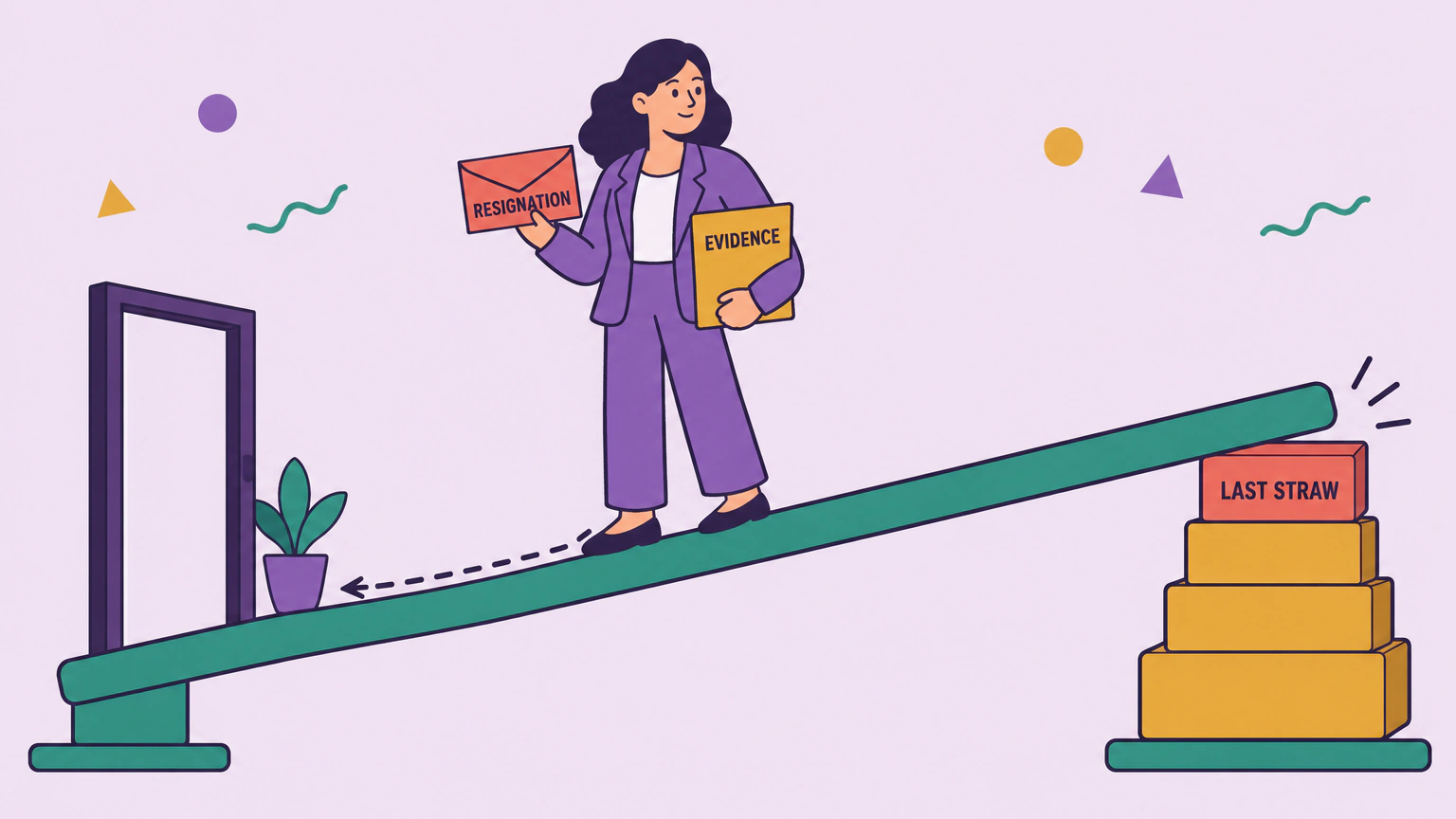
The last thing that happens before you resign doesn't have to be a serious breach on its own. It has to be the last in a series that, taken together, is one. The Court of Appeal says it "must contribute, however slightly" to the damage. It doesn't even have to be unreasonable when you look at it alone. But an "entirely innocuous" act can't be a last straw, however much it hurts.
Older treatment comes with a catch. An employee who "soldiers on and affirms the contract" can't lean on those earlier acts later, unless something new happens. When it does, the new act revives the right to resign over the whole pattern.
So keep a record of every incident, with dates. A last straw only works if the earlier straws can be shown.
Before you hand in your notice
Put it in writing as a grievance first
Citizens Advice suggests trying the other routes before you resign. Talk to your employer, ask your union to talk to them, ask for mediation, or start Acas early conciliation while you're still employed. Or raise a grievance, which it calls "a formal complaint which your employer can't ignore".
The Acas Code of Practice says to raise it "formally and without unreasonable delay with a manager who is not the subject of the grievance", and to do it in writing.
The stakes are narrower than people think. No law stops you claiming without a grievance, because the old rule that did was scrapped in Great Britain in 2009. But if a tribunal decides you unreasonably ignored the Code, it can cut your award by up to 25%. It can raise it by up to 25% if your employer was the one who did. And a grievance puts your complaint on paper, with a date on it.
Don't let it look as if you've accepted it
If you carry on as if nothing happened, a tribunal can decide you "affirmed" the contract. That means you chose to keep it going, and you've lost the right to resign over that breach.
Delay on its own isn't acceptance, the Employment Appeal Tribunal says, though a long or significant delay can become it. What matters is what you do. In the appeal tribunal's words, "the issue is essentially one of conduct and not of time". There's "no automatic time", either. It "all depends upon the context", including how long you've worked there and how much you depend on the job.
So what do you do while you think? Jacob LJ, a Court of Appeal judge, gave the answer: "Ideally a wronged employee who stays on for a bit whilst he or she considered their position would say so expressly." Tell your employer in writing that you don't accept what happened and you're considering your position. Do that, and working and drawing your pay while you decide isn't necessarily acceptance.
If you're signed off sick, the argument that you carried on as normal has "nothing like the same force". A tribunal can still find you accepted the breach, though, so send the letter anyway.
One more caution. Putting things right afterwards doesn't cancel a serious breach. But once your employer offers to make amends, the Court of Appeal says you "cannot ordinarily expect to continue with the contract for very long" without losing the option to leave.
When staying and objecting is the better move
Citizens Advice asks the right first question: would you want to stay if the problem were fixed? It also suggests finding a new job before you leave. And it warns that if the Department for Work and Pensions decides you had no good reason to resign, you could get less Universal Credit "for 3 months or longer".
If the problem is a pay cut you never agreed to, you don't have to resign to fight it. Keep working, object in writing, and claim the shortfall at an employment tribunal as an unlawful deduction from your wages.
If you sign a valid settlement agreement that covers your constructive dismissal claim, you give up the right to bring that claim.
Red flag: Don't resign over something that hasn't happened yet. If your employer has only said it will cut your pay or move you, and you quit before it does, nidirect warns that your employer could claim there was no dismissal at all. Get advice before you act.
How to resign without losing your claim
What your resignation letter should say
Acas tells you to spell it out: "In your resignation letter you should explain clearly your reasons for leaving." Citizens Advice agrees, because a written reason is your evidence. If you resigned out loud, follow it up with an email or letter.
Name the breach, and name the last thing that happened. That's the first question a tribunal asks. Our guide to resigning has a resignation letter for this situation, ready to adapt.
You can resign with notice or without it. Leaving without working your notice "could be a breach of your employment contract but it can be justified sometimes", Acas says, so take advice on that choice.
We're not your lawyer, and a resignation is the one step here you can't take back. Talk it through with your union, Citizens Advice or an employment solicitor before the letter goes. If you'd like to know who we are, here's how we work.
The day your job ends starts the clock
The clock doesn't start on the day you resign. It starts on the day your job ends. That's the last day of your notice if you give it and work it, or the day your resignation takes effect if you leave without notice.
If that day is on or after 1 October 2026, you have six months less a day in England, Scotland and Wales. Before that date it was three months less a day. Acas's method is simple: add the months, then take off a day.
Leave without notice on 15 October 2026, for example, and your last day to contact Acas is 14 April 2027. Give four weeks' notice on 15 October 2026 instead, and your job ends on 12 November 2026. Your last day is then 11 May 2027.
You must contact Acas for early conciliation before you can claim. It can last up to 12 weeks, and it pauses the clock while it runs. A grievance or an appeal doesn't pause it. Some guides still say three months, so check the date your job ends before you trust one. Our unfair dismissal guide's calculator will work out your exact deadline, conciliation pause included.
Have you worked there long enough?
The service rule, and the week the law adds
For an ordinary claim in England, Scotland and Wales, you need two years' continuous service by the day your job ends. If it ends on or after 1 January 2027, six months is enough. That includes someone who resigns in December 2026 with notice that runs into January.
If you resign outside an employer's notice period, service can count to the end of the statutory notice they would owe from your resignation date. That date must be later than your actual leaving date. Under two years, that's one week once you've worked a month. Citizens Advice puts it in one line: "This includes your statutory notice period."
Say you started on 8 November 2024 and walk out without notice on 4 November 2026. Two years would be complete on 7 November 2026, so you're three days short. Add the week, and your job counts as ending on 11 November 2026. That's enough.
The added week counts towards your service only, never towards your deadline. If you're anywhere near the line, take advice before you resign.
Claims that need no service at all
Some automatically unfair reasons let you claim without any service. For constructive dismissal, Acas names pregnancy, childbirth or maternity leave, health and safety, whistleblowing, asserting your rights under the Working Time Regulations, and asserting your right to the National Minimum Wage.
A resignation forced by discrimination counts as a dismissal under the Equality Act, and Citizens Advice confirms it needs no service. GOV.UK says legal aid may be available for discrimination disputes in England and Wales. If that's your situation, talk to discrimination solicitors.
Unpaid notice is a separate claim. You can bring it as wrongful dismissal whatever your service, and that's the work wrongful dismissal solicitors do.
| Claim | Service you need | Time limit, where the clock starts on or after 1 October 2026 |
|---|---|---|
| Constructive unfair dismissal | 2 years, or 6 months if your job ends on or after 1 January 2027 | 6 months less a day from the day your job ends |
| Unfair dismissal for a reason with no service requirement, such as whistleblowing or pregnancy | None | 6 months less a day from the day your job ends |
| Discrimination, including resigning because of it | None | 6 months less a day from the last act you complain about |
| Wrongful dismissal (unpaid notice), England and Wales | None | 6 months less a day from the day your job ends |
Where the clock started before 1 October 2026, these limits were 3 months less a day. In England and Wales a wrongful dismissal claim in the tribunal is capped at £25,000.
What a claim could be worth, and paying for help
How the money is worked out
Constructive dismissal compensation comes as two awards. The basic award is worked out like statutory redundancy pay, from your age, your service and a capped week's pay. The compensatory award is what the tribunal thinks "just and equitable" for the loss the dismissal caused you.
That second part depends on you, too. The tribunal expects you to look for work and keep your loss down, so walking into an equally paid job shrinks it. Either side's failure to follow the Acas Code can move the total up or down by up to 25%. And for jobs ending on or after 1 January 2027, there's no cap on the compensatory award at all.
Now the reality check. We couldn't find an official figure for constructive dismissal on its own. Government figures cover unfair dismissal awards as a whole: 646 in 2023/24, with a median of £6,746. Half the awards were below that, and half above. Our unfair dismissal guide sets out what each part of an award can be.
How to pay for advice
Making the claim costs nothing. GOV.UK says it plainly: "You do not have to pay a fee to make a claim to an employment tribunal." The risk is costs. A tribunal can order you to pay the other side's costs if it decides you've acted unreasonably.
Check the funding routes in this order. Your trade union may pay for a solicitor. Your insurance policies might cover the cost of a lawyer, so dig them out. Citizens Advice gives free advice, and the Acas helpline will talk through your options. In England and Wales, a damages-based no win no fee deal caps the solicitor's share at 35% of what you recover, VAT included. Expenses, including barristers' fees, sit outside that cap.
If you do go to an employment solicitor, it's worth knowing what a solicitor charges by the hour before the first meeting.
If you work in Scotland or Northern Ireland
Scotland shares the same Act, the same rules on constructive dismissal, service and time limits, and Acas. Two things differ. The 35% cap on damages-based deals is an England and Wales rule. Scotland's notice-pay deadline is currently three months less a day. A proposed change would give you six months less a day if your job ends on or after 9 November 2026.
Northern Ireland has its own law. The definition of constructive dismissal is the same, but an ordinary unfair dismissal claim needs one year's service. You have three months less a day to claim. Early conciliation runs through the Labour Relations Agency, and claims go to an industrial tribunal. If the Agency's Code isn't followed, an award can move up or down by up to 50%. The 2025 changes to deadlines and service don't apply there. The government's nidirect site adds one warning: if you do resign, "ideally you should then leave your job immediately", or your employer may argue you accepted the treatment. Solicitors in Northern Ireland can advise on the local rules.
What to do this week
You don't need to decide everything today. You do need to protect your options, and that starts with paper. Work through this list before you hand anything in:
- Write down when the problems started, each incident since, and the last thing that happened.
- Raise a formal grievance in writing, addressed to a manager who isn't part of the problem.
- If you keep working while you decide, tell your employer in writing that you don't accept what's happened.
- Keep a diary, and save copies of emails, messages, payslips, your contract and the staff handbook.
- Ask for the information your employer holds about you with a subject access request. Organisations usually have one month to reply.
- Check whether you've worked there long enough, and work out your deadline, before you hand in your notice.
- Check your insurance policies for legal expenses cover, and ask your union whether it will help.
- Talk to Citizens Advice, the Acas helpline or an employment solicitor before you resign.
Common questions about constructive dismissal
Can I claim constructive dismissal with less than two years' service?
Usually not for an ordinary claim in England, Scotland or Wales if your job ends before 1 January 2027. If it ends on or after that date, six months is enough, even if you resigned in 2026 and your notice runs into January. You need no service for reasons such as whistleblowing or pregnancy, or if the breach was discrimination. Northern Ireland needs one year for an ordinary claim.
Can I claim constructive dismissal if I already have another job?
Yes, as long as the breach was part of the reason you left. The Court of Appeal's test asks whether you resigned "in response (or partly in response)" to it. The new job affects the money, not the claim. A tribunal compensates the loss you actually suffered and expects you to keep it down, so an equally paid job means a smaller compensatory award.
Do I have to raise a grievance before I resign?
No. The old rule that barred claims without one was repealed in 2009 in Great Britain and in 2011 in Northern Ireland. But if a tribunal thinks you unreasonably ignored the Acas Code, it can cut your award by up to 25%. In Northern Ireland, ignoring the Labour Relations Agency's Code can cost up to 50%. A written grievance also gives you dated evidence of what you complained about.
Can I claim constructive dismissal while I'm off sick?
Yes. Being signed off doesn't stop you resigning and claiming. The argument that you accepted the breach by carrying on has "nothing like the same force" while you're off sick, though a tribunal can still decide you did. So tell your employer in writing that you don't accept what happened. Citizens Advice adds a money point: if you resign, you won't get more in benefits than you would on sick pay.
What's the average payout for constructive dismissal in the UK?
The closest official number covers every kind of unfair dismissal award, not constructive dismissal alone. In 2023/24, government figures show 646 unfair dismissal awards with a median of £6,746. Your own figure depends on your pay, your service and how long you're out of work. Either side's handling of the Acas Code can move it by up to 25%.
Can I get a no win no fee solicitor for constructive dismissal?
You may. In England and Wales, a damages-based deal caps the solicitor's share at 35% of what you recover, VAT included. Expenses sit outside that cap. Before you sign any deal, check whether an insurance policy covers legal costs, or whether your union will pay for a solicitor. Making the claim itself is free, though a tribunal can order costs against you if you act unreasonably.
Can I claim constructive dismissal without resigning?
No, because constructive dismissal only happens when you end the contract yourself over your employer's conduct. If you'd rather stay, raise a grievance. For a pay cut you never agreed to, you can keep working, object in writing and claim the shortfall as an unlawful deduction from your wages. And if your employer told you to resign or be sacked, Citizens Advice says that counts as a dismissal in its own right.