

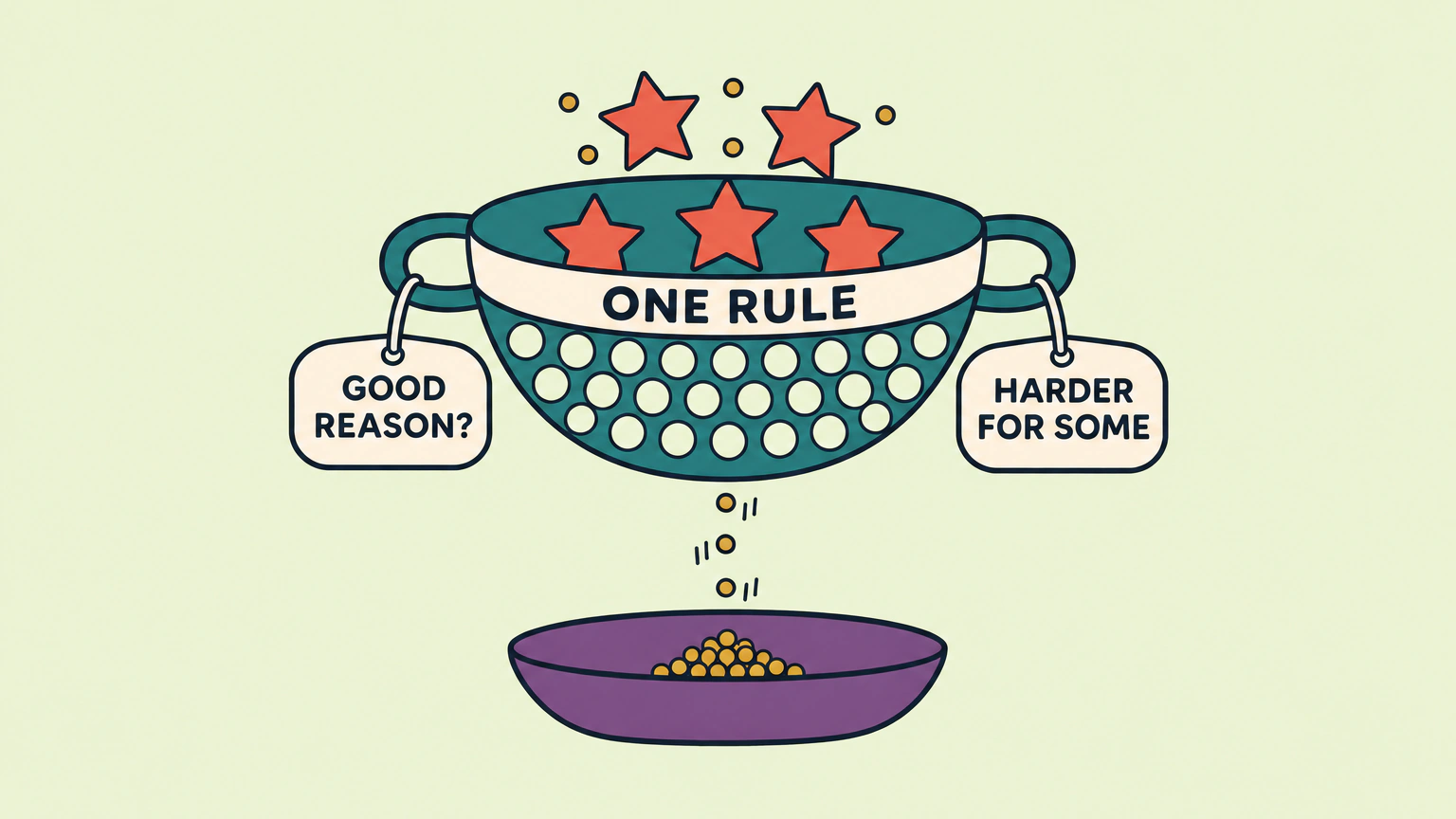
Indirect discrimination is when your employer applies the same rule to everyone, but it puts people who share a protected characteristic, such as your sex, race, age, disability or religion, at a particular disadvantage. And it puts you at that disadvantage too. In England, Scotland and Wales it's unlawful unless your employer can show the rule is "a proportionate means of achieving a legitimate aim". If the rule hit you on or after 1 October 2026, you usually have six months less a day to start a claim, contacting Acas first.
Northern Ireland runs on different laws, and they get their own section near the end. First, here's how to test the rule, what evidence to gather and how to keep your deadline safe.
On this page
- What indirect discrimination looks like at work
- The four questions a tribunal asks
- When the rule hurts you but you don't share the characteristic
- Direct or indirect, and the gaps in the list
- How to build your evidence
- Your deadline, and why to call Acas early
- What a tribunal can award
- If you work in Northern Ireland
- Getting help without losing time
- Common questions about indirect discrimination
What indirect discrimination looks like at work
The law calls the rule a "provision, criterion or practice", and it reaches a long way. Acas says it can be a formal or informal policy, a decision or a way of working, and it's "not always written down". Its own list includes toilets and rest areas, dress codes, flexible or home working, hiring, redundancy selection and working hours.
The rule doesn't have to have reached you yet. Acas says it covers people it "would apply to in the future, for example job applicants", and anyone hit by a change the employer is planning.
Nobody has to mean it. Northern Ireland's official advice site, nidirect, says indirect discrimination is unlawful "whether it is done on purpose or not". For Great Britain, Acas makes the same point: "It might not always be someone's intention to discriminate."
Here's how that plays out, one characteristic at a time, in real examples from Acas and two Supreme Court cases.
| Protected characteristic | The rule everyone gets | Who it lands on harder | Where the example comes from |
|---|---|---|---|
| Age | A job advert asks for a "recent graduate" | Older applicants | Acas |
| Age | A law degree is needed to reach the top grade | Staff aged 60 to 65, who couldn't finish a degree before retiring | Homer v Chief Constable of West Yorkshire Police, Supreme Court, 2012 |
| Disability | Everyone takes lunch at the same time, with no other breaks | A worker with type 1 diabetes who needs to eat between meals | Acas |
| Gender reassignment | Only a birth certificate is accepted as proof of identity | A trans man whose birth certificate says female | Acas |
| Race | Written English is used to choose who is made redundant | Workers whose first language isn't English | Acas |
| Race and age | A general skills test must be passed before promotion | Black and minority ethnic candidates, and candidates aged 35 or over, who passed at 40.3% and 37.4% of the other groups' rates | Essop v Home Office, Supreme Court, 2017 |
| Religion or belief | Morning and afternoon breaks are replaced by one longer lunch | Muslim staff who used their breaks to pray | Acas |
| Sex | Supervisors must work full time | Women, who are more likely to have childcare responsibilities | Acas |
| Sexual orientation | The prize for the top salesperson is a holiday in a country where same-sex relationships are illegal | Gay, lesbian and bisexual staff | Acas |
Both Supreme Court cases settled what counts as a disadvantage. Whether each employer could justify its rule went back to an employment tribunal.
The four questions a tribunal asks
The Equality Act breaks indirect discrimination into four parts, and every one has to be true. Lady Hale said so in the Supreme Court in 2017: "There is no finding of unlawful discrimination until all four elements of the definition are met." The first three are yours to show. The fourth, whether the rule can be justified, is your employer's to prove.
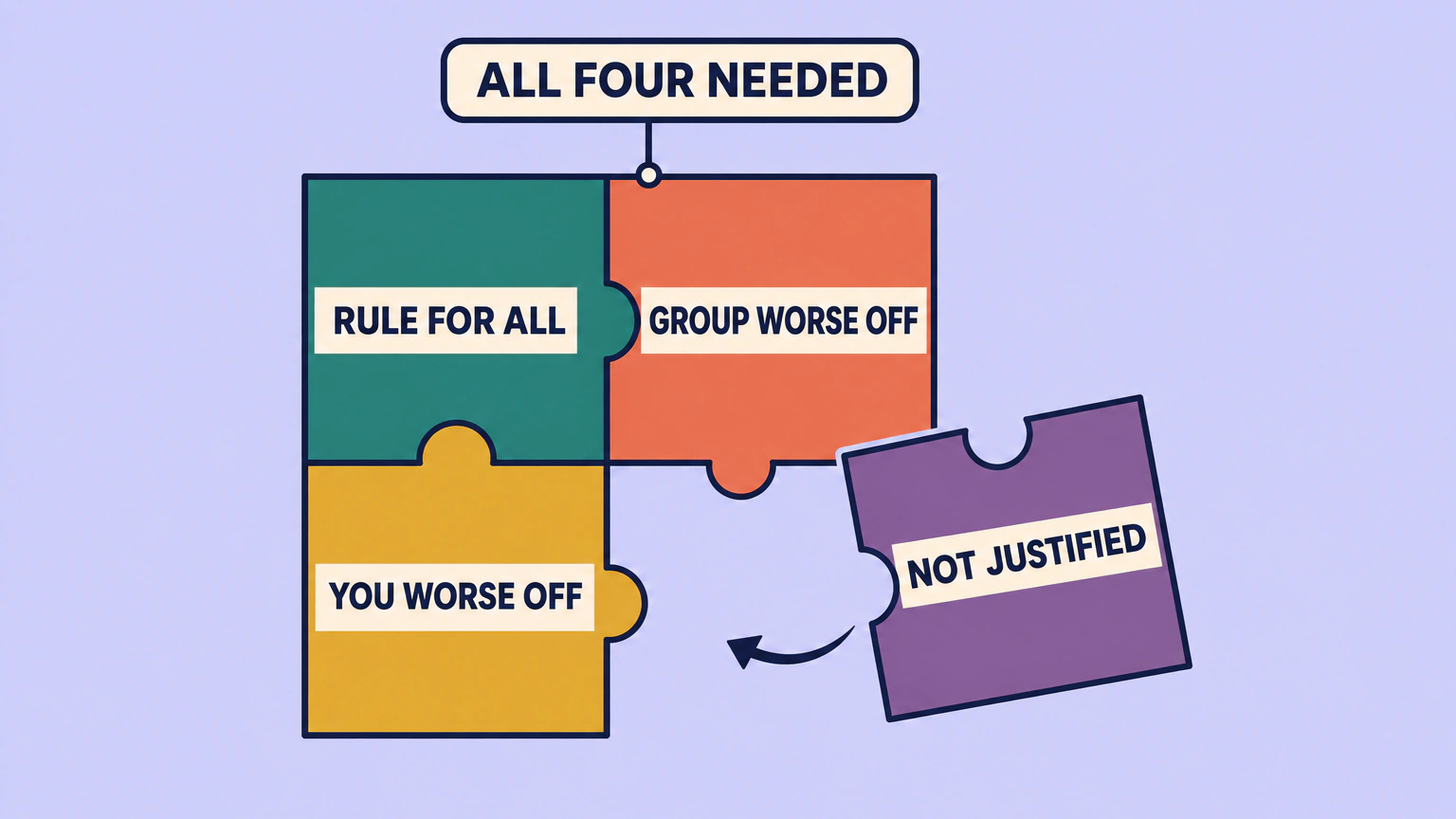
Does the rule apply to everyone, or would it?
The rule has to apply, or be going to apply, to people who don't share your characteristic as well as people who do. That's what makes it indirect. If it's aimed only at your group, it's a different claim. Citizens Advice puts it simply: "If the rule only applies to people with the protected characteristic it might be direct discrimination."
"Everyone" doesn't have to mean the whole workforce. Acas says the group could be "everyone in a particular role or team". And signing a contract that contains the rule doesn't let your employer off. "It also doesn't matter if you agreed to the rule by signing a contract," says Citizens Advice.
Does it hit people who share your characteristic harder?
Next, the rule must put people who share your characteristic at a "particular disadvantage" compared with people who don't. That group can be narrow. Acas's examples are "anyone with an equivalent level of visual impairment, not disabled people as a whole" and "all South East Asian people". You can even be the only one. In Acas's example of a factory worker with diabetes, "It does not matter that nobody else with type 1 diabetes works in the factory."
Two points from the Supreme Court make this easier than it sounds. You don't have to explain why the rule hits your group harder. And figures are the usual way to prove that it does, the court said.
The case those points come from, Essop, shows both. The Home Office made staff pass a general skills test before they could be promoted. Black and minority ethnic candidates passed at only about 40% of the white candidates' rate, and candidates aged 35 or over at about 37% of the younger ones' rate. The judgment admits: "No-one knows why." That didn't matter.
Does it put you personally at that disadvantage?
You also have to be at that disadvantage yourself. A pattern across the group isn't enough. The Supreme Court used a height rule to explain: women "are statistically more likely to fail to meet it, but only some will fail and others will pass". Only the women who fail have a claim.
You don't need to have lost out yet, though. The law says the rule "puts, or would put" you at the disadvantage. So a rota change announced for next month can count before it starts, and so can a rule in a job advert that would shut you out.
Can your employer justify it?
Now the burden moves to your employer. Your claim succeeds if it "cannot show" the rule is "a proportionate means of achieving a legitimate aim". That's two things to prove.
A legitimate aim can be "a real need on the part of the employer's business", the Supreme Court said in Homer. Acas's examples are a genuine business need or a health and safety need. Proportionate means the rule is "both an appropriate means of achieving the legitimate aim and (reasonably) necessary in order to do so". The tribunal weighs that for itself, because "it is not enough that a reasonable employer might think the criterion justified". Saving money rarely gets there. Acas says "Financial reasons alone are unlikely to justify discrimination."
Justification does sometimes win. In Acas's example, a manufacturer cutting its buying team keeps at least one Hindi speaker, because it does much of its trade with suppliers in India. It thought about training others first, and decided fluency would take too long.
Your best lever is the alternative. The Supreme Court put the burden of proof on the employer, but said it's up to you to "challenge the assertion that there was nothing else the employer could do". A tribunal has to consider any other way that's suggested or obvious. So write yours down.
Then test your employer's reason against its own records. If it says the rule keeps a shift covered, look at who's on the rotas. Say you asked for holiday for a religious festival and were told nobody could cover you. If agency staff come in whenever someone's off sick, that answer is weaker than it sounds.
When the rule hurts you but you don't share the characteristic
Since 1 January 2024, you can claim even if you don't have the characteristic yourself. Section 19A of the Equality Act covers a rule that puts a group at a particular disadvantage and puts you at "substantively the same disadvantage". Otherwise it works like the four questions, with the same defence and the same list of characteristics.
Acas's example is about hiring. A business owner who's prejudiced against Polish people avoids recruiting from a postcode where many Polish people live. That's indirect discrimination against Polish applicants. Acas says it could also be indirect discrimination against people from the same area who aren't Polish, because they're at the same disadvantage. Citizens Advice shows the idea outside work, with a single father who can't ring a hospital booking line at school-run time.
This route exists in England, Scotland and Wales only.
Direct or indirect, and the gaps in the list
Why the label matters
Direct discrimination is being "put at a disadvantage and treated less favourably" because of a protected characteristic, in Acas's words. Its example is a firm selling farm machinery that turns a woman down for a job because it thinks men have better technical skills. Indirect is the rule that looks fair on paper.
The label matters because of the defence. An employer can try to justify any indirect discrimination. The Equality Act lets it justify direct discrimination only when the reason is age, and Acas's list of what can be justified says the same.
You don't have to pick a label before you complain, though. Acas's own sample complaint letter says: "I consider this direct or indirect sex discrimination."
Pregnancy, and the extra routes for disability
Pregnancy and maternity is a protected characteristic, but it's missing from the indirect list. You're still covered. Acas says "putting someone at a disadvantage because of pregnancy or maternity is likely to be indirect sex discrimination". Its examples are no facilities for breastfeeding or expressing milk, and turning down a new mother's flexible working request without a genuine business reason.
Disabled workers have two more claims that may fit better: discrimination arising from disability, and failure to make reasonable adjustments. Marriage and civil partnership, on the other hand, is on the indirect list.
How to build your evidence
Acas suggests writing to your employer with a statement of what happened, the type of discrimination and why you think it's unlawful. Then ask questions. Its examples include management figures by sex or ethnicity, the relevant policies, interview panel notes, and how many women were promoted compared with men in the last five years.
Your employer doesn't have to reply. Acas is frank that "there's no law that says they have to answer your questions." But "The employment tribunal will look at if, and how, your employer answered questions." Set a reply date that leaves room before your deadline.
Asking is protected. Accusing your employer of breaking the Equality Act is a "protected act", and punishing you for it is victimisation. The only exception is a false allegation made in bad faith.
The law helps once you have something to show. If there are facts from which a tribunal could find discrimination, it must find it, unless your employer proves it didn't happen. And Acas says you can claim "regardless of your employment status or how long you've worked for your employer".
If the rule is pushing you towards the door, read about resigning because of how you were treated before you hand in your notice.
Before you send anything, gather:
- a copy of the rule, or a note of how it works in practice if it isn't written down
- the date the rule first affected you, and each date it has affected you since
- anything that shows how the rule falls on your group, such as rotas, promotion results or staff figures
- your employer's reason for the rule, in its own words
- records that test that reason, such as rotas showing cover was available
- any other way your employer could meet the same aim, written down as a suggestion
- copies of everything you send and receive, with dates
Your deadline, and why to call Acas early
How long you have in England, Scotland and Wales
For anything that happened on or after 1 October 2026, you have six months less a day to start a claim. Anything earlier keeps the old indirect discrimination time limit of three months less a day. Acas counts it simply: add the months, then take off a day. Something on 1 October 2026 gives you until 31 March 2027. Something on 30 September 2026 gives you only until 29 December 2026.
A rule isn't a one-off act, and the Equality Act times it differently. A rule that keeps applying to you is treated as done when that period ends. In Acas's words, "your time limit starts from the most recent date of discrimination you're including in your claim." If your employer just fails to do something you asked for, the clock starts when it decided not to. If that's unclear, the law dates the decision from when your employer did something at odds with your request, or when it could reasonably have been expected to act.
We'd still count from the earliest date you could. A tribunal can let a late claim in if it thinks that's "just and equitable", but Acas warns that "in most cases time limits are strictly enforced". A grievance won't buy you time either: "Going through grievance, disciplinary or appeal procedures does not change your time limit."
| Where you work, and when it happened | Time limit to start a claim | Where the rule comes from |
|---|---|---|
| England, Scotland or Wales, before 1 October 2026 | 3 months less a day | Equality Act 2010 s.123, before its 2026 amendment |
| England, Scotland or Wales, on or after 1 October 2026 | 6 months less a day | Equality Act 2010 s.123(1)(a), with SI 2026/954 |
| Northern Ireland, sex, race or age | 3 months | Sex Discrimination (NI) Order 1976 art 76, Race Relations (NI) Order 1997 art 65, nidirect |
| Northern Ireland, religious belief or political opinion | 3 months from when you knew or should have known, or 6 months from the act, whichever ends first | Fair Employment and Treatment (NI) Order 1998 art 46 |
Contacting Acas, or the Labour Relations Agency in Northern Ireland, pauses the clock. For religion or politics, the six months from the act keeps running. In England, Scotland and Wales a rule that keeps applying to you counts from when that period ends.
Red flag: Seen "three months minus one day" on another advice page? That's the limit for anything that happened before 1 October 2026. For anything since, England, Scotland and Wales give you six months minus one day. Northern Ireland didn't change.
Contact Acas before you file
You must notify Acas before you can make a claim, and it'll offer you early conciliation. A conciliator talks to you and your employer separately to see if you can agree. It's free, and "Early conciliation is voluntary", so either side can say no. It can run for up to 12 weeks.
Notifying Acas within your time limit pauses the clock until conciliation ends. The Equality Act also leaves you at least a month after your certificate arrives. That pause matters, because Acas says "It can take around 9 weeks for conciliation to start." Notify early and you're protected while you wait. The claim itself is free too: "You do not have to pay a fee to make a claim to an employment tribunal," says GOV.UK.
If the rule also cost you your job, the unfair dismissal deadline calculator works out that claim's deadline, and an employment solicitor can advise on both claims.
We're not your lawyer, and a deadline is the one part of this you can't get back. If your dates are close, Acas, your union or a discrimination solicitor can check them quickly.
If you'd like to know who we are, here's how we work.
What a tribunal can award
If your claim succeeds in England, Scotland or Wales, a tribunal can do three things. It can declare your rights, order your employer to pay you compensation, and recommend steps it should take within a set time to reduce the effect on you.
This is where intention comes in. If the tribunal accepts your employer didn't mean to discriminate against you when it applied the rule, it must think about a declaration or a recommendation before money. It can still award money. It just has to consider the other two first.
Compensation is worked out as a county court or sheriff court would, and the Equality Act sets no cap. It can cover money the rule cost you, as well as injury to feelings. For injury to feelings, tribunals use bands set by the employment tribunal Presidents and updated each year.
If your employer offers money to settle, it may come as a settlement agreement, and these figures help you weigh it.
| Band | Award for injury to feelings | When it's used |
|---|---|---|
| Lower | £1,300 to £12,600 | Less serious cases |
| Middle | £12,600 to £37,700 | Cases that don't merit the upper band |
| Upper | £37,700 to £62,900 | The most serious cases |
| Exceptional | Above £62,900 | The most exceptional cases |
These bands apply to claims presented on or after 6 April 2026. A tribunal in Scotland can adjust them if it decides a 10% uplift built into them doesn't apply there.
If you work in Northern Ireland
The Equality Act doesn't apply in Northern Ireland, apart from three sections on unrelated subjects. So neither its four-part test nor its same-disadvantage rule reaches you there.
Instead, Northern Ireland has a separate law for each ground. They include the Sex Discrimination (Northern Ireland) Order 1976, the Race Relations (Northern Ireland) Order 1997 and the Fair Employment and Treatment (Northern Ireland) Order 1998. Indirect discrimination is still unlawful unless it's justified, except for disability, where Northern Ireland's law has no such claim. The official advice site nidirect sets a firm test: "It is only allowed if it is necessary for the way the business works, and there is no other way of achieving it."
Claims go to an industrial tribunal, or to the Fair Employment Tribunal for religious belief or political opinion. Before you can file, you must contact the Labour Relations Agency. For sex, race and age claims the limit is three months from the act. For religion or politics it's three months from when you knew or should have known, or six months from the act, whichever ends first. For any other ground, ask the Labour Relations Agency for your limit straight away.
The Labour Relations Agency and Advice NI give free advice, and so will your union if you're a member. The Equality Commission for Northern Ireland is another body nidirect points you to. For paid help, our directory lists firms in Northern Ireland.
Getting help without losing time
Start with the free help. In Great Britain that's the Acas helpline and the Equality Advisory and Support Service, both named in Acas's guidance, plus your union if you have one. Check your home insurance as well, because some policies include legal expenses cover. A discrimination solicitor is the paid route. Ask what they charge, and how, before you sign anything.
Then do the one thing that keeps every option open. Write the date the rule first hit you on your calendar, and contact Acas, or the Labour Relations Agency in Northern Ireland, well before your deadline.
Common questions about indirect discrimination
What is an example of indirect discrimination?
A rule that supervisors must work full time is the example Acas gives. It applies to everyone, but women are more likely to have childcare responsibilities, so it's "likely to be indirect sex discrimination". The employer can defend it only by showing its business need is important enough. Other characteristics have their own versions, such as a "recent graduate" advert or one shared lunch break.
What's the difference between direct and indirect discrimination?
Direct discrimination is being treated less favourably because of a protected characteristic, such as being turned down for a job because you're a woman. Indirect discrimination is a rule that's the same for everyone but lands harder on people like you. In practice, the defence is what sets them apart. Your employer can try to justify indirect discrimination, but direct discrimination only when the reason is age.
Can indirect discrimination be justified?
Yes, if your employer proves two things. The rule has to serve a legitimate aim, such as a real business or safety need, and it has to be a proportionate way to meet it. The tribunal weighs that itself, rather than asking what a reasonable employer might think. And Acas warns that "Financial reasons alone are unlikely to justify discrimination."
Does indirect discrimination have to be intentional?
No. The Equality Act's test says nothing about intent, and Northern Ireland's advice site, nidirect, says indirect discrimination is unlawful "whether it is done on purpose or not". Intent only changes what you get. If your employer didn't mean to discriminate, a tribunal in England, Scotland or Wales must think about a declaration or recommendation before money, though it can still award money.
What is discrimination by association?
It's a type of direct discrimination where you're treated worse because of your link to someone with a protected characteristic, such as a family member, friend or colleague. In Acas's example, a worker stops being invited to work socials after colleagues learn a close friend had gender reassignment surgery. In England, Scotland and Wales, the indirect version is the same-disadvantage rule, for a rule that hits you the way it hits a group you're not in.
Is victimisation a form of discrimination?
Yes. Acas lists it as one of the four main types. It means being treated badly because you complained about discrimination, brought a claim, or gave evidence or information, or because your employer thinks you have or will. A complaint made in good faith is protected even if you turn out to be wrong. Only a false allegation made in bad faith isn't.
How many types of discrimination are there?
Acas names four main types: direct, indirect, harassment and victimisation. Disability adds two of its own, discrimination arising from disability and failure to make reasonable adjustments, so a disabled worker in Great Britain has six to consider. Acas also splits direct discrimination three ways: the ordinary kind, by association and by perception.