

In England, Scotland and Wales, any employee whose partner is having a baby can take one or two weeks' paternity leave from their first day in the job, as one block or two separate weeks. They can take it at any time within 52 weeks of the birth or, if the baby is early, the due week's start. Statutory Paternity Pay has its own tests. You need 26 weeks with your employer by the 15th week before the due week, and average earnings of at least £129 a week. Then it's £194.32 a week (the 2026 to 2027 rate) or 90% of your average weekly earnings, whichever is lower. Northern Ireland still uses the older rules. There the leave needs 26 weeks too and comes as one week or two weeks in a row, finished within 56 days of the birth or, if the baby is early, the due week's start.
If you work in Northern Ireland, your rules have their own section further down.
On this page
The leave and the pay have different tests
Paternity leave and Statutory Paternity Pay are two rights with two sets of conditions, and you can qualify for one without the other. GOV.UK says it plainly: "You may not get both leave and pay."
The leave is for employees only. Agency, zero-hours and casual workers who aren't employees can't take it, though Acas says they may still get the pay if they're on the payroll and pass the pay tests. The self-employed get neither.
You must be the baby's father, or the mother's husband, wife, civil partner or partner (same-sex partners included), and be responsible for bringing the baby up. Separated? You can still take it as long as that responsibility continues. Twins or triplets don't add any leave. Intended parents in surrogacy and adopters' partners have their own dates.
Here's how the two rights compare, test by test.
Paternity leave and pay in England, Scotland and Wales
| Paternity leave | Statutory Paternity Pay | |
|---|---|---|
| Who can get it | Employees | Employees, and some workers on the payroll |
| Time with your employer | None. It's yours from your first day | 26 weeks by the end of the qualifying week, and still employed at the birth |
| Earnings | No test | An average of £129 a week or more, before tax |
| How much | One week or two weeks | £194.32 a week, or 90% of your average weekly earnings if that's lower |
| How you take it | Two weeks together, or two separate weeks | Paid for the weeks you're on leave |
| When | From the birth, finished within 52 weeks of it or, if early, the due week's start | On your usual pay day, after tax and National Insurance |
| Notice | The due week by the qualifying week. Give notice for each period. If you start on the day your baby's born, give notice at least 28 days before the Sunday starting the week your baby's due. If you start a set number of days after birth, add that number to that Sunday, then count back 28 days. For a fixed start date, count back 28 days from that date. If meeting a deadline isn't reasonably practicable, give the information as soon as you reasonably can. | Ask in writing by the qualifying week |
The qualifying week is the 15th week before the week your baby is due. Adoption and surrogacy have their own dates. Northern Ireland's rules are different.
If your baby was born before 6 April 2026
The day-one rule doesn't reach every baby. A baby born before 6 April 2026 falls outside it, unless the week they were due began on or after 5 April 2026. For those babies the leave still needs 26 weeks with your employer by the 15th week before the due week. Their 52-week windows can run until early April 2027, so if you're planning a second week before then, check which rule covers your baby. The pay test is the same either way.
When you can take your two weeks
You can take one week, two weeks together, or two separate weeks, but not odd days. A week means the days you normally work in a week, so if you only work Mondays and Tuesdays, a week of leave is two days.
The leave can't start before the birth. It has to be finished within 52 weeks of the birth, or of the start of the due week if the baby comes early. You pick the start: the day of the birth, a set number of days after it, or a fixed date after the start of the week the baby is due. If you chose a fixed date and the baby hasn't arrived by then, you must change it, either to a later date or to a start tied to the birth, and tell your employer as soon as you reasonably can.
Holiday can cover days before the birth if your employer agrees. And your holiday keeps building up while you're on paternity leave.
Tip: If you don't know when the baby will come, choose "the day the baby is born" or "a set number of days after the birth" as your start, rather than a fixed date. Then your leave moves with the baby, and a late arrival doesn't mean fresh notice.
The notice you have to give, and when
There are two notices, and the first comes months before the birth. By the end of the qualifying week, the 15th week before the week your baby is due, tell your employer the due week. At the same time, declare in writing that you're the father or the mother's partner and will be responsible for bringing the baby up.
To find that week, Acas says to count back 15 weeks from the due week, using weeks that run Sunday to Saturday. Say your baby is due on Friday 26 February 2027. The due week starts on Sunday 21 February, so the qualifying week runs from Sunday 8 to Saturday 14 November 2026.
Ask for Statutory Paternity Pay in writing by then too. The paternity leave form to use is your employer's own, if it has one. If not, GOV.UK's online form, which replaced form SC3, does the job.
The second notice gives your start option and how long you'll be off. If leave starts when the baby is born, give notice 28 days before the due week begins. If it starts a set number of days after birth, apply that number to the due week's start and count back 28 days. For a fixed date, count back 28 days from it. To move or cancel a date, use the earlier deadline for the old and new choices. If any deadline is not reasonably practicable, give notice as soon as you reasonably can. Late notice without a good reason lets your employer delay your start, but only by writing to you within 28 days of your request.
What to give your employer, and when
- By the end of the qualifying week, tell your employer the week your baby is due.
- At the same time, confirm in writing that you're the father or the mother's partner and will be responsible for bringing the baby up.
- Ask for Statutory Paternity Pay in writing at the same time, on GOV.UK's online form or your employer's own form.
- Give notice for each period. If you start on the day your baby's born, give notice at least 28 days before the Sunday starting the week your baby's due. If you start a set number of days after birth, add that number to that Sunday, then count back 28 days. For a fixed start date, count back 28 days from that date. If meeting a deadline isn't reasonably practicable, give the information as soon as you reasonably can. Say in writing that the time is to care for the baby or support the mother.
- Ask your employer to confirm your dates in an email, and keep it.
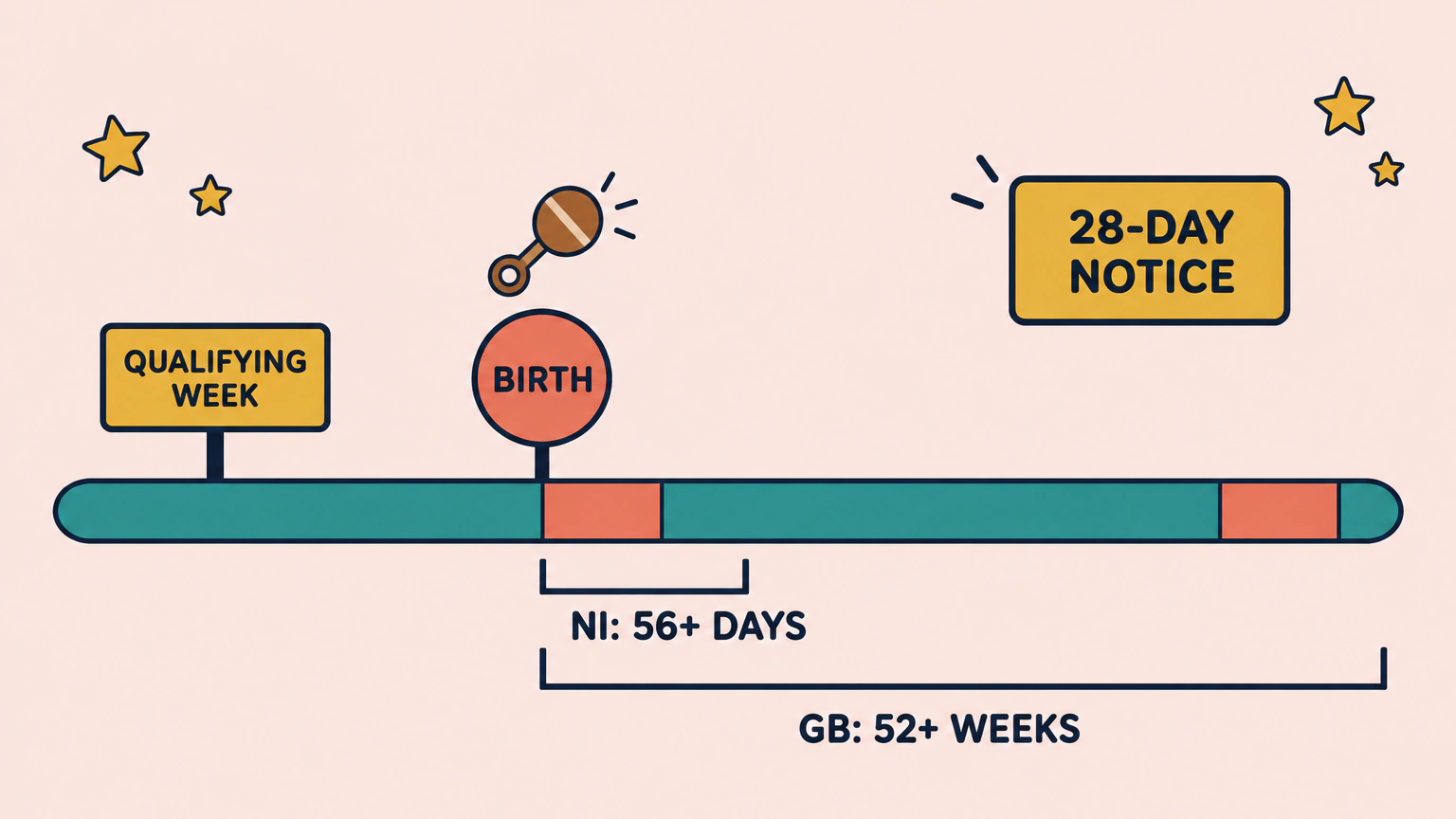
On a single timeline, the first notice lands months before the baby, and Northern Ireland's window for the leave is a sliver of the one in Great Britain.
How much paternity pay you'll get
Statutory Paternity Pay is £194.32 a week or 90% of your average weekly earnings, whichever is lower. It's paid like your wages, with tax and National Insurance taken off.
The hard part is "average weekly earnings". Your employer works it out from the relevant period, the pay days in roughly the eight weeks up to the end of the qualifying week. If you're paid monthly, they add up your pay in that period, divide by the number of months, multiply by 12 and divide by 52. On that formula £559 a month is exactly the £129 line. Above about £216 a week, or about £936 a month, the flat £194.32 is the lower figure, so that's what you'll get.
A few things change the sum. A backdated pay rise that covers the relevant period means your employer must recalculate. Under salary sacrifice, the pay you actually received is what counts, and the paternity pay itself can't be sacrificed. And in any week you're entitled to Statutory Sick Pay, you get that instead.
What paternity pay comes to, three examples
| Your pay before tax | Average weekly earnings | Paternity pay a week | Two weeks |
|---|---|---|---|
| £120 a week | £120.00 | None, under £129 | £0.00 |
| £200 a week | £200.00 | £180.00 | £360.00 |
| £2,000 a month | £461.54 | £194.32 | £388.64 |
Assumes the same pay in every week or month of the relevant period. Monthly pay is averaged over the period, times 12, divided by 52. Tax and National Insurance come off the paternity pay figures.
If you're new in the job
In England, Scotland and Wales a new starter gets the leave but usually not the pay. The pay needs 26 weeks of continuous employment ending with the qualifying week, and you must still be employed at the birth. HMRC's refusal form puts it more simply: you must have "worked for me continuously during the whole of the pregnancy up to the baby's birth". That's a fair rule of thumb, since 26 weeks back from the qualifying week lands close to the start of a pregnancy. If you don't qualify, your employer must tell you on form SPP1 within 28 days of your request.
If anyone at work says there's no leave because there's no pay, they've mixed up the two tests.
Three other sources of time or money are worth checking. Your contract or staff handbook may pay more than the law. Paid holiday is yours to ask for. And unpaid parental leave gives you up to four weeks a year per child, from the day the baby is born. Give 21 days' notice before the due week, and your employer can't postpone it when a father or partner takes it straight after the birth. In Great Britain it's been a day-one right since 6 April 2026.
In Northern Ireland a new starter gets neither the leave nor the pay.
NHS staff and other company schemes
An employer can pay more than the statutory amount but never less, so read your contract or staff handbook before you plan around £194.32.
On the NHS's Agenda for Change terms, you get two weeks' new parent support leave, which you can split into two one-week blocks and take any time in the baby's first year. It's on full pay if you've had 12 months' continuous service with any NHS employer before the leave. Full pay includes the Statutory Paternity Pay you're due rather than coming on top of it. With less service, you get Statutory Paternity Pay if you qualify. Each UK country can amend those terms, so in Scotland and Northern Ireland check your employer's own policy too.
A company scheme can make you repay enhanced pay if you don't come back, but only if your contract says so. Statutory Paternity Pay itself never has to be paid back because you didn't return.
Northern Ireland has its own rules
Employment law is devolved, and the April 2026 changes "do not apply in Northern Ireland", as the government's own campaign page puts it. The 2024 changes to when and how you take the leave never reached it either.
So the leave there still needs 26 weeks with your employer by the end of the 15th week before the due week. It's one week or two weeks in a row, never split, and must be finished within 56 days of the birth, or of the start of the due week if the baby comes early. You can't take it after shared parental leave. Workers who aren't employees don't get the leave but may get the pay.
The pay matches Great Britain's: £194.32 or 90%, with 26 weeks' service and average earnings of £129. nidirect still offers the older SC3 form for claiming it. And bereaved partner's paternity leave is only for employees "employed in England, Scotland or Wales".
A complaint about unfair treatment or dismissal goes to an industrial tribunal within three months, after early conciliation through the Labour Relations Agency. With a deadline that short, we'd talk to solicitors in Northern Ireland early.
England, Scotland and Wales compared with Northern Ireland
| England, Scotland and Wales | Northern Ireland | |
|---|---|---|
| Time in the job for the leave | None, from your first day | 26 weeks by the end of the qualifying week |
| How you can take two weeks | Together, or as two separate weeks | Together only |
| Leave must be finished | Within 52 weeks of the birth or, if early, the due week's start | Within 56 days of the birth or, if early, the due week's start |
| Paternity leave after shared parental leave | Allowed | Not allowed |
| Statutory Paternity Pay | £194.32 or 90% of earnings, 26 weeks' service, £129 a week | The same |
| Deadline for a tribunal claim about unfair treatment or dismissal | Six months less a day, if it happened on or after 1 October 2026 | Three months less a day |
| Conciliation first | Acas | Labour Relations Agency |
In Great Britain the old limit of three months less a day still applies to anything that happened before 1 October 2026.
More time off you can add
Two weeks goes quickly. Other rights can stretch it.
In Great Britain you can now take paternity leave before or after shared parental leave, in any order. Unpaid parental leave totals 18 weeks per child up to their 18th birthday, normally at no more than four weeks a year for each child.
Neonatal care leave applies if your baby spends seven or more full days in a row in neonatal care that starts within 28 days of the birth. Employees in England, Scotland and Wales get a week for every seven days, up to 12 weeks, from their first day in the job, for babies born on or after 6 April 2025. If the care overlaps paternity leave you've already booked, you take the paternity leave as planned and add the neonatal care leave after it.
Before the birth, you can take unpaid time off for two antenatal appointments of up to six and a half hours each, from your first day as an employee. And if your partner dies in the baby's first year, bereaved partner's paternity leave can give you far longer than two weeks.
If your employer says no, or treats you worse
If you qualify and gave the right notice, the leave isn't your employer's to refuse. Their only lever is delaying your start for late notice, in writing within 28 days. We'd start with a conversation. If that fails, raise a grievance, which is a formal complaint to your employer.
For pay, your employer must refuse on form SPP1 within 28 days, and you can ask for a written statement of the reasons. GOV.UK says that should come "within a reasonable time, for example 7 working days". If you still disagree, HMRC's Statutory Payment Dispute Team can decide whether you're owed the money. Our guide to how HMRC handles a statutory pay dispute walks through that process. It may help the conversation to know that most employers get 92% of statutory pay back from HMRC, and small employers can reclaim more.
Treating you worse for taking paternity leave, or planning to, is unlawful. Acas gives examples: bullying, harassment, being passed over for promotion, and training refused or hours cut without good reason. If it has become bullying or harassment, harassment solicitors handle exactly that. Dismissal for taking the leave is automatically unfair, however long you've worked there, and if you're dismissed while on leave your employer must give the reasons in writing. Our guide to unfair dismissal explains how those claims work.
Before any tribunal claim you must notify Acas for early conciliation. In Great Britain the deadline is six months less a day from the act or the dismissal if it happened on or after 1 October 2026, and three months less a day if it happened earlier. A grievance doesn't pause that clock. Northern Ireland's limit is three months. Employment solicitors can tell you where you stand while there's still time.
We're not your solicitor. If taking your leave has already cost you pay or your job, talk to Acas, the Labour Relations Agency in Northern Ireland, or an employment solicitor before your deadline runs out.
Paternity leave questions people ask
Can my employer refuse paternity leave?
No, not if you're an employee who qualifies and gave the right notice. In England, Scotland and Wales you can qualify from your first day. Your employer can only delay your start for late notice without a good reason, and must tell you in writing within 28 days. Treating you worse for taking the leave is unlawful.
Can I take paternity leave if I've just started a new job?
Yes, in England, Scotland and Wales, since 6 April 2026. If you started too late to give 15 weeks' notice, give it as soon as you reasonably can. The pay needs 26 weeks with your employer by the qualifying week, so new starters usually get the time off without Statutory Paternity Pay. Northern Ireland still requires 26 weeks for the leave too.
Can I take paternity leave during my notice period?
Yes, while you're still employed and have given the right notice. Once the job ends, so does the leave. If you were employed at the birth and qualify for the pay, your old employer still owes it after you leave, unless you start work for a new employer during those weeks. Our resignation letter guide covers the notice you owe.
Do you get paternity pay if you're self-employed?
No. The self-employed get neither Statutory Paternity Pay nor statutory paternity leave. Workers who aren't employees, which can include agency and zero-hours staff, are different. They don't get the leave, but they may get the pay if they're on the payroll and pass the service and earnings tests.
Can I take paternity leave six months after the birth?
In England, Scotland and Wales, yes. The leave can start after the birth, and the two weeks can be separate. Both must finish within 52 weeks of the birth or, if the baby was early, the due week's start. Give notice for each period. If you start on the day your baby's born, give notice at least 28 days before the Sunday starting the week your baby's due. If you start a set number of days after birth, add that number to that Sunday, then count back 28 days. For a fixed start date, count back 28 days from that date. If meeting a deadline isn't reasonably practicable, give the information as soon as you reasonably can. In Northern Ireland, no. The leave must finish within 56 days of the birth or, if the baby was early, the due week's start.
What happens to paternity leave if the baby is late?
If you chose to start on the day of the birth, or a set number of days after it, your leave moves with the baby. If you picked a fixed date and the baby hasn't come, choose a later date and tell your employer as soon as you reasonably can. Holiday can cover the wait if your employer agrees.
Does paternity leave start when labour starts?
No. Paternity leave can't start before the baby is born, so time off during labour isn't paternity leave. To be off from the first contractions, agree holiday or unpaid time with your employer in advance. Before the birth you can also take unpaid time off for two antenatal appointments, up to six and a half hours each.
Is paternity leave paid in the NHS?
Yes, on Agenda for Change terms: two weeks' new parent support leave on full pay, if you've had 12 months' continuous service with any NHS employer before it starts. Full pay includes your Statutory Paternity Pay rather than adding to it. With less service, you get Statutory Paternity Pay if you qualify. In Scotland and Northern Ireland, check your employer's policy too.